Thursday, September 21, 2006

Back To Earth, Back To Work

Atlantis Lands
No, I'm not talking about the Red Sox. I'm talking about the Space Shuttle Program which is now rebuilding the momentum it lost in the aftermath ofthe Columbia disaster. Next on the agenda are lifting the components of ISS supplied by the Europeans and the Japanese that have been sitting around in storage.

Here's the latest.
"It's obvious to me that we are rebuilding the kind of momentum that we have had in the past and that we need if we are going to finish the space station," said NASA Administrator Michael Griffin during a postlanding briefing. "We have an awesome task ahead of us.... I think we're going to make it."

That's an assessment that undoubtedly brings a smile to the project's international partners.

"International partners, especially the Japanese and Germans, were crossing their fingers, hoping this mission would pan out," says Ray Williamson, with George Washington University's Space Policy Institute. "If NASA is successful at getting the space station completed, you'll see a lot more openness in Europe and Japan to collaborate with the US in new exploration efforts."

For December's mission, spacewalking astronauts are set to perform tasks that initiate the most complicated phase of station construction, mission planners say. In addition to delivering another truss segment, Discovery's crew will overhaul the electrical wiring and cooling-system plumbing to all of the major US components.

"It would be the equivalent to changing who delivers the electricity and water to your house - not just changing the source, but changing the wires and the pipes coming into the house and being routed around and under the house. It's that significant a change," says Paul Hill, a NASA flight director. "And it's all going to be done outside."

Then come the missions of 2007, during which the shuttle will drop off more basic- infrastructure components. To install them in their permanent locations, space-station crew members will use the station's robotic arm and conduct spacewalks to move existing elements in two high-stakes, slow-motion games of musical modules. At one point, they will have to disable and move the only connector, or node, capable of mating with the space shuttle - critical for resupply and crew exchanges, as well as construction.

If astronauts damage that connector, "the contingency scenarios get kind of ugly," Mr. Hill says. Between December's wiring and plumbing job and the station crew's segment shuffles, the next 12 months will see NASA undertake "the three most complicated things we're going to do in the entire construction of the space station."
It's all smooth-sailing for now.

Lucy's Child

...so to speak. They've dug up a very interesting hominid fossil.
In a discovery sure to fuel an old debate about our evolutionary history, scientists have found a remarkably complete skeleton of a 3-year-old female from the ape-man species represented by "Lucy."

The remains found in Africa are 3.3 million years old, making this the oldest known skeleton of such a youthful human ancestor.

"It's a pretty unbelievable discovery... It's sensational," said Will Harcourt-Smith, a researcher at the American Museum of Natural History in New York who wasn't involved in the find. "It provides you with a wealth of information."

For one thing, it gives new evidence for a contentious feud about whether this species, which walked upright, also climbed and moved through trees easily.

The species is Australopithecus afarensis, which lived in Africa between about 4 million and 3 million years ago. The most famous afarensis is Lucy, discovered in Ethiopia in 1974, a creature that lived about 100,000 years after the newfound specimen.

The new find is reported in Thursday's issue of the journal Nature by Zeresenay Alemseged of the Max Planck Institute for Evolutionary Anthropology in Leipzig, Germany; Fred Spoor, professor of evolutionary anatomy at University College London, and others.
Interesting news for those of us interested in early hominids.

Tuesday, September 19, 2006

Atlantis Is Coming Home

The New Routine
The new routine is to check damages to the heat shield. Atlantis has spearated from the ISS and is coming home.
Cape Canaveral, Florida - Atlantis' astronauts gave the ship's wings and nose one last inspection on Monday with a remotely operated TV camera and laser, and Nasa said there appeared to be no damage that would prevent the shuttle from coming home.

Atlantis and its six crew members are set to touch down early on Wednesday at the Kennedy Space Centre after 11 days in space delivering a major addition to the International Space Station and conducting three spacewalks to install it.

The astronauts attached a 15-metre boom to the shuttle's robotic arm to inspect for any damage. The boom has a TV camera and a laser imagery system attached to its end. An identical survey was conducted on Day 2 of the mission.

Monday's inspection was conducted while the shuttle was about 80 kilometres from the space station.

If the astronauts had found the type of damage that could cause a deadly accident, the shuttle would have been able to return to the station. However, the space station had its own problems on Monday.

Space station crew members pulled an alarm and donned protective gear after smelling a foul odour that turned out to be burning rubber and a harmful chemical leaking from an oxygen system.
It all looks well.

Friday, September 15, 2006

Today's Headlines

"Bionic Woman"


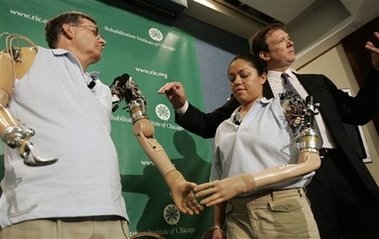
The world's first bionic woman Claudia Mitchell didn't even know about the 1970s show when she heard the term.
When her doctors first called her "The Bionic Woman," 26-year-old Claudia Mitchell didn't understand the reference to the 1970s TV show about the secret agent who was part woman, part machine.

Besides, the first woman to be outfitted with a bionic arm says that when the motors are running in the 10-pound device, it reminds her of another famous cyborg - Arnold Schwarzenegger's The Terminator.

"It's really cool," she says. "This is not just something in the movies. This is really happening." Mitchell, a former U.S. Marine, lost her left arm in 2004 on an Arkansas highway when the friend she was riding with lost control of his motorcycle.

As she struggled to cope with the loss of the limb, she read a Popular Science story about Jesse Sullivan, a Tennessee man who received the first bionic arms at the Rehabilitation Institute of Chicago after losing his in an electrical accident in 2001.

"I said, 'I've got to have one of those,' " Mitchell says.

Last year she had surgery and received an arm that's even more advanced than Sullivan's. Today, in a Washington, D.C., news conference with National Institutes of Health officials, Mitchell will show off her skills with the arm developed in a $4 million project funded largely by the NIH.

Though recent prosthetic research has focused on implanting sensors that link devices to movement commands from the brain, Mitchell was drawn to the less-invasive work in Chicago.

"Most people have been looking at trying to tap into the brain, but that has a number of challenges," says Todd Kuiken, who heads neural engineering at the Chicago institute. Implants are "becoming more doable, but if something breaks you have to have surgery to fix it. The exciting thing about this technique is we are not implanting anything into her body."

Kuiken found a way to use chest muscles to connect the prosthetic to nerves that once sent signals to the hand, wrist, elbow and shoulder. After an amputation, the brain still thinks the arm is there. It feels sensations and sends signals to move. But those signals are too weak for modern mechanics to detect from the surface of the skin, so Kuiken's team amplified them.

First, plastic surgeon Greg Dumanian of Northwestern Memorial Hospital moved the targeted nerves into muscles in Mitchell's chest. Then, the nerves that cause the motion of those muscles were disconnected. Mitchell can no longer send a signal to flex her pectoral muscle, but when she wants to close her hand or bend her elbow, the nerve impulse moves her "pec."

When that muscle moves, it sends a signal strong enough for a sensor on the skin to detect. After some rewiring by Dumanian, six muscles in Mitchell's chest now move six motors in the bionic arm.

And nerve data flow up, too. When Kuiken touches a certain spot on Mitchell's chest, she feels him touch her hand, even though it's no longer there.

There is much still to sort out. Though Mitchell can perform a simple task such as folding a pair of pants without first stretching them out on a flat surface, Kuiken calls the arm clumsy. Both he and Mitchell say they are optimistic about making the prosthetic - hers and future versions - more sensitive and precise.

"We hope to be able to close the loop with Claudia and have the sensation be there so that when she touches something, she feels a touch of her hand," Kuiken says. Mitchell, who hopes to go to college next year to study communications, says she is proud to be part of the team. "I am really excited about the prospects of being able to, hopefully, pave the way to make this something that is more common," says Mitchell, a volunteer at Washington, D.C.-area military hospitals.

Until today, her role in the bionic research project has been shrouded in secrecy. But now, the former Marine who served in Kuwait can tell the amputees she counsels about her arm and the research.
Cyberpunk is just around the corner.

ISS Spreads Its Solar Panels


The crew of Space Shuttle Atlantis are looking to do one more spacewalk.
Joe Tanner and Heidemarie Stefanyshyn-Piper, the pair who did the first spacewalk on Tuesday, are going out for the third and final excursion this morning.
"You just can't imagine a flight going as well as this one has gone," said lead space station flight director John McCullough. The astronauts have been working on installing a new addition to the space station, the first since the 2003 Columbia disaster. "I couldn't ask for a better start - a re-start - to assembly," McCullough added.
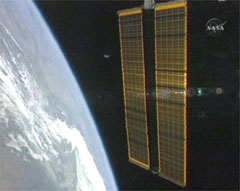
The US$372 million addition consists of two solar panel wings that will eventually provide a quarter of the space station's power when it's completed by 2010. They won't generate any electricity, though, until the next space mission - slated for December - when the power system is rewired.
On Friday's spacewalk, Tanner and Piper will be unpacking a radiator that will later be used to dissipate the heat generated by electronics on the newly installed solar panels.
They'll spend the rest of the roughly 6 1/2 hours with tasks like replacing an antenna and picking up science experiments.
All's well that works well.

Tuesday, September 12, 2006

ISS Build Conitnues

Atlantis Has Docked With The ISS


Here's the article.
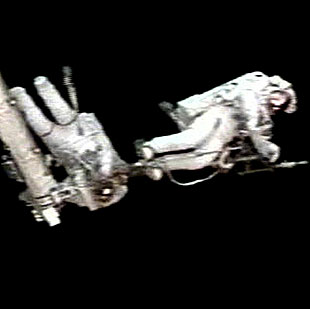
Two spacewalking astronauts began installing on Tuesday the first big addition to the international space station in more than 3½ years, and NASA pronounced the outing a success, even though a small bolt floated off and got lost.

“I felt today like this is what NASA is supposed to do,” lead space station flight director John McCullough. “This is what we're here to do.”

Wearing bulky suits and gloves, the two Atlantis astronauts ventured outside to begin attaching a new 17½-ton box-like truss section that the space shuttle delivered earlier this week. The job involved connecting 17 wires or tubes and tightening or loosening 167 bolts.

Astronaut Joe Tanner was working with a 1½-inch bolt with an attached spring, when the washer holding it in fell off. The bolt and spring floated over the head of astronaut Heidemarie Stefanyshyn-Piper and skittered across the truss.

While the washer went out into space harmlessly, Tanner worried the bolt and spring could get into the truss's wiring and tubing and cause problems.

“I just hope that bolt is on its way to Mother Earth right now and not on its way” to a crucial joint, Tanner said.

Even though NASA didn't have any video showing the bolt missing the mechanism, officials said they are certain that the bolt flew off into space harmlessly.
Err, yeah, that last bit's a little scary, but it seems all is progressing well.

Monday, September 11, 2006

H2A Flight 10

JAXA Launch A Success


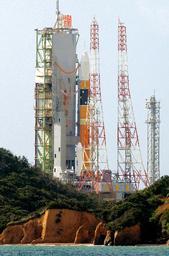
JAXA launched the 10th H2-A Rocket yesterday.
当初は10日午後に打ち上げる予定だったが、悪天候が予想されたため延期していた。全長53メートルのロケットは燃焼済みの部分を切り離しながら高度400〜600キロに達した後、衛星を南北に周回する軌道に乗せる。打ち上げ費用は衛星を除いて96億円。

 情報収集衛星は、98年の北朝鮮によるミサイル「テポドン」発射を機に国が導入を決めた事実上の偵察衛星。計画では、地球上のどの地点でも一日1回は監視できるようにするため、高性能の望遠カメラを備えた光学衛星と、電波で地上の様子を探るレーダー衛星を2基ずつ運用する。

 まず03年3月にH2A5号機で各1基を同時に投入したが、同11月の6号機の打ち上げ失敗で残り2基を失い、機能半減の状態が続いていた。今回打ち上げたのは光学衛星で、地上にある1メートル程度の物体を見分けられるという。衛星の大きさや外観、詳しい軌道などは安全保障上の理由から公表されていない。
The launch, originally scehduled for the tenth, was delayed due to bad weather. The 53m long rocket flew to a hecight of 400-600km while separating stages, launching the satellite into a north-south orbit. Thee launch cost US$ 90million excluding the satellite costs.

The satellite is specifically to carry out surveillance on North Korea who have been a regional threat since the launch of its Tepodong missile in 1998. The satellit uses both opitcal and radar for its surveillance. Orbit details, appearance and size are a secret for security reasons.

Lookng at the photos, it seems Flight 10 was launched from LPT 1, just like Flight 9.

Saturday, September 09, 2006

Atlantis Blasts Off Finally

After Many Weather Delays


Atlantis is off and flying.
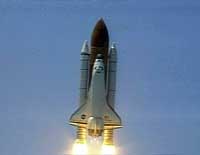
After two weeks of postponements caused by bad weather and nagging mechanical problems, the Atlantis lifted off on time at 11:14:55 a.m.

The countdown was unhindered by any major technical issue. After a blazing rise into the sky, the yellow flames of its booster rockets visible through holes in billowing cloud banks, the shuttle slipped into orbit without incident about 10 minutes later.

"Your long wait is over," NASA's launch director, Michael D. Leinbach, told the crew just before liftoff.

The fuel tank sensor that forced postponement of Friday's attempt appeared to work normally during early-morning fueling of the 500,000-gallon tank that held the propellant for the shuttle's three main engines. The engine cutoff sensor that failed and three others that operated properly in the hydrogen section of the shuttle's external tank proved not to be an issue.

The National Aeronautics and Space Administration has been trying to launch the shuttle on its 11-day mission to resume construction of the station since Aug, 27. A lightning bolt hitting the launching pad, a threatening tropical storm and equipment problems with a shuttle power generator and the fuel sensor forced repeated delays.

The shuttle had to get off this weekend to avoid conflict with a Russian launching of a Soyuz spacecraft carrying a new crew to the space station on Sept. 18 . A delay would have forced NASA to wait until at least the end of September.
Back to the construction of the ISS.
Meanwhile in Japan...

JAXA Launch Delayed Due To Weather


JAXA were launching a surveillance satellite, but they have delayed their launch due to inclement weather.
宇宙航空研究開発機構は10日未明、同日午後に予定していた政府の情報収集衛星の打ち上げを11日以降に延期する、と発表した。打ち上げ場所の種子島宇宙センター(鹿児島県)の天候が悪化したため。

 情報収集衛星は3基目で、北朝鮮のミサイル施設などを監視する事実上の偵察衛星。国産主力ロケットH2A・10号機で10日に打ち上げる予定だった。
They'll try again next week. Now that I know what it's like in the PR observation room, I can just imagine the deep sighs amongst the press. I even know that grey-haired guy in that photo handing out the PR stuff. He's a really annoying, unhelpful man.

Sunday, September 03, 2006

This Week In Space

I've been slack lately because I've actually been busy in the real world outside of cyberspace. Anyway, here's this week's space news dumpdown.

SMART-1 Probe Hits Target


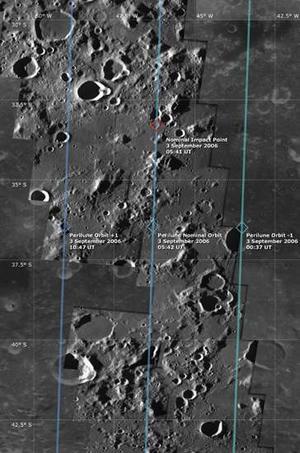
The SMART-1 probe from the ESA crash landed on the moon as scheduled, yielding the nice montage above. Here's the write up in the SMH.
Darmstadt, Germany: Europe's first spacecraft to the moon ended its three-year mission on Sunday by crashing into the lunar surface in a volcanic plane called the Lake of Excellence, to a round of applause in the mission control room.

Hitting at two kilometres per second, or 7200 kmh, the impact of the SMART-1 spacecraft was expected to leave a three- by-10-metre crater and send dust kilometres above the surface.

Observatories watched the event from Earth and scientists hoped the cloud of dust and debris would provide clues to the geologic composition of the site.

"That's it - we are in the Lake of Excellence," said spacecraft operations chief Octavio Camino as applause broke out in mission control in Darmstadt, Germany. "We have landed."

Minutes later, officials showed off a picture captured by an observatory in Hawaii displaying a bright flash from the impact.

"It was a great mission and a great success and now it's over," said mission manager Gerhard Schwehm.

The spacecraft ended a three-year mission that scanned the lunar surface from orbit and tested a new, efficient, ion-propulsion system that officials hope to use on future interplanetary missions.

Launched into Earth's orbit by an Ariane-5 booster rocket from Kourou, French Guiana, in September 2003, SMART-1 used its ion engine to slowly raise its orbit over 14 months until the moon's gravity grabbed it.

The engine, which uses electricity from the craft's solar panels to produce a stream of charged particles called ions, generates only small amounts of thrust but only needed 80 kilograms of xenon fuel.

The craft's X-ray and infrared spectrometres have gathered information about the moon's geology that scientists hope will advance their knowledge about how the moon's surface evolved and test theories about how the moon came into being.

On Saturday, mission controllers had to raise the craft's orbit by 600 metres to avoid hitting a crater rim on final approach. Had the orbit not been raised the craft would have crashed one orbit too soon, making the impact difficult or impossible to observe.

SMART-1, a cube measuring roughly a metre on each side, took the long way to the moon - more than 100 million kilometres instead of the direct route of 350,000 to 400,000 kilometres.

But the European Space Agency did it for a relatively cheap 110 million euros ($185 million).

The spacecraft also been taking high-resolution pictures of the surface with a miniaturised camera, taking its last images just minutes before the impact.
I like the price tag. It's not something Australia couldn't affford to do... if it had the vision. Except it has been underfunding space research for a very long time, there's no invested know-how left. One sort of wonder what Australia is going to do when it has to re-join space exploration.

Shuttle Countdown Recommences


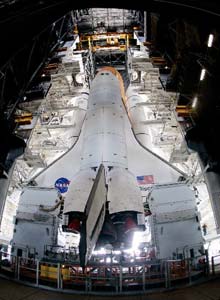
After the delay that was hurricane Ernesto, Space Shuttle Atlantis is back on deck, readying for countdown.
Launch time is set for 12:29 p.m. ET Wednesday. If the shuttle does not lift off then, NASA has launch opportunities on the following two days.

Engineers and technicians at the Kennedy Space Center planned to spend the coming days checking out flight software, testing navigational systems and fueling the cells that will power Atlantis' systems.

This is the second time a countdown was started for this mission of Atlantis, which originally was to blast off Aug. 27. The launch was delayed after lightning struck the launch pad, requiring engineers to check for damage to Atlantis' systems.

---

Atlantis will deliver a 17.5-ton, $372 million addition to the half-built international space station during the 11-day mission. Four astronauts will take three spacewalks to resume construction on the orbiting space lab, which stopped being built almost four years ago after the space shuttle Columbia disintegrated while returning to Earth.
Godspeed and all that to the crew.

Lockheed Martin To Build Next Moon Space Vehicle


Here's the article from the SMH.
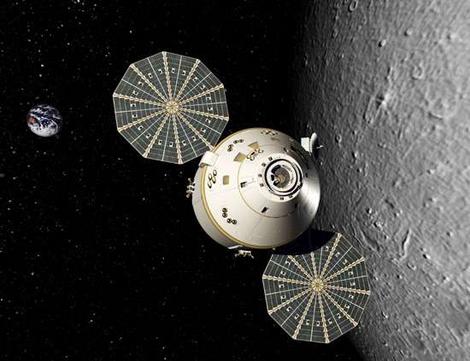
WASHINGTON: Lockheed Martin has won a multibillion-dollar contract to build a space vehicle to replace NASA's shuttles, put a human on the moon for the first time since 1972, and be the precursor to a manned ship to Mars.

The award marks NASA's most concrete step to fulfil President George Bush's $US230 billion ($300 billion) promise that the space agency would return astronauts to the moon and restore excitement about space exploration. NASA has planned to replace the shuttles since the mid-1980s, and has spent almost $US5 billion to do so - with little success so far.

"It's just thrilling, for all of us," said Skip Hatfield, NASA's project manager, after the announcement on Thursday. The vehicle, Orion, is the embodiment of the "very future of human space flight".

Orion will look somewhat like the three-man Apollo command module but will carry up to six astronauts. Like the shuttle, it will be able to carry cargo to and from the International Space Station.

Orion is expected to make its first manned flight by 2014, four years after NASA's three operating shuttles are retired. NASA hopes for a moon landing by 2020.

Unlike the shuttle, which lands on a runway, Orion will descend with the aid of a parachute to land in the ocean or on land. NASA plans to build two of the vehicles, one for manned flight and the other for unmanned. It will decide how many more to buy after judging how often they can be reused.
The Herald being the Herald, just posted up this story from Reuters.
It sort of tells you why there isn't much interest in Space Exploration in Australia.

Anti-Pluto Revisionism
Last month, in a rigged vote, Pluto lost its status as a planet. Now the backlash is on.
More than 300 scientists have signed a petition protesting against the definition of "planet" decided by the International Astronomical Union last week. That definition demoted Pluto, leaving the solar system with eight planets.

The petition states: "We, as planetary scientists and astronomers, do not agree with the IAU's definition of a planet, nor will we use it. A better definition is needed."

The signers of the petition included NASA scientists, astronomers at major observatories, university professors and graduate students. The astronomical union allowed only scientists attending a conference last week in Prague, Czech Republic, to vote.

The group's definition for a planet specifies three conditions: the object orbits the sun; it is large enough for its gravity to pull it into a round shape; and it "has cleared the neighbourhood around its orbit".

The last condition excludes Pluto, because it is located among many other icy bodies in a ring of debris known as the Kuiper Belt.
It all depends on where you draw the lines. Some people want to draw it where pluto is excluded. Others want to draw it where Pluto plus other bodies become certified planets. You'd think they'd settle in inclusion rather than exculsion, but science probably has its fair share of anal-retentive definitionalist types. It's kind off funny to watch from afar. The funny thing is, in my mind, Pluto will always be a planet to me.

Thursday, August 24, 2006

Pluto Demoted, And Other News

Not A Planet, Just A Dwarf Planet


You sort of wonder how this impacts the world. Pluto is no longer considered a planet, but merely a dwarf planet.
The International Astronomical Union, dramatically reversing course just a week after floating the idea of reaffirming Pluto's planethood and adding three new planets to Earth's neighborhood, downgraded the ninth rock from the sun in historic new galactic guidelines.

Powerful new telescopes, experts said, are changing the way they size up the mysteries of the solar system and beyond. But the scientists showed a soft side, waving plush toys of the Walt Disney character _ and insisting that Pluto's spirit will live on in the exciting discoveries yet to come.

"The word 'planet' and the idea of planets can be emotional because they're something we learn as children," said Richard Binzel, a professor of planetary science at the Massachusetts Institute of Technology, who helped hammer out the new definition.

"This is really all about science, which is all about getting new facts," he said. "Science has marched on. ... Many more Plutos wait to be discovered."

Pluto, a planet since 1930, got the boot because it didn't meet the new rules, which say a planet not only must orbit the sun and be large enough to assume a nearly round shape, but must "clear the neighborhood around its orbit." That disqualifies Pluto, whose oblong orbit overlaps Neptune's, downsizing the solar system to eight planets from the traditional nine.
The upside of this new is that the next time somebody says there are 9 planets in the Solar system, you can tell them they're wrong. It still doesn't escape the feeling that these astronomers are playing definitional games. Pluto, for the record has moons. I want to know how something that can have moons not be a planet, but clearly I'm not an astronomer. Maybe it's in line with the war on terror and tightening belts; we can't afford nine planets any more.

UPDATE:
Here's a cool article from the Beeb.
On Thursday, experts approved a definition of a planet that demoted Pluto to a lesser category of object.

But the lead scientist on Nasa's robotic mission to Pluto has lambasted the ruling, calling it "embarrassing".

And the chair of the committee set up to oversee agreement on a definition implied that the vote had effectively been "hijacked".

The vote took place at the International Astronomical Union's (IAU) 10-day General Assembly in Prague. The IAU has been the official naming body for astronomy since 1919.

Only 424 astronomers who remained in Prague for the last day of the meeting took part.

An initial proposal by the IAU to add three new planets to the Solar System - the asteroid Ceres, Pluto's moon Charon and the distant world known as 2003 UB313 - met with considerable opposition at the meeting. Days of heated debate followed during which four separate proposals tabled.

Eventually, the scientists adopted historic guidelines that see Pluto relegated to a secondary category of "dwarf planets".
It looks like it was more political than previously thought.

Countdown To Atlantis Flight

Here is the latest.
During the 11-day mission, three space walks are scheduled to install and activate the new segment, which has a wingspan of 240 feet. Part of the segment will allow the trusses to rotate and keep the solar panels pointed at the sun.

The Atlantis mission is the beginning of a series of flights to complete construction of the space station. In September, a new crew of astronauts - ISS Expedition 14 - is slated to take up residence on the space station, and National Aeronautics and Space Administration officials expect them to be occupied with assembly tasks, as more modules are added to the station.

Over the next six months to 18 months, astronauts will 'watch the complexity and size of the space station grow,' Melissa Owens, who is involved in managing Expedition 14, said at a NASA briefing Tuesday.

ISS construction began in 1998 and was slated for completion in 2004-05. But the explosion of the Space Shuttle Columbia in 2003 halted US space flights until last year, severely delaying construction.
So the ISS project is getting back on line. I know some people who would be very happy about that.

Rev-Head Record On Diesel
The world's fastest Diesel car maxed out at 525kph.
Another article has it at 588kph.


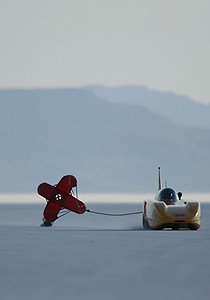
Yesterday Andy Green piloted the 9-metre machine to an FIA-sanctioned speed of 526km/h, today he shattered that record by averaging 563km/h over two passes in opposite directions within one hour.

Running soon after daybreak he recorded 588km/h on his first run and 540km/h on his return.

"It was always our ultimate goal and that was with a slow start to the second run," said Green.

"There is so much more to come as the car is pulling like a train and we still haven't used sixth gear!

"Today's record proves the potential we have always believed JCB Dieselmax to possess. This is another great result for a wonderful team and a testament to British engineering."

Boasting twin JCB444 common rail injection diesels with turbochargers and intercoolers, the JCB Dieselmax generates an impressive 560kW at 3,800 rpm.

Green is no stranger to speed. Not only is he a Royal Air Force jet pilot, but he holds the overall land speed record of 1227km/h, set in 1997 with the jet-propelled ThrustSSC car.

Wow, is the word.

Friday, August 18, 2006

Turning The Corner

The Ozone Hole
In the 1980s, the Ozone Hole was hotly debated, but eventually resulted in the Montreal Protocol. It seems it's working, but not as fast as we thought.
Over huge areas of Europe, North America and Asia in the northern hemisphere and over southern Australasia, Latin America and Africa, the layer would be back to pre-1980 levels by 2049, the agencies said.

This was five years later than forecast in the last major scientific report in 2002.

The agencies' message came in an official summary of a report by 250 scientists to be issued next year on the effects of the 1987 Montreal Protocol, which committed signatory nations progressively to ban the use of ozone-harmful products.

"The early signs that the atmosphere is healing demonstrate that the Montreal Protocol is working," said Achim Steiner, executive director of UNEP.

"But the delayed recovery is a warning that we cannot take the ozone layer for granted and must maintain and accelerate our efforts to phase out harmful chemicals," he said in a statement issued in Geneva and Nairobi.

Over Antarctica, where so-called "ozone holes" have grown over the past 30 years, recovery was likely to be delayed until 2065, 15 years later than earlier hoped.

"While these latest projections of ozone recovery are disappointing, the good news is that the level of ozone-depleting substances continues to decline from its 1992-94 peak in the troposphere and the 1990s peak in the stratosphere," said WMO secretary-general Michel Jarraud.
I take th egood news that international efforts to curb the Ozone depletion worked, and it didn't kill us to do it. Now, the challenge is on for Global Warming and Global Dimming to be tackled properly.

Thursday, August 17, 2006

What Separates Us From Chimps

108 Letters Of Destiny
This is interesting.
I'm quoting it wholus bolus because it's so interesting. My apologies to 'The Guardian'.
James Randerson, science correspondent
Thursday August 17, 2006
The Guardian

Scientists have identified perhaps the most crucial genetic region that makes us human. By comparing human DNA with that of chimpanzees and other animals they have found the region of the genome subjected to the strongest natural selection since we shared a common ancestor with chimps.
The 108-letter stretch of DNA contains two genes that appear to control brain development. The researchers speculate that the blistering pace of evolution indicates that they may have been crucial in the rapid increase in brain size and complexity that occurred in the human lineage. Our brains are three times larger than our closest relatives, the chimps.

"It's evolving incredibly rapidly," said Katherine Pollard at the University of California in Davis. "It's really an extreme case." Most of the 15m or so differences between the chimp genome and our own are random, inconsequential changes that make no difference to our appearance or abilities. To sort the interesting changes from the less influential ones, Professor Pollard looked further down the evolutionary tree to find regions of DNA that really are useful. She and her colleagues first looked for bits of the genome that are nearly identical in the mouse, rat and chimpanzee. These shared a common ancestor around 80m years ago, so the scientists reasoned that any DNA region that had not changed much in this time must be crucial for survival and that changes in its sequence would lead to problems rapidly weeded out by natural selection.

They then trawled these conserved regions for instances where the human equivalent had changed a lot. The beauty of the technique, according to experts, is that they did not have to know what the DNA was actually doing. Top of the list is a 108-letter sequence called HAR1 (Human Accelerated Region 1) which contains two genes. This region differs by just two changes between chimps and chickens, which shared a common ancestor around 310m years ago. But since humans and chimps split 5m years ago there have been 18 changes.

"There has been tremendous pressure for millions of years to keep the sequence as it was. Then something happened in our lineage," said Pierre Vanderhaueghen at the Free University of Brussels in Belgium.

He was able to get clues by adding colour labelled chemicals that would stick to the RNA product produced by the genes to slices of brain tissue from human foetuses. The brains were obtained from aborted or miscarried foetuses and were used with the consent of the mothers.
His results showed that one of the genes is expressed strongly in the developing neocortex during weeks seven to nine of pregnancy. "It's a very exciting finding because it is expressed in cells that have a fundamental role in the design and development of the mammalian cortex," said co-author David Haussler, also at the University of California.
Of course some people are in denial of evolution so they're probably in denial of their 108 letter legacy.

Atlantis Scheduled To Launch


Working On The ISS
Forgotten in the myriad problems of the Space Shuttle has been the International Space Station. They're working to rectify that.
NASA officials say they will hold two briefings next week concerning the current and next mission to the International Space Station.

Officials said the briefings will focus on the station`s ongoing Expedition 13 mission and the upcoming Expedition 14 mission, which is scheduled to be launched next month.

The briefings -- originating at NASA`s Johnson Space Center in Houston -- will be broadcast live on NASA TV, available at the space agency`s Web site. Questions from news media representatives will be taken at various NASA locations across the nation.

Participants of the Expedition 14 preflight briefing at 2 p.m. EDT Tuesday will be Kirk Shireman, deputy International Space Station program manager; Melissa Owens, Expedition 14 increment manager, and Ginger Kerrick, Expedition 14 lead flight director.

Scheduled to take part in the Expedition 13 recap briefing at 3 p.m. EDT Tuesday are Merri Sanchez, Expedition 13 increment manager; Cathy Koerner, Expedition 13 lead flight director; Julie Robinson, deputy International Space Station program scientist, and Dr. Stevan Gilmore, Expedition 13 flight surgeon.
Well, the next Atlantis flight will signal going back to business.
NASA managers on Wednesday unanimously picked Aug. 27 for the first attempt to launch the space shuttle Atlantis on a mission to resume construction of the international space station — but two precariously attached bolts securing a crucial antenna could delay those plans.

Engineers suspect that two of the bolts are too short on the KU-band antenna, which transmits images and other essential data between the space shuttle and Mission Control. They want to make sure the bolts are secure enough so that the antenna doesn't fly off while in the payload bay during a launch, which could cause catastrophic damage.

“We're not going to fly if we think there's a possibility the antenna will come off,” said NASA Administrator Michael Griffin.

Atlantis has flown with those bolts without trouble since they were first installed two decades ago. The problem was discovered last week, after Atlantis was rolled to the launch pad, when a review of paperwork on bolts on NASA's three space shuttles was ordered because a related problem was found in Discovery.
Back to hauling materials for the space truck.

Sunday, August 13, 2006

Pluto Is Not A Dog

It Might Not Ecven Be A Planet
That's according to this article.
"The pivotal question is the status of Pluto, which is clearly very different from Jupiter, Saturn, Uranus, and Neptune," Owen Gingerich, professor of Astronomy and History of Science emeritus a the Harvard-Smithsonian Center for Astrophysics told Reuters.

Debate has raged within the scientific community over the status of Pluto for decades after the planet was found to be only one four-hundredths of the mass of the earth.

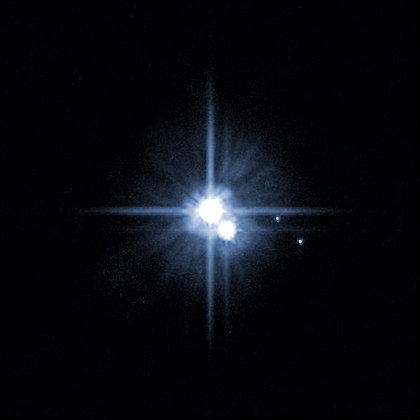
That discussion intensified in 2003 when astronomers at the California Institute of Technology discovered UB 313. Nicknamed Xena after the character in the television show, UB 313 is one of more than a dozen celestial bodies in our solar system found to be larger than Pluto.

Xena and Pluto are large icy bodies that reside in the Kuiper Belt -- where thousands of floating bodies travel -- beyond Neptune. Images from the Hubble Space Telescope put Xena's diameter at 1,490 miles or so. That is slightly bigger than Pluto, which measures 1,422 miles across.
Well more planets as opposed to fewer would be gas. Seems to be a spoilsport sort of mentation that wants to *sowngrade* Pluto from a planet to *something else without a name yet*. That's just me, though.

UPDATE:
Reuters is now reporting that the solar planet numbers may go from 9 to 12.
PRAGUE (Reuters) - The question of whether Pluto is a real planet, hotly debated by scientists for decades, came to a head on Wednesday when the global astronomers' body proposed a definition of a planet that raises their number to 12 from nine.

The definition set out by a committee of the International Astronomers Union (IAU) answers the key question: How small can a body be and still be called a planet? in a way that leaves Pluto's status intact -- but modified.

Some 2,500 astronomers and scientists from round the world, attending an IAU conference in the Czech capital, have to weigh the committee's two-part definition, on which IAU members will vote on August 24.

To be called a planet, a celestial body must be in orbit around a star while not itself being a star, and must be large enough in mass for its own gravity to pull it into a nearly spherical shape, the seven-member committee said.

The need to define, for the first time, what it takes to be a planet stems from technological advances that enable astronomers to look further into space and to measure more precisely the size of celestial bodies in our solar system.

Pluto would remain a planet but would fall into a newly created category called Plutons, which are distinguished from classical planets in that they take longer than 200 years to orbit the sun.

Pluto would be joined in this category by two other celestial bodies, Xena and LinkCharon, while another, Ceres, would be known as a dwarf planet.

In all, 12 planets would be listed in our solar system, at least for the time being.
12!
And the only thing Forbes can think of is the new wave of textbooks and toys that will make for better business.
The idea that our nine-planet solar system may soon join the obsolete world of eight-track tapes and slide rules should send science teachers, textbook writers and toymakers back to the cosmic drawing board.

"Does it make our products obsolete?" asked Kim McLynn, spokeswoman for Illinois-based Learning Resources, which makes an inflatable solar system and a Planet Quest game. "Wow, a whole new universe."

Though not approved yet, the 76-year-old lineup of the solar system's planets would grow to 12 under a proposal by leading astronomers. Their recommendation will be decided by a vote of the International Astronomical Union on Aug. 24.
For people who make their living on the old Mercury-through-Pluto system, a change in the planets means quick but welcome revisions, no matter how costly.

"This is, of course, a huge headache for publishers," said Gilbert Sewall, director of the American Textbook Council, a New York-based research institute that follows educational textbooks. Last-minute changes are expensive, but won't break any publisher, he said.

For example, Pearson Prentice Hall has science texts for next year going before California's textbook approval board and will try to get the 12-planet revision in for the state officials to review, said Julia Osborne, the publisher's science editorial director.

"It's worth it because this is such an exciting thing," Osborne said. But 2006 textbooks are already at schools, she said, so for "most students this fall it will be out of date."

Because schools keep textbooks for five to 10 years, it will be about seven years before most school books have 12 planets in them, said Osborne and Sewall.

Pity Jack Horkheimer, director of the Miami Space Transit Planetarium and host of PBS' "Star Gazer" show. His very first book, a full-length cartoon guide to naked-eye astronomy, features an entire chapter on the solar system - the nine-planet version.

It won't be out for four more weeks - after the world's astronomers are likely to open the solar system doors to three new planets: Ceres, Charon, and one nicknamed Xena to be renamed later.

"My book is out-of-date before it even hits the bookstands," Horkheimer said. "It's kind of like buying a computer. By the time you get it out of the box and get it hooked up, it's already obsolete."

At the Adler Planetarium in Chicago, the main pavilion has a model of the solar system - the sun and nine planets (Earth is the size of a softball). The planetarium will likely have to add three new planets.

"They're pretty small," said astronomy director Geza Gyuk of the proposed new planets. "Maybe we can bring in a pingpong ball and that'll do the trick."

The Adler already has a planetary anachronism. When it opened 76 years ago, plaques had already been commissioned for just eight planets. Pluto was discovered a few months laterGyuk doesn't see the Adler adding plaques for Pluto or the three proposed planets because "we just don't have space."

For the several thousand planetariums around the world, this is more exciting than difficult, said Susan Reynolds Button, president-elect of the International Planetarium Society.

"It's not a problem," Reynolds Button said. "We already have the visuals. We already have the equipment to do it. It's just a matter of presenting new data."

Reynolds Button, who used to take planetarium shows to schools, said the addition of three new planets "is a real nice juicy topic to get kids excited about."

Dan Reidy, a sixth-grade science teacher in Moultonborough, N.H., was sitting in his classroom preparing for the new school year and gazing at his model of the solar system. He usually asks his students, "What's wrong with this picture?" The correct answer is that the planet sizes and their distances from the sun are all out of proportion.

If the planet lineup changes, there will be something else wrong with his model.

Reidy will also have to figure out where to place the new planets on a large parachute-cloth solar system map that demonstrates proper size and scale, but he said it was exciting.

The race to change solar system toys more permanently is already on.

Discovery Channel Store spokeswoman Pamela Rucker predicted new 12-planet toys could be in stores in time for the Christmas season.

"We're already starting to work on 12 planets," said McLynn of Learning Resources.


The more things change...

Idiot Watch
This is tragic.
The latest issue of Science has a statistical analysis that gets into some of the whys and hows of the strange relationship the US public has with the science of evolution. The results are really best analyzed in two parts. The first compares the US's acceptance of evolution with that in 32 European countries plus Japan. The results produce the graph at right (it's part of the original article, but has been reproduced in several locations on the web already, so I'll join in). The US places next-to-last both in terms of accepting the accuracy of the theory of evolution, and in terms of considering it absolutely false. The country we're racing to the bottom is Turkey, which news reports suggest has some obvious issues with both the quality of the national education system and religious fundamentalism. Edging us out is Cyprus, which is currently partitioned as the result of a centuries-old conflict.


But within the grim figures generated by the "Yes/No/Unsure" question are some interesting subtleties. When asked whether species adapt and go extinct over millions of years in a question that did not use the term "evolution," nearly 80 percent of US respondents felt it was true; only six percent called the statement false. Which is good, until you consider that this indicates that the majority of the public must have no grasp of the concept underlying all of biology. The lack of scientific literacy also came screaming through in indications that nearly half the respondents had no idea about the degree to which humans share DNA sequences with other mammals, and half were either unsure or wrong about whether early humans shared the planet with dinosaurs. The high degree of uncertainty probably explains why at least two percent of respondents could apparently agree that humans both did and did not evolve from earlier species. The authors also note that the amount of uncertainty over evolution has actually increased in the last 10 years.
It's interesting while at the same time being absolutely awful.

Monday, July 17, 2006

Shuttle Lands Safelly


The Space Shuttle Discovery landed safely.
Discovery landed at Kennedy Space Center at 9:14 a.m. in only the second shuttle flight since the 2003 Columbia disaster killed seven astronauts.
"Welcome back, Discovery, and congratulations on a great mission," Mission Control told shuttle commander Steven Lindsey after Discovery rolled to a stop.

"It was a great mission, a really great mission, and enjoyed the entry and the landing," Lindsey replied.

The smooth landing was sure to leave NASA officials jubilant, after conquering the chronic threat of foam chunks that break off the external fuel tank during launch - still a problem, but not a serious one in this mission.

The shuttle came in from the south, swooping over the Pacific, Yucatan Peninsula, Gulf of Mexico and across Florida to cap a 5.3-million-mile journey that began on the Fourth of July.

A last-minute buildup of clouds led NASA to switch the shuttle's direction for landing. By the time Discovery approached, it was so cloudy, Lindsey couldn't spot the runway until about a minute before landing.

A couple of minutes out, NASA made a racket to keep birds out of the way of the approaching spacecraft. Car horns blared, and the sound of gunshots and firecrackers erupted.

At touchdown, shouts and whistles came from the few hundred astronauts' relatives and space center workers at the runway. "It's exciting to see the shuttle back," said astronaut Scott Kelly, the identical twin brother of Discovery's co-pilot, Mark Kelly.

"We're back on track with maybe flying the shuttle regularly here starting again in August."

Atlantis is up next with a crew poised to carry out assembly of the international space station, a task put on the back burner after Columbia.
I guess that's what really counts. Compared to last time, it was a lot less scary.

Hotel Orbitalia? Hotel Balloonia?


A private consortium is trying to build an inflatable object to float up to Low Earth Orbit. It's a going to be a hotel. Here's the article.
Bigelow Aerospace’s Genesis 1 module activated its compressed air tanks to inflate the skin as planned, and is now sending back low-res photos to earth.

The concept of an inflatable craft was conceived by Nasa in the 60s, and is much cheaper than standard spaceships as it takes up less room on the launch vehicle.

The only inhabitants of the 15ft by 8ft module are cockroaches, but the company is planning two more missions over the next year and believes a full-sized version for humans could be ready by 2010.

Fears that a giant bouncy castle might be a little prone to being punctured by space debris are apparently unfounded – the walls contain Kevlar, which is used in bullet proof vests, and the internal temperature is said to be a pleasant 26 degrees.

Founder Robert Bigelow is also trying to stoke up competition by launching ‘America’s Space Prize’, which is offering $50 million to any US company that can create a craft that can take 5 people into space. Looks like long weekends in space might be on the cards soon.
Clearly, the space race has now been privatised.

Battery Operated

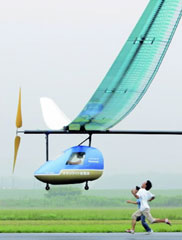
This is a battery operated aircraft. That's right.
This aircraft flew 59 seconds for 391m using 160 A batteries, recording a maximum altitude of 5,2m. It spans 31m, and weighs 54kg. It was flown by Tomohiro Kamiya of Tokyo as part of a University project.
The craft was sponsored by Matsushita Electric, othrwise known to us as Panasonic. I guess they brought the batteries.

Thursday, July 13, 2006

Fangaroo


Scientists have made some interesting discoveries regarding pre-historic marsupials.
SYDNEY, Australia - Forget cute, cuddly marsupials. Paleontologists say they have found the fossilized remains of a fanged killer kangaroo and what they describe as a "demon duck of doom."

A University of New South Wales team said the fearsome fossils were among 20 previously unknown species uncovered at a site in Australia's northwest Queensland state.

Professor Michael Archer said Wednesday that the remains of a meat-eating kangaroo with wolflike fangs were found, as well as a galloping kangaroo with long forearms that could not hop like a modern kangaroo.

"Because they didn't hop, these were galloping kangaroos, with big, powerful forelimbs. Some of them had long canines (fangs) like wolves," Archer told Australian Broadcasting Corp. radio.

Vertebrate paleontologist Sue Hand said modern kangaroos look almost nothing like their ferocious forebears, which lived between 10 million and 20 million years ago.

The species found at the dig had "well muscled-in teeth, not for grazing. These things had slicing crests that could have crunched through bone and sliced off flesh," Hand said.

The team also found prehistoric lungfish and large ducklike birds.

"Very big birds ... more like ducks, earned the name 'demon duck of doom', some at least may have been carnivorous as well," Hand told ABC radio.

Archer said the team was studying the fossils to better understand how they were affected by changing climates in the Miocene epoch between 5 million and 24 million years ago.
The Demon Duck of Doom. Now I know what my nightmares have been about all these years. :)

Monday, July 10, 2006

Not A Good Outcome


Like I said some months before: Launching rockets is difficult stuff to do.
The INSAT-4c went up in smoke as GSLV FO2 rocket veered off course and exploded 60seconds after lift-off.


SRIHARIKOTA (AP), JULY 10:A day after the Agni-III ballistic missile failed to meet test expectations, India’s space programme took a knocking when the Geosynchronous Satellite Launch Vehicle (GSLV FO2), carrying the INSAT-4C communication satellite, veered off course and exploded 60 seconds after lift-off.
The three-stage rocket burst into flames during the first stage operation, a minute after lift-off at 5.38 pm from the Satish Dhawan Space Centre in Sriharikota, some 80 km from Chennai.

The failure of the Rs 256 crore-mission was being attributed to pressure in one of the four strap-on motors dropping to zero in the first stage operation, causing the GSLV to “deviate slightly” from the designed trajectory.

“This is one of the rarest phenomena and could be due to a problem in one of the strap-ons which led to the mission’s failure,” said a crestfallen G Madhavan Nair, ISRO chairman, while briefing the media after the launch mishap.

“The problem developed in the course of the first stage. After the deviation, we gave the ‘Destruct’ command because we had to safeguard locals,” he said, adding that the debris had fallen into the sea.

“A quick look at the preliminary findings show that of the four strap-on motors, pressure in one of them dropped to zero. The other three functioned normally,” said Madhavan Nair. This caused the deviation in the trajectory. While four degrees of angular error was within the normal limit, the vehicle went off the path by 10 degrees.

"Until 60 seconds, we received huge data on the telemetry. But it has to be analysed and this process has been initiated. We will know what exactly caused the failure in the next few days,” he said.
According to the ISRO chief, work on another INSAT-4 satellite was on and “we will have a successful launch within a year”. This would be a heavier satellite and would be launched from Kourou in French Guiana.
It's not an easy road ahead.

Sunday, July 09, 2006

The Weekend Dumpdown

INSAT-4C Satellite


The Indian Space programme is about to launch its rocket GSLV with the INSAT 4C satellite from Satish Dhawan Space Centre.
This is the first launch of GSLV from the state-of-the-art Second Launch Pad (SLP) at SDSC. SLP, which was commissioned in May 2005 with the successful launch of PSLV-C6 is designed to reduce the occupancy time for the integration and launch.

The GSLV would lift off with the 2168 kg INSAT-4C, the heaviest in its class, at 4 30 pm tomorrow, Indian Space Research Organisation (ISRO) chairman G Madhavan Nair said.

The 49-metre-tall, 414 tonne GSLV is a three stage vehicle. The first stage, GS1, comprises a core motor with 138 tonne of solid propellants and four strap-on motors, each with 42 tonnes of hypergolic liquid propellant. The second stage has 39 tonne of the same hypergolic liquid propellant. The third (GS3) is a cryogenic stage with 12.6 tonne of liquid oxygen (LOX) and liquid hydrogen (LH2). INSAT 4C, the second satellite in the INSAT 4 series, would give a boost to Direct-to-Home television services, video picture transmission and digital satellite news gathering. It will also provide space for National Informatics Centre's VSAT connectivity.
Call me 'rocket boy' but this is exciting. We wish them godspeeed.

Space Walking


The shuttle crew did a space walk to make certain there were no significant damages to the shuttle.
British-born astronaut Piers Sellers and American Michael Fossum took turns strapping their feet on to a small platform and dangling from the end of a 30m boom that would allow astronauts to reach every part of a shuttle.

"It's like being in a very slow elevator," Sellers radioed to ground controllers as he rode atop the end of the boom, which is a combination of the Space Shuttle Discovery's 15m robot arm and a 15m extension.

The exercise, performed at 28,000km/h, 357km above the Earth, was part of NASA's efforts to recover from the 2003 Columbia disaster and make certain there were options for repairing a damaged shuttle before it returned into the atmosphere. Seven astronauts on Columbia in 2003 died without knowing their shuttle was critically damaged when insulation foam fell off during liftoff. The vessel broke apart over Texas as it returned to Earth. "Hopefully, we never have to use it but we have the capability if we ever need to," flight director Tony Ceccacci said after the boom test.
It seems the sshuttle is a-okay for the return. This is much better than the last effort.
The last re-entry scared the bejesus out of me.

Hayabusa Debrief


Sorry this one's in Japanese, but it's from he JAXA symposium. The salient point is that the asteroid-visiting Hayabusa mission was given better and fairer coverage overseas than in Japan.
サイエンスに、感謝されたはやぶさプロジェクト
 「はやぶさ」の評価は日本よりも、海外の方が高かったと、山根氏が「サイエンス」誌の最新号を壇上で掲げながら、川口プロジェクトマネージャーと、話を始めた。サイエンスの編集長は、はやぶさプロジェクトの偉業をたたえるとともに、小惑星の地質の情報が分かったことで、地球に小惑星がぶつかる可能性があるとき、それを避けるための実際の情報として使えると、感謝の意を表している。アメリカや、ヨーロッパでは、恐竜を滅ぼした原因と言われる小惑星の地球への衝突に対して、真剣に回避を考えている組織がある。

 サイエンスが日本の探査機の成果を大々的に取り上げるのも異例なら、その成果に対して感謝の意を表するのも大変異例のことであり、日本の研究技術レベルに大きな誇りを感じると、山根氏が感激気味に話した。

なぜ意味があるのか
 地球−太陽−いとかわの距離はほぼ等しいが、なぜそんなところにいって、サンプルを持ち帰る意味があるのかを、川口氏が話した。だれも着陸したことがない、火星より遠い小惑星いとかわに着陸し、かえってくることも大きな意味を持つが、地球や、太陽系のできたころの姿が、保存されている。小惑星のサンプルを持ち帰ることができれば、地球の火山活動でマントルから出てきた、かんらん石などの成分と、比べることで実証できる。

 はやぶさは、いとかわの地面に、弾丸を打ち込んで、サンプルを吸い上げる実験には失敗したが、弾丸を打ち出す部屋は3つあり、弾丸も3つ。ひとつ打つごとに部屋が回転して、サンプルを吸い込む仕組みになっている。はやぶさが地面に着いたとき塵が舞い上がったりして、それがサンプルの取り込み口から自然に入る可能性もある。アメリカのスターダスト計画が、今年彗星の尻尾から持ち帰ったサンプルは、ミクロンオーダーだが大変貴重な情報になった。はやぶさにも、ほこり程度でも入っていれば、大変な成果だと思う。
The projected recovery of the asteroid sample will be in 2010.

Wednesday, July 05, 2006

Shuttle Launch On Independence Day 2006


NASA says the shuttle launch is a success.
The Space Shuttle Discovery and its crew of seven astronauts have blasted into orbit on NASA's first launch in a year. The lift-off went ahead despite objections from some within NASA who argued for more fuel tank repairs. Discovery finally cleared the tower after two weather delays and last-minute problems with the insulation foam.

Problems with fuel tank insulation were what doomed the shuttle Columbia and her crew in 2003. A piece of foam the same size as a slice of bread could be seen falling off Discovery during the launch. But experts said it was too small to pose a safety risk.

Discovery is aiming to link up with the International Space Station. But commentators say if anything goes wrong with the mission, it could mean the end of the Shuttle programme, and George W. Bush's plans for further exploration of the Moon and Mars could be in jeopardy.
The modified fuel tank went well, apparently.
"I think the tank performed very, very well indeed," said Wayne Hale, NASA’s space shuttle manager during an evening press briefing here at the Kennedy Space Center (KSC). "We saw nothing that gives us any kind of concern about the health of the crew of the vehicle."

Hale’s comments came after a quick first-look at imagery of Discovery’s launch, arrival in orbit and the jettison of its external tank after the spacecraft and its seven-astronaut STS-121 crew launched into space on July 4 at 2:37:55 p.m. EDT (1837:55 GMT).

During that cursory look at a veritable flood of images, video and radar data, shuttle analysts found seven instances – of which five are related to fuel tank foam debris – of objects falling from Discovery’s launch stack.

"We put the tank under a microscope this time," Hale said. "It did not perform flawlessly, in that we lost some foam off the tank apparently."
Although the Telegraph in the UK is reporting this:
America's accident-prone space programme hit more trouble yesterday when the shuttle Discovery shed several chunks of foam insulation shortly after take-off from Cape Canaveral in Florida.

Nasa said a number of pieces fell from the external fuel tank during the launch but insisted that by then the shuttle and its crew of seven were beyond the point in its flight where the debris could pose a hazard.

"This isn't too abnormal," said Bill Gerstenmaier, the associate administrator for spaceflight. "We fully expected to lose some foam."

Engineers maintained that the flyaway debris was expected to be small and any damage it may have caused would have no extreme consequence to the shuttle at the most dangerous point in its flight, its re-entry to Earth's atmosphere in 11 days.

The flight was delayed twice because of bad weather and there were further last-minute jitters over a chunk of insulation foam that fell from the fuel tank in the build-up to take-off, leaving a 4 in scar at the top of the tank.

After the broken chunk was discovered, Nasa's top engineer and chief of safety wanted to postpone Discovery's launch until the damage had been fixed.
Make of that what you will, but let's hope the whole thing keeps going well, safely.

Friday, June 30, 2006

The HII And HII-A Rockets

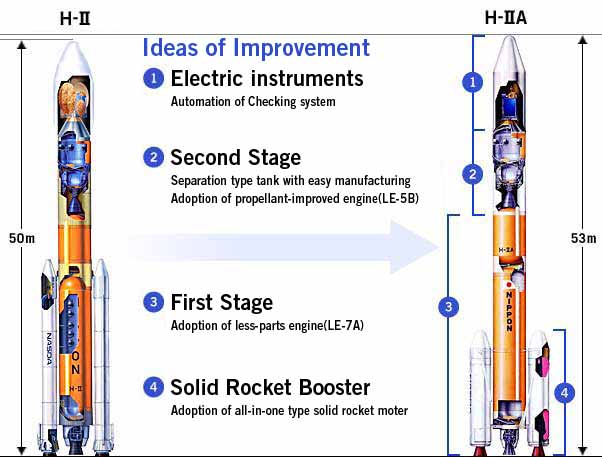
Just thought I'd post this diagram before I forgot. It illustrates the bits they improved and changed from the all domestic HII rocket to the new and improved HII-A rocket. Apart from a drastic reduction in parts there are some structural changes that are noteworthty. The bit that connects the first and second stage known as the interstage section was one of the places where they vastly reduced parts and mass.

Wednesday, June 28, 2006

Back To The Other Future


No Laughing Matter
NASA thinks the next generaiton of space craft will be back to the rocket model they so disavowed at the dawn of the Space Shuttle era.
Instead of being carried into orbit piggy-back like the shuttle, its replacement will be sent into space as the payload of a rocket, in similar fashion to the Apollo Moon landers.

Steve McDanels, manager of Nasa’s failure analysis branch at the Kennedy Space Centre in Florida, said that this was the only certain way of protecting crew capsules from the sort of damage that caused the Columbia disaster in February 2003.

“Having a payload-type craft application, where the craft is integral to the structure, is going to be the way forward,” he said. “There is no possibility of a foam strike that way.”

None of the designs currently under consideration for the Crew Exploration Vehicle that will replace the shuttle in 2012 features a winged, reusable craft, and it is highly unlikely that Nasa will return to the model that symbolised manned spaceflight in the 1980s and 1990s. “I think that won’t be at the forefront of the technologies explored,” Dr McDanels said.
This amounts to a total write-off of the last 20-30years of NASA since the Apollo missions ended. You really wonder where all that money went. Ugh. Talk about a 'wasted generation'.

They Don't Like Negativity
Engineer Charlie Camarda was displaced from the Shuttle crew in the upcoming launch.
WASHINGTON - New York astronaut Charlie Camarda has been bumped from his top NASA engineering post for backing colleagues who questioned the safety of Saturday's planned space shuttle launch, NASA officials said yesterday.
Camarda's removal heightened the turmoil over NASA Administrator Michael Griffin's decision to take the "acceptable risk" of launching the Discovery orbiter despite warnings of potentially fatal blastoff debris.

Camarda, who flew aboard the troubled flight of Discovery last July, told colleagues in an e-mail that he was fired from his post as chief engineer at Houston's Johnson Space Center and given another NASA engineering job.

"I refused to abandon my position and asked that if I would not be allowed to work this mission that I would have to be fired from my position and I was," he wrote.

Camarda, 54, of Ozone Park, Queens, said he supported the dissents on launch safety made by NASA safety chief Bryan O'Connor and engineer Chris Scolese.
Maybe it's not such a bad thing for his health.
The Shuttle is scheduled for lunch this Satutday.

Monday, June 26, 2006

The HTV

JAXA Release Details Of HTV
While the whole International Space Station hangs on the shuttle mission, JAXA have released their idea of supplying the ISS.


This is the HTV 1/20th Model:

I've seen this object sittng in one of the foyers in Tsukuba. The model has moving sections when you press a switch up front.

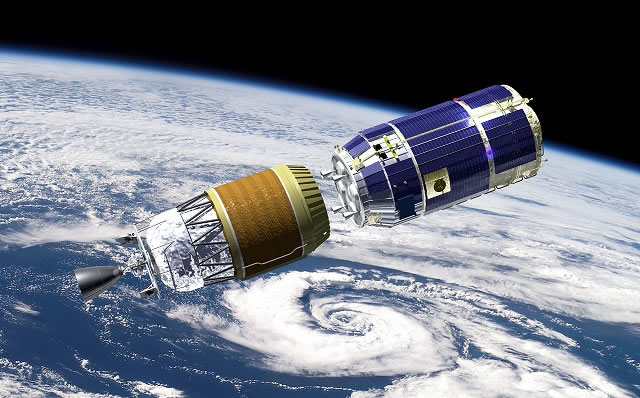
This is how the HTV will be launched, on the the H-IIB rocket:


The HTV module is much heavier than any of the other pay-loads JAXA have fired into orbit. It's certainly rated to be beynd the capacity of the current H-IIA rocket system. Hence the development work going into the successor.

Once the HTV is launched and detached, it docks with the ISS:


...at one of the nodes.


What's really interesting about the HTV is that it has a pressurised section and a non-pressureised section. Once in docking position, people on the ISS can get into the HTV's pressurised section as one of the modules of ISS. Then there is the de-pressurised section which can be exposed to the hard vacuum.
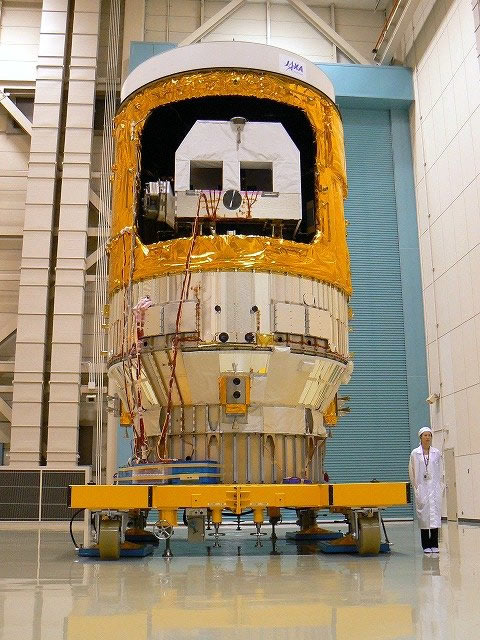
This is a mock up of the actual HTV


When I was there, they were laying in and testing electrical circuitry in this thing.
Now that I see these photos, I'm kind of a little nostalgic about my time there in Tsukuba. I was so exhausted by the end of the trip and it was the last location so I couldn't wait to get out of there; but looking back and seeing these photos, I kind of regret not pestering for more information.