Wednesday, May 24, 2006

Saturday, May 20, 2006
Space Shuttlin'
...Across the Universe
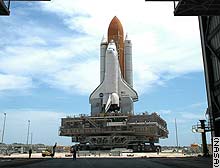
They have started to move Space Shuttle Discovery to Cape Canaveral in preparation for the next launch scheduled in July.
Here we go again. It's always scary.
Air Force Col. Steven Lindsey will command the next mission, designated STS-121. The shuttle is to dock with the international space station, delivering supplies and dropping off German astronaut Thomas Reiter.
Shuttle astronauts Piers Sellers and Mike Fossum are scheduled to conduct at least two spacewalks while the Discovery is docked with the space station.
The first will test the stability of the shuttle's new second robotic arm, called the Orbiter Boom Sensor System, as a work platform. The second is to repair part of the station's mobile transporter, a train track on the exterior that permits its robotic arm to move around.
If time permits, Sellers and Fossum may conduct a third spacewalk to test techniques to repair damage to the shuttle's thermal protection system.
NASA intends to retire the shuttle fleet in 2010 after completing assembly of the international space station.
The next-generation manned spacecraft, called the Crew Exploration Vehicle, is in the design stage. NASA says it hopes to begin test flights in 2012.
More Apewatch
Some apes have demonstrated they have the capacity to think ahead.
Nicholas Mulcahy and Josep Call of the Max Planck Institute for Evolutionary Anthropology in Leipzig tested whether our closest great ape relative--the bonobo--and our most distant--the orangutan--share our ability to plan for the future. The researchers first trained five bonobos and five orangutans to use a tool to get a fruit treat from a mechanical apparatus. They then blocked access to the treat but allowed the apes to handle suitable and unsuitable tools for the task before ushering them into a waiting room for an hour. After that hour, they were brought back into the first room and, if they had brought the right tool, they could use it to get the treat.How come some people I know have lost this ability? :)
The apes both took a suitable tool out of the test room and brought it back in with them after the waiting period significantly more often than predicted by chance. A female orangutan named Dokana proved particularly adept, completing the task successfully in 15 out of 16 attempts. Even when the delay time was extended through the night--14 hours--Dokana succeeded in garnering the tool and the fruit more than half of the time. A bonobo named Kuno did even better with the long delay than the short one, completing the task in eight out of 12 attempts.
To determine whether the apes were simply associating the tool with the food reward, or whether they were actively planning ahead, the researchers devised two more tests. In the first, two of the bonobos and two of the orangutans faced a similar challenge but with only juice as a reward--to discount for the possibility that the apes had taken the right tool previously simply because they were currently hungry. Again, the apes proved capable.
Finally, some naïve apes were presented with tools but not the mechanical apparatus. If they brought back the right tool they were still rewarded with a treat. But most did not, seemingly disproving a simple associative link between the tool and the treat. "Apes selected, transported and saved a suitable tool not because they currently needed it but because they would need it in the future," the authors write in the paper presenting the research in today's Science.
That bonobos and orangutans can plan ahead suggests that the ability evolved in the great apes prior to 14 million years ago rather than in our hominid forebearers within the past 2.5 million years, the scientists note. And other creatures may have undergone convergent cognitive evolution. Indeed, another study published online yesterday by Science found that scrub jays hid and re-hid food depending on whether they were watched by other birds.
From The Mailbag
Pleaides sent in this link. We may have gone too far.
Record amounts of the Arctic ocean failed to freeze during the recent winter, new figures show, spelling disaster for wildlife and strengthening concerns that the region is locked into a destructive cycle of irreversible climate change.And so on.
Satellite measurements show the area covered by Arctic winter sea ice reached an all-time low in March, down some 300,000 square kilometres on last year -an area bigger than the UK.
Scientists say the decline highlights an alarming new trend, with recovery of the ice in winter no longer sufficient to compensate for increased melting in the summer. If the cycle continues, the Arctic ocean could lose all of its ice much earlier than expected, possibly by 2030.
Walt Meier, a researcher at the US National Snow and Ice Data Centre in Colorado, which collected the figures, said: "It's a pretty stark drop. In the winter the ice tends to be pretty stable, so the last three years, with this steady decline, really stick out."
Experts are worried because a long-term slow decline of ice around the north pole seems to have sharply accelerated since 2003, raising fears that the region may have passed one of the "tipping points" in global warming. In this scenario, warmer weather melts ice and drives temperatures higher because the dark water beneath absorbs more of the sun's radiation. This could make global warming quickly run out of control.
Dr. Meier said there was "a good chance" the Arctic tipping point has been reached. "People have tried to think of ways we could get back to where we were. We keep going further and further into the hole, and it's getting harder and harder to get out of it."
bad news for the polar bears, it says.
Thursday, May 18, 2006
Monkey News Day
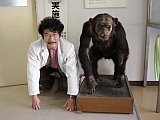
Chimps And Human Speciation Was Messy According To DNA Analysis
This article is very troubling.
I've put in red the bit that got me chuckling with a kind of horror.
"For the first time, we're able to see the details written out in the DNA," said Eric Lander, one of the collaborators on the study. "What they tell us at the least is that the human-chimp speciation was very unusual."
Unusual, indeed. The researchers, from the Broad Institute of MIT and Harvard, propose that humans and chimpanzees first split up about 10 million years ago. Then, after evolving in different directions for about 4 million years, they got back together for a brief fling that produced a third, hybrid population with characteristics of both lines.
That genetic collaboration then gave rise to two separate branches — one leading to humans and the other to chimps.
The work has inspired both admiration and skepticism. Many paleontologists have a hard time believing some of the humans that are known to have lived during that era could have been pairing up with apes.
"It's a totally cool and extremely clever analysis," said Daniel Lieberman, a professor of biological anthropology at Harvard who wasn't involved in the study. "My problem is imagining what it would be like to have a bipedal hominid and a chimpanzee viewing each other as appropriate mates — not to put it too crudely."
The research is the latest fruit of the Human Genome Initiative, the effort to transcribe and read out the entire genetic message of human chromosomes, which was completed in 2003.
Humans have 23 pairs of chromosomes that contain about 30,000 genes. Each gene is made of strands of DNA "letters" in a specific order, and the letters can change, by mutation, over time. The rate at which changes occur is fairly constant and very slow.
The number of DNA differences between two species' versions of the same gene is an indication of how long the species have been separate — or not interbreeding and sharing genes.
When the scientists at the Broad Institute compared the genes of humans and chimps, they found one of the chromosomes — the female sex chromosome known as X — was 1.2 million years younger than the others. It appeared the two species shared a common ancestor who gave them their X chromosomes and did so more recently than the ancestors who gave them the other chromosomes.
The best explanation for this, the scientists think, is that ancient humans and chimps broke away from each other not once, but twice. The first time was more than 6.3 million years ago. The second time was at least a million years later.
What probably happened was some of the evolving human ancestors bred with evolving chimpanzees. This was perhaps not as weird as it seems, for though there were some physical differences between the two groups, "the early humans must have looked pretty much like chimpanzees," said James Mallet, a geneticist at University College in London not involved in the new research.
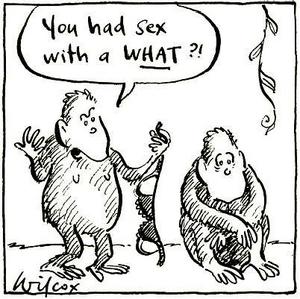
The horror, the horror. It just feels *wrong*.
But now that I think about it, there's a human population out there that fuck sheep; why not chimps?
Monkeys Talk In Full Sentences
 Here's the article.
Putty-nosed monkeys put two different alarm calls together to create urgent warnings, according to observations recently made of the West African primates.Which is amazing because I've met humans who couldn't do exactly that. Some of them were in charge of science and space policy in Australia! :)
These monkey "sentences" appear to be evidence of what is widely considered to be a uniquely human ability: stringing words together to convey a message, or syntax.
"These monkeys combine different calls into more complex call sequences with novel meanings," said Klaus Zuberbühler, a psychology researcher at the University of St. Andrews in Scotland.
Zuberbühler co-wrote a study about the monkey calls appearing in tomorrow's issue of the journal Nature.
He and co-author Kate Arnold do not make a direct analogy between the monkeys' call sequences and human language. (Read related news: "Monkeys Deaf to Complex Communication, Study Says" [2004].)
But Zuberbühler said that their work shows that "the main carriers of meaning are not the individual calls, but the call sequence."
Monkey "Sentence"
Putty-nosed monkeys belong to a group of African monkeys called guenons. The species' most obvious distinguishing feature, and the one the animals are named for, is a bright white nose that stands out against a brown face.
The monkeys are found throughout the Ivory Coast (map of the Côte D'Ivoire), in parts of Liberia, and along the entire northwest coast of the Congo River.
Groups consisting of a single male accompanying 12 to 30 females and their offspring defend territories within this range.
Like other guenons, putty-nosed monkeys use two loud calls, usually referred to as "pyows" and "hacks." They use a series of pyows to warn of a leopard threatening the group and a string of hacks to indicate the presence of crowned eagles.
Zuberbühler and Arnold found that male monkeys often combine the two calls into a kind of simple sentence that they call a "pyow-hack."
Tuesday, May 16, 2006
Not Good News

Part 1, How NASA Lost Its DART
NASA has losst onee of its satellites. The automated DART Satellite was supposed to rendezvous with a Pentagon satellite, but somehow it went awry.
The 800-pound (362-kilogram) DART spacecraft – short for Demonstration for Autonomous Rendezvous Technology – launched from California’s Vandenberg Air Force Base on April 15, 2005 atop an Orbital Sciences-built Pegasus XL rocket. The spacecraft was expected to rendezvous with MUBLCOM, or Multiple Path Beyond Line of Site Communication; a small communications satellite launched for the U.S. military in 1999.And that is that. not a good show.
DART’s $110-million mission called for the spacecraft to approach within 16 feet (five meters) of MUBLCOM and perform a series of intricate maneuvers near the older satellite, all without human intervention. The mission was to occur throughout a 24-hour period. But while DART ultimately found and approached the MUBLCOM satellite, it apparently closed to within 300 feet (91 meters) and ran out of fuel, bumping into the target spacecraft while both vehicles were 472 miles (760 kilometers) above Earth.
“Less than 11 hours into the mission, DART collided with MUBLCOM,” the investigation summary states. “MUBLCOM did not appear to experience significant damage, and the impact actually pushed it into a higher orbit.”
According to the mishap summary, DART’s velocity measurements by its primary global positioning system (GPS) receiver were off by about 1.9 feet per second (0.6 meters per second), an inaccuracy that persisted in the spacecraft despite a computer reset because the needed software patch was never installed. DART’s main computer repeatedly detected its velocity anomaly, reset itself, then again detected the same glitch, the summary stated.
An initial mismatch between expected and actual position appears to have started the continuous cycle – which forced the excessive thruster firings – but it was still not enough to lead DART into failure, according to the summary report. A computer logic setting that regulated how much weight the spacecraft gave its estimated and measured orbital speed and positions was set too high, allowing the initial glitch to continue, the summary stated.
Many of DART’s failings could have been avoided if the mission’s team members thoroughly reviewed and applied data and experience from previous NASA projects, investigators found.
Global Warming Is Killing Coral Seas
I know this is a bit 'I Told You So', but I told you so.
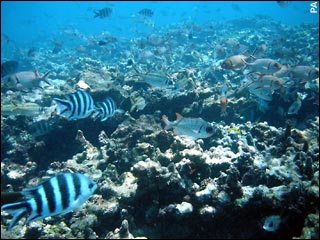
Earlier studies focused on coral damage but today's report is the first to show the long-term impact on fish and other creatures of the 1998 event where global warming caused Indian Ocean surface temperatures to increase to unprecedented and sustained levels, killing off (or "bleaching") more than 90 per cent of the inner Seychelles coral.Not a very pretty sight. Here's another entry from The Environmental News Service.
The team, led by the University of Newcastle upon Tyne, and which comprises researchers from Britain, Australia and the Seychelles, publishes its findings today in the Proceedings of the National Academy of Sciences.
The research in the inner islands of the Seychelles in 1994 and 2005 showed that, while the 1998 event was devastating in the short term, the main long-term impacts result when the damaged reefs were unable to re-seed and recover.
Many collapsed into rubble that became covered by algae. The collapse removed food and shelter from predators for a large, diverse amount of marine life. In 2005, average coral cover in the area was just 7.5 per cent.

Lead researcher Nick Graham, of Newcastle University's School of Marine Science and Technology, said, "We have shown there has been very little recovery in the reef system of the inner Seychelles islands for seven years after the 1998 coral bleaching event."If more people in power only knew how beautiful these things were, they'd probably campaign to make sure they didn't die out like this. It's a tragedy and a travesty.
While the 1998 event was devastating in the short term, the main long-term impacts are that the damaged reefs are largely unable to reseed and recover. "Many global warming bleaches simply collapsed into rubble which became covered by unsightly algae," Graham's team writes in their study, published Monday in the "Proceedings of the National Academy of Sciences," a U.S. publication.
"Reefs can sometimes recover after disturbances," said Graham, "but we have shown that after severe bleaching events, collapse in the physical structure of the reef results in profound impacts on other organisms in the ecosystem and greatly impedes the likelihood of recovery."
Bleaching occurs when corals encounter stressful environmental conditions, explain scientists at the Australian Institute of Marine Science in Townsville, a partner on the study team. High water temperature is the most prevalent stress leading to coral bleaching.
Stresses cause coral to expel zooxanthellae, the small algae living inside the bodies of coral. Because the zooanthellae give the coral their color, when they dissipate the corals suffer a loss of color, hampering the photosynthesis process. This eventually leads to death of the corals.
The collapse of the Seychelles reefs removed food and shelter from predators for a large number of diverse marine species. In their 2005 survey, the scientists found the average coral cover in the area to be just 7.5 percent.
The survey showed that four fish species are possibly already locally extinct - a type of butterfly fish, two types of wrasses and a type of damsel fish.
Six species are at critically low levels, the scientists found - a type of file fish, three types of butterfly fish and two damsel fish. Their decline probably started to happen soon after 1998, they said.
The survey also revealed that species diversity of the fish community had decreased by 50 percent in the heavily impacted sites. "Reduced biodiversity results in a more fragile and less stable ecosystem," the scientists wrote.
Smaller fish have been reduced in number more quickly than larger species but their decreased availability has started to have a more lasting effect on the food chain, the researchers found, and they projected that this effect is likely to be amplified as time goes on.
They observed a decrease in herbivorous fish, worrisome because these fish species control the spread of algae.
Wednesday, May 10, 2006
India To The Moon

Out Of The Blue
The Indian Space Research Organisation is sending 2 NASA Probes to the moon.
Marking India’s determination to keep up with spacefaring rivals such as China, Chandrayaan-1 will be propelled into space by a satellite launcher from the Satish Dhawan Space Centre at Sriharikota, 100km north of Chennai.I've added a link to ISRO on the side bar. I wasn't aware they were that advanced.
The first Nasa chief to visit India in an official capacity since the early 1970s, Michael Griffin, signed the two memorandums of understanding covering the symbolic collaboration at a ceremony in Bangalore.
The US imposed sanctions on India’s space programme in 1998 following the country’s nuclear tests, but resumed the granting of export licences in September 2001 and has been looking to collaborate with India in developing space technologies. “There was a period of time between our nations where, because of nuclear proliferation issues and other factors, the ability to co-operate on technical matters was less strong than it is today,” Mr Griffin said after signing the deal.
The Indian Space Research Organisation said the two devices – a mini synthetic aperture radar (MiniSar) and a moon mineralogy mapper (M3) – were selected on merit from among 16 firm proposals received from around the world.
The main objective of the MiniSar is to detect water in the permanently shadowed areas of lunar polar regions, while the role of the M3 is to characterise and map minerals on the moon’s surface.
If even India has a Space programme, why doesn't Australia have one? Seriously.
Tuesday, May 09, 2006
Fusion Reaction
In Japan they're reporting that they've managed to keep plasma active for a world record 28 seconds.
It lasted 28.6 seconds, lengthening the time from the previous record of 16.5 seconds. They think that they've seen the light in getting a longer time record, which of course is the hope of fusion research.
You read it here first in English, because there's nary a report in English newspapers this minute!
「プラズマ」維持、世界最長を達成・原子力機構Key points: They did in in Ibaraki prefectue using the Fusion module 'JT-60'. By using a ferrite alloy, they managed to control the magnetic field better inside the vacuum vessel.
日本原子力研究開発機構は、原子と原子をぶつけてばく大なエネルギーを取り出す核融合に不可欠なプラズマという原子状態を、世界最長となる28秒間維持することに成功した。国際熱核融合実験炉(ITER)の標準運転に必要な条件の下での実験で、核融合の実用化につながると期待される。成果は6月にイタリアで開かれる欧州物理学会で発表する。
茨城県那珂市の研究施設にある臨界プラズマ装置「JT—60」で実験した。プラズマを加熱する高速イオンの損失を防ぐため、フェライト鋼という材料を真空容器内に装着。従来の炭素材タイルだけの場合に比べて磁場の形を改良し、プラズマをうまく閉じ込められるようになった。
ITERの標準運転で想定する状態で、これまでの世界最長記録はJT—60の16.5秒だった。今回の28.6秒はこれを1.7倍に延ばし、ITERの長時間燃焼が実現する公算が大きくなった。
It lasted 28.6 seconds, lengthening the time from the previous record of 16.5 seconds. They think that they've seen the light in getting a longer time record, which of course is the hope of fusion research.
You read it here first in English, because there's nary a report in English newspapers this minute!
Monday, May 08, 2006
The Names They Give Themselves

It turns out dolphins give themselves names:
The evidence suggests dolphins share the human ability to recognise themselves and other members of the same species as individuals with separate identities.Which of course reminds me of the following Larsen cartoon:
The research, on wild bottlenose dolphins, will lead to a reassessment of their intelligence and social complexity, raising moral questions over how they should be treated.
The research was carried out by Vincent Janik of the Sea Mammal Research Unit at St Andrews University in Scotland, who has found bottlenose dolphins to be among the animal world's quickest learners of new sounds.
"Each animal develops an individually distinctive signature whistle in the first few months of its life, which appears to be used in individual recognition," he said.
The research has its origin in the 1960s when dolphin trainers first noticed captive animals each had their own repertoire of whistles.
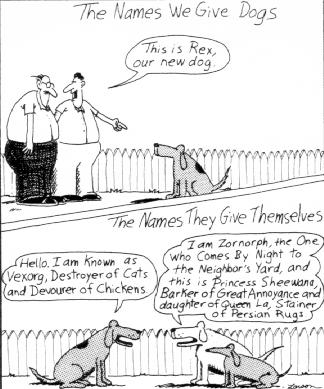
Guess you had to be there.
Sunday, May 07, 2006
Huygens Update

Movie Time
You can now view the Huygens module descending and landing on Titan in this video here.
An explanation is here.
A little more than one year after the spectacular descent of the European Space Agency's Huygens on Saturn's giant moon Titan, scientists from the probe's Descent Imager/Spectral Radiometer (DISR) have released two new movies of the descent. These represent the best visual product from the mission obtained so far and most realistic way yet to experience the landing on a far-away world.There is another movie here.
These movies were built thanks to the data collected by DISR on 14 January 2005, during the 147-minutes plunge through Titan's thick orange-brown atmosphere to a soft sandy riverbed. The data were analysed for months after the landing.
The movie "View from Huygens on 14 January 2005" shows in 4 minutes 40 seconds what the probe actually "saw" within the few hours of the descent and the eventual landing.
"At first the Huygens camera just saw haze over the distant surface," said DISR team member Erich Karkoschka, from the DISR team at the University of Arizona and creator of the movies.
"The haze started to clear only at about 60 kilometres altitude, making it possible to resolve surface features as large as 100 metres" he continued. "But only after landing could the probe's camera resolve little grains of sand millions and millions times smaller than Titan. A movie is a perfect medium to show such a huge change of scale."

The second, more technical movie (called "DISR movie"), shows DISR's 4-hour operating life in less than five minutes, too. A detailed caption to explain how the movie is structured is provided with the video.And that is all I have today on Huygens. Enjoy the movies!
The scientists analyzed Huygens' speed, direction of motion, rotation and swinging during descent, represented in this movie. It also features Huygens' trajectory views from the south, indication of the large and unexpected parachute movements, the changing direction of view as Huygens rotates along with the relative positions of the sun and Cassini, and a clock to follow the actual sequence of events.
Sounds from a left speaker trace Huygens' motion, with tones changing with rotational speed and the tilt of the parachute. There are also clicks that clock the rotational counter, as well as sounds for the probe's heat shield hitting Titan's atmosphere, parachute deployments, heat shield release, jettison of the DISR cover and touch down.
Tuesday, May 02, 2006
Eileen Collins Quits
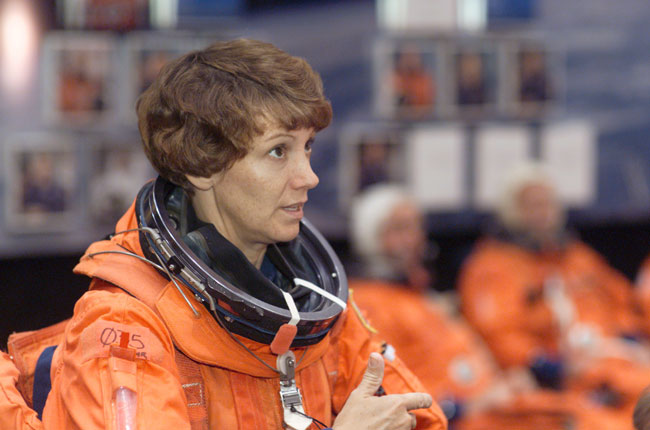
Got Scared? I Would Too
The first female commander of the US Shuttle fleet called it quits citing family as a reason. I would've cited boredom between flights and you know, the issue that maybe the shuttle was nowhere near as safe as advertised when she first joined the ranks of astronauts.
Collins, 49, commanded NASA’s first shuttle mission – STS-114 aboard Discovery – since the 2003 Columbia disaster, and is a veteran of four orbiter flights throughout a nearly 16-year astronaut career.Errr, yeah Commander Collins. Let's all share around the death seat. I just couldn't bear to watch STS-114 come back down because it was so nerve wracking.
"Eileen Collins is a living, breathing example of the best that our nation has to offer," said NASA chief Michael Griffin, in a statement. "She is, of course, a brave, superb pilot and a magnificent crew commander.”
But the experienced shuttle astronaut will not plunge into a post-spaceflight career immediately. Collins said she’s reserved the entire upcoming summer to spend with her husband, Pat Youngs, daughter Bridget, 10, and son Luke, 5.
“They’ve put up with all of my training schedules and then I was gone for five weeks over last summer,” Collins said of her family, citing the three weeks of quarantine and two weeks in space during her last mission, not to mention the many national and international appearances that followed her return. “Now that it’s been eight or nine months, I’m just going to chill out and finish the remaining work to be done from STS-114, then it’s on to something new.”
Collins said she hopes her retirement will also allow newer astronauts an opportunity to fly before the shuttle fleet itself retires in 2010. Though a native of Elmira, New York, Collins said she will remain in Houston, Texas – home to NASA’s Johnson Space Center – for the time being.
“It’s important to me that these young people get a chance to fly,” Collins said. “It’s very important to the country to have more people that have flown in space because we take that spaceflight experience with us, which is a valuable thing to have when you go on to design future spacecraft and educate young people.”
When I went to JAXA earlier in the year, I found myself looking at the experiment module JAXA had built at Tsukuba for the International Space Station. It's a very big module and the only thing that can get it up to orbit is of course the shuttle. Of course the shuttle quickly got suspended after STS-114, so I pointed out this module was at risk of never getting up to the ISS. You should've seen the grim looks I got.
One JAXA engineer spat out "I hate people who say shit tlike that!" and walked away.
The other JAXA engineer said "How do you know?"
I told him about the shuttle's structural woes and how fundamentally unsound it was and he said "Well, you've done your research. We're just praying it works well enough here."
So even people in the space exploration business are willing to admit that's that.
Subscribe to:
Posts (Atom)