Sunday, October 30, 2005

Chimps Short On Altruism


What's In It For The Chimp?
It's interesting that chimps are seen as 'lackng in altrusim'. Here' the article


In the experiments, the chimps were given a chance to give themselves a food treat, and to also give the same treat to the other chimp sitting nearby in a clearly-visible cage. Or not.

In fact, the researchers report in the current issue of the journal Nature that the chimps pulled the lever to give a treat to their counterpart only about as often as they pulled that same lever when the cage opposite them was empty. In other words, they could care less about their pals.

Emory University researchers earlier this year reported that chimps do possess a sense of "fairness", rejecting a lousy-tasting cucumber when they see another chimp getting a tasty grape, when both had performed the same task. But chimp fairness only goes so far, says Silk's team. Chimps don't seem to mind when they benefit and somebody else gets stiffed.

The finding suggests that humankind's history of cooperation may be unique to our species, says the team, or at least is part of human behavior that has only developed since people and chimp ancestors diverged more than 5 million years ago.

The corollary of that could be a selfish human is less 'evolved'. :)
Or the experiment is totally culturally observer-biased and not worth spit.

Wednesday, October 26, 2005

Mailbag Stuff

Optical Illusion.
Very interesting.

Human version 2.0 from the SMH. It's tantamount to a sort of "Cyber Manifesto"


Between 2000 and 2014 we'll make 20 years of progress at 2000 rates, equivalent to the entire 20th century. And then we'll do the same again in only seven years. To express this another way, we won't experience 100 years of technological advance in the 21st century; we will witness in the order of 20,000 years of progress when measured by the rate of progress in 2000, or about 1000 times that in the 20th century.

Ultimately, we will merge with our technology. As we get to the 2030s, the non-biological portion of our intelligence will predominate. By the 2040s it will be billions of times more capable than the biological part.

Above all, information technologies will grow at an explosive rate. And information technology is the technology that we need to consider. Ultimately, everything of value will become an information technology: our biology, our thoughts and thinking processes, manufacturing and many other fields. As one example, nanotechnology-based manufacturing will enable us to apply computerised techniques to automatically assemble complex products at the molecular level.

This will mean that by the mid 2020s we will be able to meet our energy needs using very inexpensive nanotechnology-based solar panels that will capture the energy in 0.03 per cent of the sunlight that falls on the Earth, which is all we need to meet our projected energy needs in 2030.

A common objection is that there must be limits to exponential growth, as in the example of rabbits in Australia. The answer is that there are, but they're not very limiting. By 2020, $1000 will purchase 1016 calculations per second (cps) of computing (compared with about 109 cps today), which is the level I estimate is required to functionally simulate the human brain. Another few decades on, and we will be able to build more optimal computing systems. For example, one cubic inch of nanotube circuitry would be about 100 million times more powerful than the human brain. The ultimate 1-kilogram computer - about the weight of a laptop today - which I envision late in this century, could provide 1042 cps, about 10 quadrillion (1016) times more powerful than all human brains put together today.

And that's if we restrict the computer to functioning at a cold temperature. If we find a way to let it get hot, we could improve that by a factor of another 100 million. And we'll devote more than 1 kilogram of matter to computing. We'll use a significant portion of the matter and energy in our vicinity as a computing substrate.

Our growing mastery of information processes means the 21st century will be characterised by three great technology revolutions. We are now in the early stages of the "G" revolution (genetics, or biotechnology). Biotechnology is providing the means to change your genes: not just designer babies but designer baby boomers. But perfecting our biology will only get us so far.

Biology will never be able to match what we will be capable of engineering, now that we are gaining a deep understanding of biology's principles of operation. That will bring us to the "N" or nanotechnology revolution, which will achieve maturity in the 2020s. There are already early impressive experiments. A biped nanorobot created by Nadrian Seeman and William Sherman, of New York University, can walk on legs only 10 nanometres long, demonstrating the ability of nanoscale machines to execute precise manoeuvres.

Interesting stuff if you like Futue Shocking yourself. :)

Tuesday, October 25, 2005

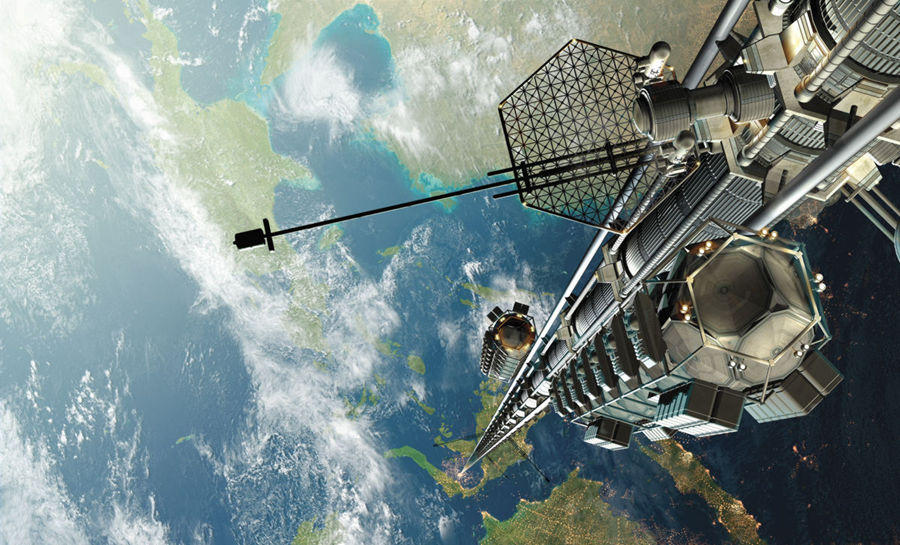
Space Elevator


Update
Here's the latest on the Space Elevator concept.
I've linked it, but here's the text in its entirety.


One day in the future, not too far from today, a hazy weekend in Mountain View could be written into the history of space exploration.

A three-day competition at the NASA Ames Research Center, which wrapped up Sunday, brought together callow college students and grizzled engineering hobbyists to design a ``space elevator'' -- a platform rising beyond the Earth's atmosphere along a super-strong ribbon of carbon ``nanotubes'' that could, one day, carry cargo into space much more cheaply than rockets.

Just as the first airplane flight at Kitty Hawk lasted only 12 seconds, the seven ``robot climbers'' entered in the competition didn't ascend more than a few dozen feet up a tether attached to a giant crane. And none performed well enough to win the $50,000 grand prize.

But they broke a barrier on Sunday nonetheless -- proving that the idea is not some science-fiction fantasy.

``If we get financing, it'll be one or two years'' before a space elevator becomes a reality, said Brad Edwards, a former staff scientist at Los Alamos National Laboratory who has written a book on the subject.

Edwards was a judge at the competition, sponsored by the Spaceward Foundation of Mountain View. Just as railroads opened up the western United States and the Internet opened up cyberspace, Edwards believes that a space elevator will lead humanity across yet another frontier.

While rockets are prohibitively expensive because of their fuel, a space elevator could cover the same distance for a tiny fraction of the cost, Edwards said. It could be used to cheaply launch satellites or missions to Mars.

It could even solve the energy crisis by lifting massive banks of solar cells into orbit around Earth, proving unlimited clean, efficient and safe power. ``You can't do that with rockets,'' Edwards said.

Contestants were asked to develop either a super-strong elevator tether or a robotic platform that would climb up the tether into space.

Four teams entered the tether contest, according to Marc Schwager of the Spaceward Foundation. That contest also had a $50,000 prize, offered by the NASA Centennial Challenges Program -- but to win it, a team had to demonstrate that their tether was not only stronger than others entered in the competition, but also 50 percent stronger than NASA's ``house tether.''

Schwager said a tether developed by a three-man team from Logan, Utah, beat the other teams but broke just before reaching the 50-percent prize threshold. Since nobody won either prize this year, Schwager said the money for both the climber and the tether will be rolled into next year's pot.

The idea of offering prizes to spur scientific breakthroughs dates back to at least 1714, when the British government offered the ``Longitude Prize'' for the first method to precisely determine a ship's longitude.

But contestants in the Spaceward Foundation challenge said they weren't motivated by money as much as by the idea of creating something that crossed a scientific frontier.

Michael Fischer, a 50-year-old software engineer from Auburn, put about $5,000 into a climber powered by a Stirling engine using external combustion and helium.

At the last minute, Fischer's climber developed a leak, so he ended up cannibalizing it for parts to help other teams, including one from the University of British Columbia.

That team of students, led by Steve Jones, came in second, with a climber that converted the light from powerful spotlights into energy. It rose about 30 feet, while the winning team, from the University of Saskatchewan, used light to climb 60 feet.

``It was amazing to watch these silent machines gliding on light,'' Schwager said. ``Two college teams came in and showed industry how to build a space elevator.''


It has to be said, it's hard to visualise whhat exactly the elevator shaft/stem is going to look like, but there you go.
I actually think there's an idea for a start up company in it right now.

Sunday, October 23, 2005

Putting The Trap Into Claptrap


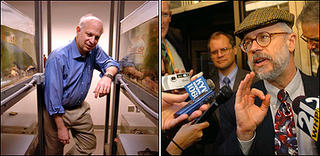
The good doctor on the left, the idiot doctor on the right. What are they doing at the Boston Globe?

Sceptical About Evolution?
Here's a great little article covering why this debate has hit the cultural spotlight right now.


Debate over evolution has been a constant thread in American society, before and since the 1925 Tennessee trial that found science teacher John Scopes guilty of violating a state law against teaching evolution. A higher court later overturned the verdict on a technicality without ruling on the merits of the law.

The fact that the debate has returned with such force in 2005 may reflect a time of frightening cultural change when people "look for something that is absolute and certain," said Mark Sisk, the Episcopal bishop of New York.

"I believe that a fair amount of this is an attempt to corner God. And when one does that it approaches idolatry," he added. The Biblical account of creation simply means that "God is the source of everything" and nothing in that conflicts with Darwin, he said.


I quote that bit in particular because I want to note that being religious doesn't equal wanting creationism/Intelligent Design to be taught.

There's also this bit:


John West, a senior fellow at the Discovery Institute, said the debate has ripened because more credentialed scientists are critical of Darwin's theory. The institute has a list of 400 people with a variety of degrees in and out of academia who it said have signed a "dissent."

It states that they are "skeptical of claims for the ability of random mutation and natural selection to account for the complexity of life. Careful examination of the evidence of Darwinian theory should be encouraged."

What the institute would like to see, West, said, is a requirement that schools "teach the controversy" -- to note in lessons on evolution that not everyone accepts the theory.

That approach is equally abhorrent to Michael Zimmerman, dean of the College of Letters and Sciences at the University of Wisconsin, Oshkosh.

He blames the spreading debate in part on "narrow-minded religious leaders repeatedly saying people have to choose between science and religion." What they really want, Zimmerman said, is "to overturn the scientific paradigm that explains the natural world in materialistic terms."

He has gathered nearly 9,000 signatures of U.S. clergy members on a letter posted online urging school boards to keep teaching evolution "as a core component of human knowledge."

You can see the double whammy: It's wrong, but it's also adding to the confusion. And as more people are confused, it allows religion to insert itself into a topic that's been open and shut in the US courts since the Monkey Trials of 1925.
Who'd a thunk we'd live in such times?

In Australia, Where They Make Us Really Stupid
The Sydney Morning Herald ran this article showing just how fucked up people can be:


The view presented by some scientists, and affirmed in your editorial ("A matter of faith", October 22-23), is that intelligent design is plainly not science because it fails the basic requirement to be scientific: it must be testable against observation. I agree with this premise.

But I have a problem. Evolution by natural selection (trial and error) is claimed to be the process by which life as we know it came into existence. However, this claim is not testable against observation nor is it supported by the facts since no-one can test against observation how life actually came into existence.

Based on what can be observed, scientists interpret the evidence by assuming what they think is the case and testing it. Thus their conclusions are interpretations as to what they think may be the how and what concerning the origins of life and the universe. Hence any viewpoint about the origins of life and the universe can only be, at best, a theory.

To assert a theory to be fact is not science - it is a matter of faith.
- Mike Geeves Mount Riverview

The Herald editorial conclusion that teaching intelligent design in science classes would be tantamount to fraud was spot on. Government funding should be withdrawn from any school that includes this totally non-scientific doctrine in its science curriculum.
- John Moyse Newcastle

On the one hand science students are taught the basic law of science that without intelligent input, matter always tends to a state of greater disorder and disorganisation. But in the same science class it is claimed that in the distant past, contrary to this observable law of science, matter somehow became highly organised without any intelligent input. It seems to me that evolution is just as much a matter of faith as intelligent design.
- George Wells Belmont

Albert Einstein once said that in the laws of nature "an intelligence so superior is revealed that in comparison all the significance of human thinking and human arrangements is a completely worthless reflection".

To preclude the teaching of intelligent design theory because it is deemed to be unscientific (which it may well be) is to suggest that science exhausts the boundaries of human knowledge, a proposition that is manifestly absurd.

The question of God, or the infinite, cannot be confined within the boundaries of scientific research and to exclude consideration of these questions is closed minded and arrogant.
- Richard Shankland Pymble

Evolution and intelligent design are two different theories of natural history. Evolutionists first believe in evolution, then seek supporting evidence to fill in the gaps. One hypothesis is that life is incredibly improbable to occur by chance, so it happened once; over time, all species evolved from that.

One could examine DNA and bones of living and dead organisms, looking for commonalities that support a hypothesis of common ancestry. Another hypothesis says there is one designer, not many. One could examine DNA and bones of living and dead organisms, looking for commonalities that support the single designer hypothesis, evidenced by similarities and genetic code reuse. Either way, knowledge is increased. Why are professional evolutionists so against education or research of alternate hypotheses?

True scientific method is independent evaluation of evidence, testing against all hypotheses, not dogmatic assertion that only one theory is worth the effort.
- Nathan Miller Kambah (ACT)

Science is about discovery, and involves uncertainty, but also persistent seeking of truth. Religious belief is about revelation, as revealed and certified by people, usually male power-seekers who love hierarchy and see themselves as shepherds for the poor unenlightened rest of us. I can no longer trust such people who proclaim certainty - the Earth is still flat, isn't it? It used to be. And what an intelligent design, to make the sun revolve around the Earth every day.
- Fred McArdle Brunswick (Vic)

Mike Archer and his group of science experts claim in their letter that intelligent design is philosophy and therefore should not be taught in school science classes ( "Intelligent design is not science: experts", October 21). They may have a point, but what they are not telling us is that evolution is likewise a philosophy. If we are to ban intelligent design from science classes then to be consistent we will have to ban evolution, too.

They claim that evolution can be tested and repeated, but this is mere bluster. The central tenet of evolution, that life arose from non-life sometime in the unimaginable past, can neither be tested nor repeated, but it can be questioned and this is the object of intelligent design arguments. This debate is not about science v religion but rather it is about philosophy v philosophy.
- Ewan McDonald Timmering (Vic)

So intelligent design makes no predictions and cannot be tested. Since when have scientists been able to test evolution? How about the Big Bang theory? All supposition, unrepeatable in experimentation.

Intelligent design requires accepting that man is not in fact the ultimate result of billions of years of random mutation, but is the product of the ordered intention of a being greater than ourselves. Unfortunately, the arrogance of mankind means that this is generally an unacceptable contention.
- Andrew Tiedt St Ives

You don't have to be an expert to know that creationism, by whatever name you try to disguise it, is not science.
- Fred Pilcher Kaleen (ACT)


What scares me is that there are more folks in favor of defending 'ID' than there are lambasting it for the errant stupidity that it is. Kind of explains the rise of the 'Family First' Party and the desire to obfuscate the line between Church and Politics in this country. I don't care about (or for that much care for) people's issues of faith; it's just that they're not germaine to science no matter how much they raise questions.
Let's face it, a lot of the questions they raise are rhetorical and they're not interested in hearing the scientific answers. There are answers to every single one of the questions raised by 'ID' in order to get to its thesis.

Maybe I should insist that they should teach 'Irreducible Stupidity' in sociology classes, covering this growing throng of flat-earth society types.

Tuesday, October 18, 2005

Come See The Face Of Stupidity


This Is Just Nuts
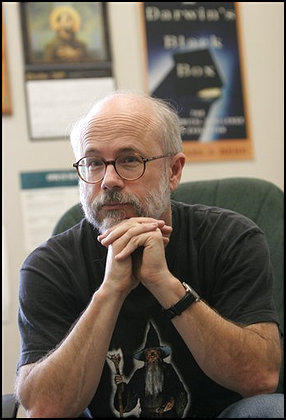
But at least we now now the anti-intellectual epi-centre of this current pandemic of dementia known as 'Intelligent design". The idiot you see above is the man responsible for spreading this stupid notion.
Here's the NYT article:


HARRISBURG, Pa., Oct. 17 - Michael J. Behe, a biochemistry professor at Lehigh University in Pennsylvania, has spent the last eight years traveling to colleges promoting intelligent design as a challenge to the theory of evolution.

On Monday Mr. Behe brought his lecture and slides to a closely watched trial in federal district court, where a judge will decide whether the town of Dover, Pa., violated the boundary between church and state when it required students to hear a statement about intelligent design in a high school biology class.

The Dover school board is being sued by 11 parents who say intelligent design is inappropriate in a biology class because it is merely religious creationism repackaged to resemble science. Proponents of intelligent design, however, argue that living organisms are so complex that the best explanation is that a higher intelligence designed them.

With the trial in its fourth week, Mr. Behe was the first expert witness for the defense. Asked whether intelligent design is religion, or "based on any religious beliefs," Mr. Behe said, "No, it isn't."

"It is based entirely on observable, physical evidence from nature," he said.

Mr. Behe said the "best and most striking example of design" is the bacterial flagellum, "the outboard motor bacteria use to swim." He projected a drawing of a flagellum depicting what he called a "rotary motor" attached to a "drive shaft" that pushes a propeller, and said it was impossible avoid concluding that the mechanism was "a purposeful arrangement of parts."

Mr. Behe is the author of "Darwin's Black Box," a book published in 1996 that spurred the intelligent design movement. He is also a fellow at the Discovery Institute, a research organization that advocates intelligent design.

For three weeks, the plaintiffs called expert witnesses, including a biologist, a theologian, a paleontologist and two philosophers, who testified that intelligent design did not meet the definition of science because it could not be tested or disproved. They said that intelligent design proponents had not published scientific articles in peer-reviewed journals and that most scientists did not question evolution's basic tenets.

Mr. Behe testified that intelligent design was science and that it made testable claims.

Mr. Behe said he had been able to publish only one article on intelligent design in a peer-reviewed scientific journal, a piece he co-wrote in Protein Science in 2004.

Robert Muise, a defense lawyer, asked Mr. Behe, "Do you perceive a bias against publishing articles on intelligent design in peer-reviewed journals?"

Mr. Behe said he did. "My ideas on intelligent design have been subjected to a thousand times more scrutiny than anything I've written before."

Mr. Behe testified that intelligent design did not claim to identify the intelligent designer, or even to "require knowledge of the designer."

However, Mr. Behe, a Roman Catholic, was asked whether he had concluded that "the designer is God." He said yes, but added that his conclusion was not based on science.

"I concluded that based on theological, philosophical and historical facts," he said.

Mr. Behe said he believed schools should teach evolution because it was "widely used in science" and "many aspects are well substantiated." And he said intelligent design was "quite limited" because it challenged only one part of evolutionary theory, natural selection.

Mr. Muise then asked whether natural selection could "explain the existence" of DNA, the immune system or blood clotting. Mr. Behe said no.

As Mr. Behe's responses grew increasingly long and arcane, Judge John E. Jones III slumped in his chair. When Mr. Muise asked the judge whether he should stop for the day, Judge Jones sat up and agreed, saying, "We've certainly absorbed a lot, haven't we?"

Randy Tomasacci, a woodworker who serves on his school board in Shickshinny, Pa., said his district was considering teaching intelligent design. He said Mr. Behe's testimony "reinforces my point of view."

So this is the moron who has been peddling this idiocy. *Ugh* Who gave this man aadegree and why haven't they stripped him of his degree yet?

Poms In Space

Here's an article I almost missed with my recent hiataus.

After years of not funding astronautical training, a body in the UK found that it might be time to start investing in astronautial training.


The report warns Britain risks being isolated on the international stage if it continues its longstanding refusal to fund the human exploration of space.

The RAS expert panel says the cost of joining other nations with astronaut programmes could be some £120m a year.

But the scientific, educational and economic benefits would be worth it, it argues.

"Recent developments across the world strongly suggest that, after a 30-year lull, space-faring nations are gearing up for a return to the Moon and then to Mars," said panel member, Professor Ken Pounds, of the University of Leicester.

"It is hard to imagine that the UK, one of the world's leading economies, would not be fully involved in a global scientific and technology endeavour with such strong potential to inspire.

"We therefore recommend that the government re-evaluates its longstanding opposition to British involvement in human space exploration."

Scientific merits

Current policy only allows for tax payers' money to be spent on robotic missions, which means the UK, although a member state of the European Space Agency (Esa), gives no funds to Esa's astronaut corps.

Those UK-born individuals who have made it into orbit recently, such as Michael Foale and Piers Sellers, have done so by taking out US citizenship and joining the American space agency (Nasa).

As well as space physicist Professor Pounds, the panel includes Dr John Dudeney, deputy director of the British Antarctic Survey; and Frank Close, a physics professor at Oxford University, who acts chairman.

Their nine-month investigation into the scientific merits of having British astronauts finds "compelling" reasons to change present policy.

The men say robotic missions to the Moon and Mars can answer many of the questions we want to ask about the origin of the Solar System and the evolution of life within it ¿ but machines do not yet have the ingenuity and flexibility of people.

Industrial rewards

The panel believes the industrial and educational rewards from joining other nations on manned missions beyond low-Earth orbit in the coming decades could be huge.

"Surveys have shown a significant economic multiplier from investment in space projects, with an additional overall gain in competitiveness," the panel reports.

And they add: "The outreach potential for human space exploration can be a strong positive influence on the interests and educational choices of children."

Professor Close commented: "We commenced this study without preconceived views and with no formal connection to planetary exploration.

"Our personal backgrounds made us lean towards an initial scepticism on the scientific value of human involvement in such research.

"However, while fully recognising the technical challenge and the need for substantial investment, we have, nevertheless, been persuaded by the evidence presented to us that the direct involvement of humans in situ is essential if we are to pursue science of profound interest to humankind that can only be undertaken on the Moon and Mars."

As part of its fact-finding exercise, the RAS panel tested public opinion through the BBC News website.

An analysis of responses to a Have Your Say debate found 61% were in favour of the UK having its own astronauts, 26% were against and 13% were undecided.

So why notAustralia when we haave so many resources?
Meanwhile I spotted this rather bleak little article


But much has changed. The Cold War that provided the initial motivation for our space program is long over, and human space exploration has been overtaken by technological progress. Astronauts on Mars, locked in their space suits, would be unable to venture far from shelter against the constant bombardment of energetic particles that are unscreened by Mars' thin atmosphere. Beyond Mars, there is no place humans can go in the foreseeable future.

The great adventure of the 21st century is to explore where no human can ever set foot. The great quest is to find life to which we are not related. Could nature have solved the problem of life in some other way in some other place? When we find out we will know much more about ourselves.

Two mechanical geologists, Spirit and Opportunity, are searching for evidence of water, the key to life, on opposite sides of Mars. They don't break for lunch or complain about the cold nights, and they live on sunshine. They've been at it for nearly two years, yet sending them to Mars cost less than sending a shuttle with a new astronaut crew to the International Space Station. The brains of Spirit and Opportunity are the brains of geologists back on Earth.

Human space flight is a terribly old-fashioned idea. It's about over. It's too expensive and provides too little return.

The president must know all this. He must also knows the American public identifies progress in space with human astronauts. The solution is to create an impossibly expensive and pointless program for some other administration to cancel, thus bearing the blame for ending human space exploration. The moon mission will never take place because it has no purpose. It's just a poison pill.

Robert L. Park is a professor of physics at the University of Maryland.

Yeah, we also ought to perish on this world too. What a dick.

Monday, October 17, 2005

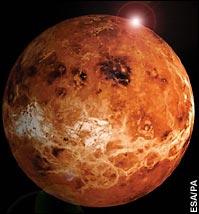
Peeping Up Venus' Dress

It's Only Natural To Probe her Secrets


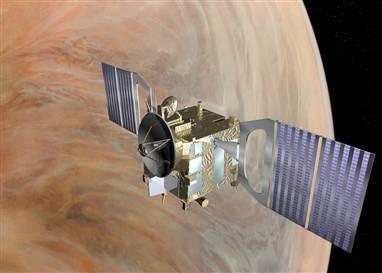
The Europeans are sending a probe into Venus for a price ticket of US$240Million.


One of the mysteries the mission is trying to solve is why Venus is so hot. Advanced instruments onboard will peer beneath the thick cloudy atmosphere to find out if volcanoes are to blame. Venus Express will also explore the giant hurricanes that sweep the planet’s surface.

A British-build magnetometer will look at the interaction between the planet’s weak magnetic field and the solar wind, a torrent of electrically charged particles that stream from the sun.

Imperial College space scientist Chris Carr said Earth's magnetic field deflects solar-wind particles so that they don't "cause us any trouble to speak of."

"If you’re at Venus, you have no protecting magnetic field, and this million-mile-an-hour stream of ionization radiation slams straight into the upper atmosphere of the planet,” Carr told reporters.

Understanding this interaction could be of more than just academic interest. Some scientists warn that future climate change could make Earth more like Venus.

“We’re struggling to understand the Earth’s climate, and in particular how it will change," Taylor said. "And it is in fact changing in the direction towards being more like Venus, more CO2 (carbon dioxide) in the atmosphere, higher temperatures. I’m not saying the Earth will ever become as extreme as Venus, but it’s moving in that direction."

The results of the Venus Express mission could "help us to plan our own future and understand it," Taylor said, and perhaps even suggest new ways to avoid the worst-case scenarios for climate change.

The way I see it, she's hot because she's a babe... err... maybe not. Just kidding :)


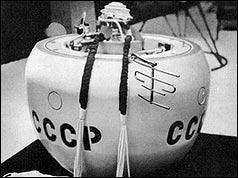
Of course, the Russians have sent a probe to Venus in the mighty Soviet days:


After its four-month journey from Earth, Venera 4 plunged through the planet's dense cloud cover and down towards the surface.

Almost immediately it began sending back coded bleeps carrying details of the gases that make up the air around Venus, as well as readings for temperatures and pressure.

It is the first time any measurements have been taken from inside the planet's atmosphere.

The Soviet Union had hoped to attempt a "soft" landing on the surface of Venus, and Venera 4 carried equipment designed to allow communications even while submerged beneath any oceans which it was suspected there might be on the surface.

But contact was lost 94 minutes after the probe entered the atmosphere, when it would still have been about 15 miles (25 km) above the planet itself.

Space cooperation

The signals sent back from Venera 4 were picked up by the radio telescope at Jodrell Bank in Cheshire.

The observatory was invited to take part in the mission to Venus by the Soviet Academy of Scientists.

The director of Jodrell Bank, Professor Sir Bernard Lovell, said the radio signals sent back from Venera 4 confirmed that it was unlikely and almost impossible that there was life on the planet.

At a news conference, Professor Lovell said Jodrell Bank was delighted to help the Soviet Union in tracking the spacecraft.

"This appears ... as a rational common-sense attitude, the sort of thing one always hopes will emerge in these colossal, expensive space enterprises," he said.

Venera 4 is the first successful attempt to reach Venus after three failed Soviet missions.

Venera 3 came closest, and successfully reached the planet, but communications had already failed, making the mission a failure.

Within the next few days, the American spacecraft Mariner 5 is also expected to arrive at Venus.

It is not, however, planning to attempt a landing, but will fly past at about 2,500 miles (4,000 km) from the planet while instruments on board measure the atmosphere and magnetic fields.

A previous American mission, Mariner 2, was the first to fly by Venus and scan its features in December 1962.

Data sent back from that mission suggested that Venus has hot surface temperatures and an atmosphere dominated by carbon dioxide.


The word is that knowing Venus could help with understanding our own issues of Global Warming:


Scientists involved in the £140m mission said that studying the extreme environment of Venus, which has been called Earth's "evil twin", will help climate researchers to make better predictions about global warming caused by changes to our own atmosphere.

Venus, the second planet from the Sun and the closest neighbour to Earth, is one of the least understood bodies in the solar system, primarily because it is shrouded in dense, impenetrable clouds of sulphuric acid. Venus was formed at the same time as the Earth and from the same sort of material. It is also about the same size, mass and density. However, Venus is a searing hot place with average temperatures hovering around 464C, about 400C higher than they should be because an intense Venusian greenhouse effect traps the Sun's energy before it can be reflected from the planet's surface back into space.

Professor Fred Taylor of Oxford University, who first proposed the mission to Venus, said that Venus had long been an object of fascination and mythology. "The human race has been studying Venus since the beginning of time because it's far the brightest object in the sky," he said.

Yet despite the many reasons for believing that Venus is the twin planet of Earth, scientists are still not sure about the precise reasons why the two planets differ so widely in their respective greenhouse effects.

And so it goes.

Shenzhou 6 Returns


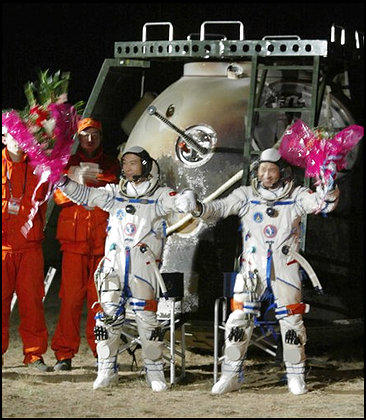
Here's another update on the Kettle and the chinese guys with 'the right stuff'. We salute you!


This photo released by China's Xinhua News Agency shows Chinese astronauts Fei Junlong, left, and Nie Haisheng hold flowers in front of the re-entry capsule of China's second manned spacecraft, Shenzhou 6, after landing in Siziwang Banner County, north China's Inner Mongolia Autonomous Region Monday, Oct. 17, 2005. The space capsule carrying two Chinese astronauts landed by parachute in the country's northern grasslands before dawn Monday following a five-day mission meant to affirm China's status as an emerging space power. Astronauts Fei and Nie were "in good health" and "feeling good" after their Shenzhou 6 capsule touched down at 4:32 a.m. (2032 GMT) in the Inner Mongolia region, the official Xinhua News Agency said. (AP Photo/Xinhua, Zhao Jianwei)


So, the second manned Chinese space mission returned safely to Earth.
Here's a section from the AP Report.


BEIJING Oct 17, 2005 — An elated public celebrated the successful landing Monday of China's second manned space flight, a feat that a senior Chinese leader declared a victory for the Communist Party and a boost to the country's status as a space power.

The pre-dawn landing of the Shenzhou 6 capsule on the country's northern grasslands was shown live on television as part of a propaganda effort meant to rouse support for the ruling party.

Scenes of astronauts Fei Junlong and Nie Haisheng emerging smiling and waving were shown throughout the day on television, sparking an outpouring of patriotic excitement about China's growing technological might.

"It's really incredible and we're all filled with pride," said Li Guoqiang, a Shanghai electrician. "It's about developing and expressing our national strength."

Fei and Nie were flown to Beijing, where they received a hero's welcome, riding in an open car in a parade past thousands of cheering soldiers at a military base.

State television showed residents of Fei's hometown of Kunshan, west of Shanghai, setting off firecrackers and weeping with joy.

"This will further improve the country's international status and national strength, and will help to mobilize its people to rally around the Communist Party and work harder for the future of the country," said Wu Bangguo, the party's No. 2 leader, who watched the landing at a Beijing control center.

Far out. It's already China. How much more international status and national strength does this nation need? :)


"Today, every son of the Yellow Emperor feels very proud," said Shanghai furniture salesman Zhang Jinhua, 34, referring to the legendary founder of the Chinese nation.

Communist leaders hope that such sentiment will shore up their standing at a time of public frustration with corruption, wrenching economic change and a growing gap between rich and poor.

Shenzhou 6 flew 2 million miles in 115 hours, 32 minutes in space, Xinhua said. The mission was far longer and more complex than the 2003 flight, when astronaut Yang Liwei orbited for 21 1/2 hours.

The flight cost some $110 million, Tang said.

The government says the manned space program has cost a total of $2.3 billion _ a fraction of the budget of its American counterpart.

The government says it wants to land an unmanned probe on the moon by 2010 and send up an orbiting laboratory.

China has had a rocketry program since the 1950s and launched its first satellite in 1970. The manned space program began in 1992.

The Shenzhou 6 is a modified version of Russia's Soyuz capsule. China also bought Russian technology for spacesuits, life-support systems and other equipment. But space officials say all the items launched into orbit were Chinese-made.

And so it goes.

Wednesday, October 12, 2005

More Fun Than You Can Wave A Bat At

Chinese Rocket Launch


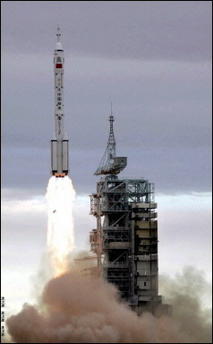
China has launched another manned mission.


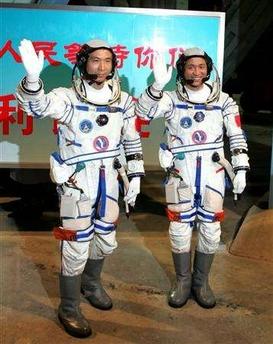
Shenzhou VI, based on Soviet Soyuz technology, lifted off on a Long March 2F carrier rocket from Jiuquan Satellite Launch Center at 9:00 am (0100 GMT) for a five-day mission carrying air force pilots Fei Junlong and Nie Haisheng.

It entered a fixed orbit 21 minutes later.

Having two crew on board is a departure from October 2003, when Yang Liwei spent 21 hours on a solo odyssey -- a mission that made China only the third country after the United States and former Soviet Union to send a man into space.

"I feel good," said Fei in his first transmission from the craft.

Fei, 40, and Nie, 41, were seen off by Premier Wen Jiabao, who was at the launch pad to drum up nationalistic sentiment, saying he believed "the astronauts will accomplish the glorious and sacred mission".

"The entire nation has waited, the entire world is watching the success of the Shenzhou VI manned space launch," he said, adding that the "great achievement" would go down "in the annals of the history of the Chinese people".

Amid some concern that China could use space for military purposes, Wen said this was not the case.

"China's entering into the scientific experiment of space flight is entirely for peaceful purposes and is a contribution towards the human race's works in promoting science and peace," he said


Yes, promoting science and peace through rocket launches. Good. We may as well take that at face-value.
There's also this Reuters Report:


BEIJING (Reuters) - China's second manned spacecraft blasted off from a remote northwestern launch site on Wednesday, two years after the country joined an elite club of space powers.

Astronauts Fei Junlong, 40, and Nie Haisheng, 41, both colonels in the People's Liberation Army, were handpicked from 14 fighter pilots and had been in the running for China's first manned space launch in 2003.

"There is nothing to worry about," state television quoted the pair as saying before Shenzhou VI lifted off as a light snow fell. "We will accomplish the mission resolutely. See you in Beijing."

"I feel good," Fei, a native of China's richest city, Kunshan, said minutes after the blast-off from the Jiuquan Satellite Launch Center, deep in the desert of the northwestern province of Gansu.

State television broadcast the lift-off live and showed the pair inside the Shenzhou capsule waving at the camera after the spacecraft entered orbit.

The capsule, based on the Russian Soyuz spacecraft developed in the late 1960s and is still in service, is due to touch down in the remote northern region of Inner Mongolia on Monday.

The launch came just a day after the Communist Party wrapped up a key meeting to map out the development of the world's seventh-largest economy for the next five years. It also came as China opens its 10th National Games, dubbed its mini-OlympicGames, ahead of the Beijing Olympics in 2008.

An elated Premier Wen Jiabao and other leaders were in Jiuquan to witness the launch.

"You will once again show that the Chinese people have the will, confidence and capability to mount scientific peaks ceaselessly," the official Xinhua news agency quoted Wen as telling the astronauts.

China had stressed on Tuesday that its space program was peaceful and it did not want to enter any arms race in space.

SPACE COWBOY

In the Chinese capital, President Hu Jintao and Vice President Zeng Qinghong watched the lift-off at the Beijing Aerospace Command and Control Center.

China is determined to become a serious space player and set up a National Astronaut Training Center in Beijing this week. Xinhua said it was only the third such facility in the world.

"We should never slacken our efforts to explore the mystery of space," Nie, described by Xinhua as a "cowboy," said.

State television has been filled with images of spacecraft and astronauts for the past few days.

China's first man in space was Colonel Yang Liwei, who orbited Earth 14 times aboard Shenzhou V craft in October 2003.

Underlining how far China has to catch up space powers Russia and the United States, a Russian capsule carrying a cosmonaut, a U.S. astronaut and an American space tourist returned to Earth on Tuesday from the International Space Station.

The former Soviet Union and the United States put their first men into space in 1961.

China has had a long -- if not always successful -- relationship with space travel.

The country invented gunpowder and legend has it that a Ming dynasty (1368-1644) official named Wan Hu attempted the world's first space launch. He strapped himself to a chair with kites in each hand as 47 servants lit 47 gunpowder-packed bamboo tubes tied to the seat.

When the smoke had cleared, Wan was apparently found to have been obliterated.

But the dream survived.

(Additional reporting by Guo Shipeng and Judy Hua)

Et cetera, et cetera.

Russian Craft Goes Missing
It turns out that while I've been away watching the playoffs, the Russian Mini-shuttle a.k.a. The Demonstrator went missing.


The Demonstrator spacecraft — designed to carry cargo and passengers from the international space station to Earth — was launched from the submarine Borisoglebsk in the Barents Sea on Friday and was reported to have descended toward its target on time.

Russian news agencies and television, however, later reported that engineers had no communication with the craft and had to call off the search at nightfall.

Officials were not immediately available for comment Saturday.

On Saturday, the Borisoglebsk also conducted a successful test firing of a ballistic missile, hitting a target on Kamchatka, the Defense Ministry said. The Barents Sea is a section of the Arctic Ocean northwest of Russia and north of Norway.

The Demonstrator is intended to be folded up and transported to the international space station on a Russian Progress cargo ship and will be used to bring payloads back to Earth, designers say.

The ship's collapsible, cone-shaped body is made of light material that can withstand high temperatures and it can fly on a predictable trajectory without engines — making it a cheap alternative to the Soyuz spacecraft currently in use.

It was built on contract for the European Space Agency and the European Aeronautic Defence & Space Co., Interfax said.

Sorrt of reminds me of that Thomas Dolby song, 'One Of Our Submarines'.
That wasn't the only launch that went awry for the Russians this week. There was also this launch


MOSCOW - A European Space Agency satellite that was to have collected data on polar ice broke up in flight after being launched on a converted ballistic missile, a Russian space agency official said Saturday.

Remnants of the satellite crashed into the ocean, Vyacheslav Davidenko, a spokesman for the Russian Federal Space Agency, told The Associated Press.

The loss of the CryoSat satellite is a major blow to the agency, which had hoped to conduct a three-year mapping of polar sea ice and provide more reliable data for the study of global warming.

The incident also damaged the reputation of the Russian space agency, which is aggressively trying to move into the commercial satellite launch business. German news reports said the satellite cost an estimated $210 million.

The problem appeared to be with the booster rocket that was supposed to lift the CryoSat unit into orbit, Davidenko said.

"The booster unit did not switch on and it resulted in the failure of the satellite to reach orbit," he said. "The remnants of the satellite have fallen into the northern Arctic Ocean."

"According to preliminary information, it was not a failure of the Space Forces, but the malfunction of the apparatus, which failed in bringing the satellite to orbit," Davidenko said.

Davidenko said the head of the Khrunichev production company, which manufactured the booster unit, apologized to ESA officials for the failure.

Engineers lost contact with the Russian rocket and the satellite some two hours after it blasted off from Russia's northern Plesetsk launch facility at about 7:02 p.m. local time, said Franco Bonacina, a spokesman for the European Space Agency.

He said the satellite was supposed to reach orbit at around 8:30 p.m. — about 1 1/2 hours after launch — but by 8:50 p.m., Russian and European flight controllers had had no contact with it.

"We're trying to figure out exactly what happened," he told the AP by telephone from Plesetsk.

Vikor Remichevsky, deputy director of the Federal Space Agency, was quoted by the ITAR-Tass news agency as saying that there had been "a failure of the navigation system."

The satellite was supposed to spend three years surveying polar ice to help scientists gain a new understanding of global warming.

Equipped with radar altimeters, it was to assess the miles-thick ice sheets that cover Greenland and the Antarctic land mass and the comparatively thin sea ice in the polar regions.

Previous satellites have been able to assess only sea ice.

So the Russian space agency is putting a halt on such launches.

Japan's Mission Problems
In a week of all sorts of launch problems and whatnot (you'd think it was a little bit like erectile problem), here's this news that says the Japanese Space Agency is struggling with their Asteroid Sample-return mission.


PARIS -- Japan's Hayabusa asteroid sample-return spacecraft has lost the use of a second reaction wheel, forcing increased reliance on its chemical-propellant thrusters for attitude control and raising questions about whether it can make its planned asteroid touchdown in November, Japan's Institute of Space and Astronautical Science (ISAS) announced Oct. 4.

Hayabusa, known as MUSES-C before its May 2003 launch, remains in a stable position 6.8 kilometers from its target, the Itokawa asteroid, now 305.9 million kilometers from Earth. Using two reaction control systems with the remaining reaction wheel, the probe is scheduled to continue scouting possible landing sites on Itokawa in the coming weeks.

ISAS said part of the mission -- to take high-resolution pictures of the asteroid -- almost is completed. The mission also has validated the performance of the on-board optical navigation camera, according to ISAS.

Hayabusa ground controllers must now alter their mission profile to conserve fuel burned by the unanticipated use of the reaction control system. The first reaction wheel failed in July. The most recent failure occurred late Oct. 2 Japan Standard Time.

If the original mission scenario is maintained, Hayabusa in November will perform what ISAS calls "touch and go" maneuvers -- briefly landing on the asteroid, scooping up small samples and then taking off -- before beginning its return voyage to Earth, with the samples, in December. Its arrival is scheduled for June 2007.


That doesn't sound too good.

Friday, October 07, 2005

Russian Space Shuttle


Folly, Or Not?
The Russians have test launched their own version of a "mini-shuttle", according to AP reports:


MOSCOW - Russia on Friday successfully test-launched a mini-shuttle spacecraft on a sea-based ballistic missile, Russian news agencies reported.

The Demonstrator spacecraft, which was launched on a converted Volna booster rocket from the Borisoglebsk nuclear submarine in the Barents Sea, landed in the Kura test range on Russia's Far East Kamchatka Peninsula.

The spacecraft is to be folded up and transported to the international space station on a Russian cargo ship, and is to be used to bring cargoes back to earth, the ITAR-Tass news agency reported. It was built on contract for the European Space Agency and the German firm EADS ST, the Interfax news agency said.

Three previous launches failed, ITAR-Tass said, but this time the Demonstrator launched successfully.

"The unfolding and inflating system worked successfully in space, the heat protection did not let the craft down in the dense layers of the atmosphere," ITAR-Tass quoted the Russian space agency as saying.


Here's more


RIA Novosti reported that telemetric data indicated that Demonstrator 2 successfully entered orbit and later re-entered the Earth's atmosphere. Data obtained during the test flight will be used to develop a new generation of descent modules. This test model is not reusable, although future mini-shuttles are planned to be reusable. The 146 kg (322 lbm) mini-shuttle is 0.8 meters (2.6 ft) in diameter when folded. The Babakin Science Research Center developed the mini-shuttle. The mini-shuttle began development as part of the "Mars 96" project which was later cancelled due to budget cuts.

The sub-orbital launch was made from the Barents Sea by the submerged K-44 Ryazan submarine, with the shuttle attached to Volna (Wave) which is based on an earlier RSM-50 ICBM (NATO designation SS-N-18).

Well, if it's working, it's working. Why is that one working and not the American one?

Wednesday, October 05, 2005

Ig Nobel Prize

These are funny every year.
Here's a link to the news version


Abrahams created the Ig Nobels in 1991 when, as the editor of a science magazine, he found himself inundated with requests for advice on how to garner a real Nobel prize from scientists whose work had taken them far from the scientific mainstream.

"Some of them had done things that were really staggering," Abrahams said. "It made you laugh and then it made you think, and from the beginning that's what this has been about."

Two physics and two chemistry Nobel laureates will be among the presenters of 10 Ig Nobels awarded in such fields as medicine, physics, chemistry and biology, with the identities of the winners a closely-guarded secret in the best traditions of the Nobel Academy in Stockholm.

Abrahams would only divulge that the 2005 laureates came from "slightly more" than four continents. "I can't explain that right now," he added.

There is also an Ig Nobel Peace Prize, won last year by Daisuke Inoue, the Japanese inventor of karaoke who was cited for "providing an entirely new way for people to learn to tolerate each other."

The Ig Nobel board of governors -- "a shadowy group," according to Abrahams -- trawls through 5,000 nominations every year.

The winners are discretely contacted beforehand to give them an opportunity to decline. It is a testament to the growing prestige of the event that very few turn down the offer and agree to attend at their own expense.

Acceptance speeches have a one-minute time limit, strictly enforced by a pre-teenage mistress of ceremonies who, when she feels the recipient has said enough, approaches the lectern and repeatedly shouts "Please stop, I'm bored" until they comply.

"Simple, but believe me it works," said Abrahams. "Nobody has ever been able to withstand that."

During the entire proceedings the audience traditionally peppers the stage with paper aeroplanes.

For the past four years, the task of sweeping the planes off the stage was happily undertaken by Roy Glauber, a professor of physics at Harvard. On Tuesday, Glauber was awarded the Nobel Prize in Physics for his work on quantum optics.

"It gives people in the science world a chance to cut loose, relax and enjoy themselves," said Abrahams. "For everyone else, it's a chance for one evening to be part of that world and get exposed to some subjects and ideas you might never run across."

Previous winners include doctors James Nolan, Thomas Stillwell and John Sands who shared the 1993 Ig for Medicine for their painstakingly researched study: "Acute Management of the Zipper Entrapped Penis."

And Dr. Mara Sidoli of Washington D.C. was honoured with a Literature Ig in 1998 for her pioneering essay published in the Journal of Analytical Psychology: "Farting as a Defence Against Unspeakable Dread."

It takes all kinds.

The Winner Is
Fake dog testicle creator Greg Miller


What started 10 years ago with an experiment on an unwitting Rottweiler named Max has turned into a thriving mail-order business. And on Thursday night Miller's efforts earned him a dubious yet strangely coveted honor: the Ig Nobel Prize for medicine.

"Considering my parents thought I was an idiot when I was a kid, this is a great honor," he said. "I wish they were alive to see it."

The Ig Nobels, given at Harvard University by Annals of Improbable Research magazine, celebrate the humorous, creative and odd side of science.

Miller has sold more than 150,000 of his Neuticles, more than doubling his $500,000 investment. The silicone implants come in different sizes, shapes, weights and degrees of firmness.

The product's Web site says Neuticles allow a pet "to retain his natural look" and "self esteem."

Although the Ig Nobels are not exactly prestigious, many recipients are, like Miller, happy to win.

"Most scientists - no matter what they're doing, good or bad - never get any attention at all," said Marc Abrahams, editor of the Annals of Improbable Research.

Some, like Benjamin Smith of the University of Adelaide in Australia, who won the biology prize, actually nominated their own work. "I've been a fan of the Ig Nobels for a while," he said.

Smith's team studied and catalogued different scents emitted by more than 100 species of frogs under stress. Some smelled like cashews, while others smelled like licorice, mint or rotting fish.

He recalled getting strange looks when he'd show up at zoos asking to smell the frogs. "I've been turned away at the gate," he said.

This year's other Ig Nobel winners include:

_ PHYSICS: Since 1927, researchers at the University of Queensland in Australia have been tracking a glob of congealed black tar as it drips through a funnel - at a rate of one drop every nine years.

_ PEACE: Two researchers at Newcastle University in England monitored the brain activity of locusts as they watched clips from the movie "Star Wars."

_ CHEMISTRY: An experiment at the University of Minnesota was designed to prove whether people can swim faster or slower in syrup than in water.

The Ig Nobel for literature went to the Nigerians who introduced millions of e-mail users to a "cast of rich characters ... each of whom requires just a small amount of expense money so as to obtain access to the great wealth to which they are entitled."

Life goes on.