Monday, July 17, 2006

Shuttle Lands Safelly


The Space Shuttle Discovery landed safely.
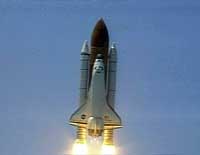
Discovery landed at Kennedy Space Center at 9:14 a.m. in only the second shuttle flight since the 2003 Columbia disaster killed seven astronauts.
"Welcome back, Discovery, and congratulations on a great mission," Mission Control told shuttle commander Steven Lindsey after Discovery rolled to a stop.

"It was a great mission, a really great mission, and enjoyed the entry and the landing," Lindsey replied.

The smooth landing was sure to leave NASA officials jubilant, after conquering the chronic threat of foam chunks that break off the external fuel tank during launch - still a problem, but not a serious one in this mission.

The shuttle came in from the south, swooping over the Pacific, Yucatan Peninsula, Gulf of Mexico and across Florida to cap a 5.3-million-mile journey that began on the Fourth of July.

A last-minute buildup of clouds led NASA to switch the shuttle's direction for landing. By the time Discovery approached, it was so cloudy, Lindsey couldn't spot the runway until about a minute before landing.

A couple of minutes out, NASA made a racket to keep birds out of the way of the approaching spacecraft. Car horns blared, and the sound of gunshots and firecrackers erupted.

At touchdown, shouts and whistles came from the few hundred astronauts' relatives and space center workers at the runway. "It's exciting to see the shuttle back," said astronaut Scott Kelly, the identical twin brother of Discovery's co-pilot, Mark Kelly.

"We're back on track with maybe flying the shuttle regularly here starting again in August."

Atlantis is up next with a crew poised to carry out assembly of the international space station, a task put on the back burner after Columbia.
I guess that's what really counts. Compared to last time, it was a lot less scary.

Hotel Orbitalia? Hotel Balloonia?


A private consortium is trying to build an inflatable object to float up to Low Earth Orbit. It's a going to be a hotel. Here's the article.
Bigelow Aerospace’s Genesis 1 module activated its compressed air tanks to inflate the skin as planned, and is now sending back low-res photos to earth.

The concept of an inflatable craft was conceived by Nasa in the 60s, and is much cheaper than standard spaceships as it takes up less room on the launch vehicle.

The only inhabitants of the 15ft by 8ft module are cockroaches, but the company is planning two more missions over the next year and believes a full-sized version for humans could be ready by 2010.

Fears that a giant bouncy castle might be a little prone to being punctured by space debris are apparently unfounded – the walls contain Kevlar, which is used in bullet proof vests, and the internal temperature is said to be a pleasant 26 degrees.

Founder Robert Bigelow is also trying to stoke up competition by launching ‘America’s Space Prize’, which is offering $50 million to any US company that can create a craft that can take 5 people into space. Looks like long weekends in space might be on the cards soon.
Clearly, the space race has now been privatised.

Battery Operated

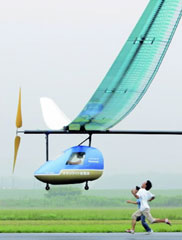
This is a battery operated aircraft. That's right.
This aircraft flew 59 seconds for 391m using 160 A batteries, recording a maximum altitude of 5,2m. It spans 31m, and weighs 54kg. It was flown by Tomohiro Kamiya of Tokyo as part of a University project.
The craft was sponsored by Matsushita Electric, othrwise known to us as Panasonic. I guess they brought the batteries.

Thursday, July 13, 2006

Fangaroo


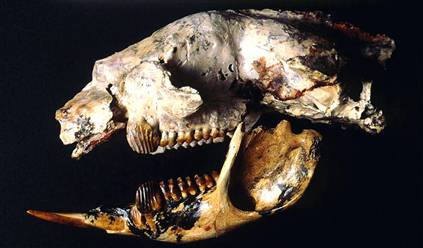
Scientists have made some interesting discoveries regarding pre-historic marsupials.
SYDNEY, Australia - Forget cute, cuddly marsupials. Paleontologists say they have found the fossilized remains of a fanged killer kangaroo and what they describe as a "demon duck of doom."

A University of New South Wales team said the fearsome fossils were among 20 previously unknown species uncovered at a site in Australia's northwest Queensland state.

Professor Michael Archer said Wednesday that the remains of a meat-eating kangaroo with wolflike fangs were found, as well as a galloping kangaroo with long forearms that could not hop like a modern kangaroo.

"Because they didn't hop, these were galloping kangaroos, with big, powerful forelimbs. Some of them had long canines (fangs) like wolves," Archer told Australian Broadcasting Corp. radio.

Vertebrate paleontologist Sue Hand said modern kangaroos look almost nothing like their ferocious forebears, which lived between 10 million and 20 million years ago.

The species found at the dig had "well muscled-in teeth, not for grazing. These things had slicing crests that could have crunched through bone and sliced off flesh," Hand said.

The team also found prehistoric lungfish and large ducklike birds.

"Very big birds ... more like ducks, earned the name 'demon duck of doom', some at least may have been carnivorous as well," Hand told ABC radio.

Archer said the team was studying the fossils to better understand how they were affected by changing climates in the Miocene epoch between 5 million and 24 million years ago.
The Demon Duck of Doom. Now I know what my nightmares have been about all these years. :)

Monday, July 10, 2006

Not A Good Outcome


Like I said some months before: Launching rockets is difficult stuff to do.
The INSAT-4c went up in smoke as GSLV FO2 rocket veered off course and exploded 60seconds after lift-off.


SRIHARIKOTA (AP), JULY 10:A day after the Agni-III ballistic missile failed to meet test expectations, India’s space programme took a knocking when the Geosynchronous Satellite Launch Vehicle (GSLV FO2), carrying the INSAT-4C communication satellite, veered off course and exploded 60 seconds after lift-off.
The three-stage rocket burst into flames during the first stage operation, a minute after lift-off at 5.38 pm from the Satish Dhawan Space Centre in Sriharikota, some 80 km from Chennai.

The failure of the Rs 256 crore-mission was being attributed to pressure in one of the four strap-on motors dropping to zero in the first stage operation, causing the GSLV to “deviate slightly” from the designed trajectory.

“This is one of the rarest phenomena and could be due to a problem in one of the strap-ons which led to the mission’s failure,” said a crestfallen G Madhavan Nair, ISRO chairman, while briefing the media after the launch mishap.

“The problem developed in the course of the first stage. After the deviation, we gave the ‘Destruct’ command because we had to safeguard locals,” he said, adding that the debris had fallen into the sea.

“A quick look at the preliminary findings show that of the four strap-on motors, pressure in one of them dropped to zero. The other three functioned normally,” said Madhavan Nair. This caused the deviation in the trajectory. While four degrees of angular error was within the normal limit, the vehicle went off the path by 10 degrees.

"Until 60 seconds, we received huge data on the telemetry. But it has to be analysed and this process has been initiated. We will know what exactly caused the failure in the next few days,” he said.
According to the ISRO chief, work on another INSAT-4 satellite was on and “we will have a successful launch within a year”. This would be a heavier satellite and would be launched from Kourou in French Guiana.
It's not an easy road ahead.

Sunday, July 09, 2006

The Weekend Dumpdown

INSAT-4C Satellite


The Indian Space programme is about to launch its rocket GSLV with the INSAT 4C satellite from Satish Dhawan Space Centre.
This is the first launch of GSLV from the state-of-the-art Second Launch Pad (SLP) at SDSC. SLP, which was commissioned in May 2005 with the successful launch of PSLV-C6 is designed to reduce the occupancy time for the integration and launch.

The GSLV would lift off with the 2168 kg INSAT-4C, the heaviest in its class, at 4 30 pm tomorrow, Indian Space Research Organisation (ISRO) chairman G Madhavan Nair said.

The 49-metre-tall, 414 tonne GSLV is a three stage vehicle. The first stage, GS1, comprises a core motor with 138 tonne of solid propellants and four strap-on motors, each with 42 tonnes of hypergolic liquid propellant. The second stage has 39 tonne of the same hypergolic liquid propellant. The third (GS3) is a cryogenic stage with 12.6 tonne of liquid oxygen (LOX) and liquid hydrogen (LH2). INSAT 4C, the second satellite in the INSAT 4 series, would give a boost to Direct-to-Home television services, video picture transmission and digital satellite news gathering. It will also provide space for National Informatics Centre's VSAT connectivity.
Call me 'rocket boy' but this is exciting. We wish them godspeeed.

Space Walking


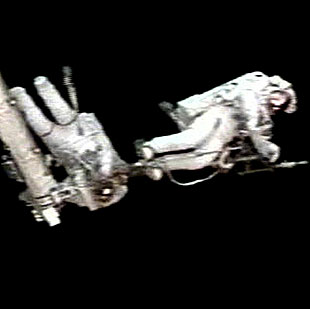
The shuttle crew did a space walk to make certain there were no significant damages to the shuttle.
British-born astronaut Piers Sellers and American Michael Fossum took turns strapping their feet on to a small platform and dangling from the end of a 30m boom that would allow astronauts to reach every part of a shuttle.

"It's like being in a very slow elevator," Sellers radioed to ground controllers as he rode atop the end of the boom, which is a combination of the Space Shuttle Discovery's 15m robot arm and a 15m extension.

The exercise, performed at 28,000km/h, 357km above the Earth, was part of NASA's efforts to recover from the 2003 Columbia disaster and make certain there were options for repairing a damaged shuttle before it returned into the atmosphere. Seven astronauts on Columbia in 2003 died without knowing their shuttle was critically damaged when insulation foam fell off during liftoff. The vessel broke apart over Texas as it returned to Earth. "Hopefully, we never have to use it but we have the capability if we ever need to," flight director Tony Ceccacci said after the boom test.
It seems the sshuttle is a-okay for the return. This is much better than the last effort.
The last re-entry scared the bejesus out of me.

Hayabusa Debrief


Sorry this one's in Japanese, but it's from he JAXA symposium. The salient point is that the asteroid-visiting Hayabusa mission was given better and fairer coverage overseas than in Japan.
サイエンスに、感謝されたはやぶさプロジェクト
 「はやぶさ」の評価は日本よりも、海外の方が高かったと、山根氏が「サイエンス」誌の最新号を壇上で掲げながら、川口プロジェクトマネージャーと、話を始めた。サイエンスの編集長は、はやぶさプロジェクトの偉業をたたえるとともに、小惑星の地質の情報が分かったことで、地球に小惑星がぶつかる可能性があるとき、それを避けるための実際の情報として使えると、感謝の意を表している。アメリカや、ヨーロッパでは、恐竜を滅ぼした原因と言われる小惑星の地球への衝突に対して、真剣に回避を考えている組織がある。

 サイエンスが日本の探査機の成果を大々的に取り上げるのも異例なら、その成果に対して感謝の意を表するのも大変異例のことであり、日本の研究技術レベルに大きな誇りを感じると、山根氏が感激気味に話した。

なぜ意味があるのか
 地球−太陽−いとかわの距離はほぼ等しいが、なぜそんなところにいって、サンプルを持ち帰る意味があるのかを、川口氏が話した。だれも着陸したことがない、火星より遠い小惑星いとかわに着陸し、かえってくることも大きな意味を持つが、地球や、太陽系のできたころの姿が、保存されている。小惑星のサンプルを持ち帰ることができれば、地球の火山活動でマントルから出てきた、かんらん石などの成分と、比べることで実証できる。

 はやぶさは、いとかわの地面に、弾丸を打ち込んで、サンプルを吸い上げる実験には失敗したが、弾丸を打ち出す部屋は3つあり、弾丸も3つ。ひとつ打つごとに部屋が回転して、サンプルを吸い込む仕組みになっている。はやぶさが地面に着いたとき塵が舞い上がったりして、それがサンプルの取り込み口から自然に入る可能性もある。アメリカのスターダスト計画が、今年彗星の尻尾から持ち帰ったサンプルは、ミクロンオーダーだが大変貴重な情報になった。はやぶさにも、ほこり程度でも入っていれば、大変な成果だと思う。
The projected recovery of the asteroid sample will be in 2010.

Wednesday, July 05, 2006

Shuttle Launch On Independence Day 2006


NASA says the shuttle launch is a success.
The Space Shuttle Discovery and its crew of seven astronauts have blasted into orbit on NASA's first launch in a year. The lift-off went ahead despite objections from some within NASA who argued for more fuel tank repairs. Discovery finally cleared the tower after two weather delays and last-minute problems with the insulation foam.

Problems with fuel tank insulation were what doomed the shuttle Columbia and her crew in 2003. A piece of foam the same size as a slice of bread could be seen falling off Discovery during the launch. But experts said it was too small to pose a safety risk.

Discovery is aiming to link up with the International Space Station. But commentators say if anything goes wrong with the mission, it could mean the end of the Shuttle programme, and George W. Bush's plans for further exploration of the Moon and Mars could be in jeopardy.
The modified fuel tank went well, apparently.
"I think the tank performed very, very well indeed," said Wayne Hale, NASA’s space shuttle manager during an evening press briefing here at the Kennedy Space Center (KSC). "We saw nothing that gives us any kind of concern about the health of the crew of the vehicle."

Hale’s comments came after a quick first-look at imagery of Discovery’s launch, arrival in orbit and the jettison of its external tank after the spacecraft and its seven-astronaut STS-121 crew launched into space on July 4 at 2:37:55 p.m. EDT (1837:55 GMT).

During that cursory look at a veritable flood of images, video and radar data, shuttle analysts found seven instances – of which five are related to fuel tank foam debris – of objects falling from Discovery’s launch stack.

"We put the tank under a microscope this time," Hale said. "It did not perform flawlessly, in that we lost some foam off the tank apparently."
Although the Telegraph in the UK is reporting this:
America's accident-prone space programme hit more trouble yesterday when the shuttle Discovery shed several chunks of foam insulation shortly after take-off from Cape Canaveral in Florida.

Nasa said a number of pieces fell from the external fuel tank during the launch but insisted that by then the shuttle and its crew of seven were beyond the point in its flight where the debris could pose a hazard.

"This isn't too abnormal," said Bill Gerstenmaier, the associate administrator for spaceflight. "We fully expected to lose some foam."

Engineers maintained that the flyaway debris was expected to be small and any damage it may have caused would have no extreme consequence to the shuttle at the most dangerous point in its flight, its re-entry to Earth's atmosphere in 11 days.

The flight was delayed twice because of bad weather and there were further last-minute jitters over a chunk of insulation foam that fell from the fuel tank in the build-up to take-off, leaving a 4 in scar at the top of the tank.

After the broken chunk was discovered, Nasa's top engineer and chief of safety wanted to postpone Discovery's launch until the damage had been fixed.
Make of that what you will, but let's hope the whole thing keeps going well, safely.