Thursday, August 24, 2006

Pluto Demoted, And Other News

Not A Planet, Just A Dwarf Planet


You sort of wonder how this impacts the world. Pluto is no longer considered a planet, but merely a dwarf planet.
The International Astronomical Union, dramatically reversing course just a week after floating the idea of reaffirming Pluto's planethood and adding three new planets to Earth's neighborhood, downgraded the ninth rock from the sun in historic new galactic guidelines.

Powerful new telescopes, experts said, are changing the way they size up the mysteries of the solar system and beyond. But the scientists showed a soft side, waving plush toys of the Walt Disney character _ and insisting that Pluto's spirit will live on in the exciting discoveries yet to come.

"The word 'planet' and the idea of planets can be emotional because they're something we learn as children," said Richard Binzel, a professor of planetary science at the Massachusetts Institute of Technology, who helped hammer out the new definition.

"This is really all about science, which is all about getting new facts," he said. "Science has marched on. ... Many more Plutos wait to be discovered."

Pluto, a planet since 1930, got the boot because it didn't meet the new rules, which say a planet not only must orbit the sun and be large enough to assume a nearly round shape, but must "clear the neighborhood around its orbit." That disqualifies Pluto, whose oblong orbit overlaps Neptune's, downsizing the solar system to eight planets from the traditional nine.
The upside of this new is that the next time somebody says there are 9 planets in the Solar system, you can tell them they're wrong. It still doesn't escape the feeling that these astronomers are playing definitional games. Pluto, for the record has moons. I want to know how something that can have moons not be a planet, but clearly I'm not an astronomer. Maybe it's in line with the war on terror and tightening belts; we can't afford nine planets any more.

UPDATE:
Here's a cool article from the Beeb.
On Thursday, experts approved a definition of a planet that demoted Pluto to a lesser category of object.

But the lead scientist on Nasa's robotic mission to Pluto has lambasted the ruling, calling it "embarrassing".

And the chair of the committee set up to oversee agreement on a definition implied that the vote had effectively been "hijacked".

The vote took place at the International Astronomical Union's (IAU) 10-day General Assembly in Prague. The IAU has been the official naming body for astronomy since 1919.

Only 424 astronomers who remained in Prague for the last day of the meeting took part.

An initial proposal by the IAU to add three new planets to the Solar System - the asteroid Ceres, Pluto's moon Charon and the distant world known as 2003 UB313 - met with considerable opposition at the meeting. Days of heated debate followed during which four separate proposals tabled.

Eventually, the scientists adopted historic guidelines that see Pluto relegated to a secondary category of "dwarf planets".
It looks like it was more political than previously thought.

Countdown To Atlantis Flight

Here is the latest.
During the 11-day mission, three space walks are scheduled to install and activate the new segment, which has a wingspan of 240 feet. Part of the segment will allow the trusses to rotate and keep the solar panels pointed at the sun.

The Atlantis mission is the beginning of a series of flights to complete construction of the space station. In September, a new crew of astronauts - ISS Expedition 14 - is slated to take up residence on the space station, and National Aeronautics and Space Administration officials expect them to be occupied with assembly tasks, as more modules are added to the station.

Over the next six months to 18 months, astronauts will 'watch the complexity and size of the space station grow,' Melissa Owens, who is involved in managing Expedition 14, said at a NASA briefing Tuesday.

ISS construction began in 1998 and was slated for completion in 2004-05. But the explosion of the Space Shuttle Columbia in 2003 halted US space flights until last year, severely delaying construction.
So the ISS project is getting back on line. I know some people who would be very happy about that.

Rev-Head Record On Diesel
The world's fastest Diesel car maxed out at 525kph.
Another article has it at 588kph.
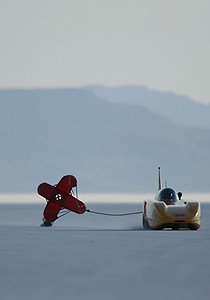

Yesterday Andy Green piloted the 9-metre machine to an FIA-sanctioned speed of 526km/h, today he shattered that record by averaging 563km/h over two passes in opposite directions within one hour.

Running soon after daybreak he recorded 588km/h on his first run and 540km/h on his return.

"It was always our ultimate goal and that was with a slow start to the second run," said Green.

"There is so much more to come as the car is pulling like a train and we still haven't used sixth gear!

"Today's record proves the potential we have always believed JCB Dieselmax to possess. This is another great result for a wonderful team and a testament to British engineering."

Boasting twin JCB444 common rail injection diesels with turbochargers and intercoolers, the JCB Dieselmax generates an impressive 560kW at 3,800 rpm.

Green is no stranger to speed. Not only is he a Royal Air Force jet pilot, but he holds the overall land speed record of 1227km/h, set in 1997 with the jet-propelled ThrustSSC car.

Wow, is the word.

Friday, August 18, 2006

Turning The Corner

The Ozone Hole
In the 1980s, the Ozone Hole was hotly debated, but eventually resulted in the Montreal Protocol. It seems it's working, but not as fast as we thought.
Over huge areas of Europe, North America and Asia in the northern hemisphere and over southern Australasia, Latin America and Africa, the layer would be back to pre-1980 levels by 2049, the agencies said.

This was five years later than forecast in the last major scientific report in 2002.

The agencies' message came in an official summary of a report by 250 scientists to be issued next year on the effects of the 1987 Montreal Protocol, which committed signatory nations progressively to ban the use of ozone-harmful products.

"The early signs that the atmosphere is healing demonstrate that the Montreal Protocol is working," said Achim Steiner, executive director of UNEP.

"But the delayed recovery is a warning that we cannot take the ozone layer for granted and must maintain and accelerate our efforts to phase out harmful chemicals," he said in a statement issued in Geneva and Nairobi.

Over Antarctica, where so-called "ozone holes" have grown over the past 30 years, recovery was likely to be delayed until 2065, 15 years later than earlier hoped.

"While these latest projections of ozone recovery are disappointing, the good news is that the level of ozone-depleting substances continues to decline from its 1992-94 peak in the troposphere and the 1990s peak in the stratosphere," said WMO secretary-general Michel Jarraud.
I take th egood news that international efforts to curb the Ozone depletion worked, and it didn't kill us to do it. Now, the challenge is on for Global Warming and Global Dimming to be tackled properly.

Thursday, August 17, 2006

What Separates Us From Chimps

108 Letters Of Destiny
This is interesting.
I'm quoting it wholus bolus because it's so interesting. My apologies to 'The Guardian'.
James Randerson, science correspondent
Thursday August 17, 2006
The Guardian

Scientists have identified perhaps the most crucial genetic region that makes us human. By comparing human DNA with that of chimpanzees and other animals they have found the region of the genome subjected to the strongest natural selection since we shared a common ancestor with chimps.
The 108-letter stretch of DNA contains two genes that appear to control brain development. The researchers speculate that the blistering pace of evolution indicates that they may have been crucial in the rapid increase in brain size and complexity that occurred in the human lineage. Our brains are three times larger than our closest relatives, the chimps.

"It's evolving incredibly rapidly," said Katherine Pollard at the University of California in Davis. "It's really an extreme case." Most of the 15m or so differences between the chimp genome and our own are random, inconsequential changes that make no difference to our appearance or abilities. To sort the interesting changes from the less influential ones, Professor Pollard looked further down the evolutionary tree to find regions of DNA that really are useful. She and her colleagues first looked for bits of the genome that are nearly identical in the mouse, rat and chimpanzee. These shared a common ancestor around 80m years ago, so the scientists reasoned that any DNA region that had not changed much in this time must be crucial for survival and that changes in its sequence would lead to problems rapidly weeded out by natural selection.

They then trawled these conserved regions for instances where the human equivalent had changed a lot. The beauty of the technique, according to experts, is that they did not have to know what the DNA was actually doing. Top of the list is a 108-letter sequence called HAR1 (Human Accelerated Region 1) which contains two genes. This region differs by just two changes between chimps and chickens, which shared a common ancestor around 310m years ago. But since humans and chimps split 5m years ago there have been 18 changes.

"There has been tremendous pressure for millions of years to keep the sequence as it was. Then something happened in our lineage," said Pierre Vanderhaueghen at the Free University of Brussels in Belgium.

He was able to get clues by adding colour labelled chemicals that would stick to the RNA product produced by the genes to slices of brain tissue from human foetuses. The brains were obtained from aborted or miscarried foetuses and were used with the consent of the mothers.

His results showed that one of the genes is expressed strongly in the developing neocortex during weeks seven to nine of pregnancy. "It's a very exciting finding because it is expressed in cells that have a fundamental role in the design and development of the mammalian cortex," said co-author David Haussler, also at the University of California.
Of course some people are in denial of evolution so they're probably in denial of their 108 letter legacy.

Atlantis Scheduled To Launch


Working On The ISS
Forgotten in the myriad problems of the Space Shuttle has been the International Space Station. They're working to rectify that.
NASA officials say they will hold two briefings next week concerning the current and next mission to the International Space Station.

Officials said the briefings will focus on the station`s ongoing Expedition 13 mission and the upcoming Expedition 14 mission, which is scheduled to be launched next month.

The briefings -- originating at NASA`s Johnson Space Center in Houston -- will be broadcast live on NASA TV, available at the space agency`s Web site. Questions from news media representatives will be taken at various NASA locations across the nation.

Participants of the Expedition 14 preflight briefing at 2 p.m. EDT Tuesday will be Kirk Shireman, deputy International Space Station program manager; Melissa Owens, Expedition 14 increment manager, and Ginger Kerrick, Expedition 14 lead flight director.

Scheduled to take part in the Expedition 13 recap briefing at 3 p.m. EDT Tuesday are Merri Sanchez, Expedition 13 increment manager; Cathy Koerner, Expedition 13 lead flight director; Julie Robinson, deputy International Space Station program scientist, and Dr. Stevan Gilmore, Expedition 13 flight surgeon.
Well, the next Atlantis flight will signal going back to business.
NASA managers on Wednesday unanimously picked Aug. 27 for the first attempt to launch the space shuttle Atlantis on a mission to resume construction of the international space station — but two precariously attached bolts securing a crucial antenna could delay those plans.

Engineers suspect that two of the bolts are too short on the KU-band antenna, which transmits images and other essential data between the space shuttle and Mission Control. They want to make sure the bolts are secure enough so that the antenna doesn't fly off while in the payload bay during a launch, which could cause catastrophic damage.

“We're not going to fly if we think there's a possibility the antenna will come off,” said NASA Administrator Michael Griffin.

Atlantis has flown with those bolts without trouble since they were first installed two decades ago. The problem was discovered last week, after Atlantis was rolled to the launch pad, when a review of paperwork on bolts on NASA's three space shuttles was ordered because a related problem was found in Discovery.
Back to hauling materials for the space truck.

Sunday, August 13, 2006

Pluto Is Not A Dog

It Might Not Ecven Be A Planet
That's according to this article.
"The pivotal question is the status of Pluto, which is clearly very different from Jupiter, Saturn, Uranus, and Neptune," Owen Gingerich, professor of Astronomy and History of Science emeritus a the Harvard-Smithsonian Center for Astrophysics told Reuters.

Debate has raged within the scientific community over the status of Pluto for decades after the planet was found to be only one four-hundredths of the mass of the earth.

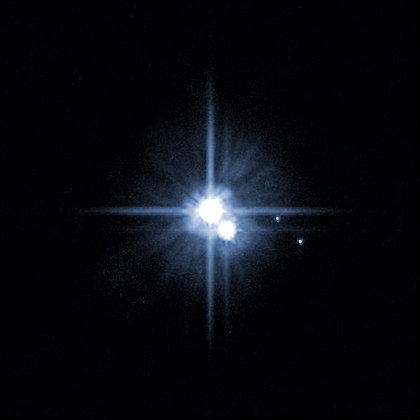
That discussion intensified in 2003 when astronomers at the California Institute of Technology discovered UB 313. Nicknamed Xena after the character in the television show, UB 313 is one of more than a dozen celestial bodies in our solar system found to be larger than Pluto.

Xena and Pluto are large icy bodies that reside in the Kuiper Belt -- where thousands of floating bodies travel -- beyond Neptune. Images from the Hubble Space Telescope put Xena's diameter at 1,490 miles or so. That is slightly bigger than Pluto, which measures 1,422 miles across.
Well more planets as opposed to fewer would be gas. Seems to be a spoilsport sort of mentation that wants to *sowngrade* Pluto from a planet to *something else without a name yet*. That's just me, though.

UPDATE:
Reuters is now reporting that the solar planet numbers may go from 9 to 12.
PRAGUE (Reuters) - The question of whether Pluto is a real planet, hotly debated by scientists for decades, came to a head on Wednesday when the global astronomers' body proposed a definition of a planet that raises their number to 12 from nine.

The definition set out by a committee of the International Astronomers Union (IAU) answers the key question: How small can a body be and still be called a planet? in a way that leaves Pluto's status intact -- but modified.

Some 2,500 astronomers and scientists from round the world, attending an IAU conference in the Czech capital, have to weigh the committee's two-part definition, on which IAU members will vote on August 24.

To be called a planet, a celestial body must be in orbit around a star while not itself being a star, and must be large enough in mass for its own gravity to pull it into a nearly spherical shape, the seven-member committee said.

The need to define, for the first time, what it takes to be a planet stems from technological advances that enable astronomers to look further into space and to measure more precisely the size of celestial bodies in our solar system.

Pluto would remain a planet but would fall into a newly created category called Plutons, which are distinguished from classical planets in that they take longer than 200 years to orbit the sun.

Pluto would be joined in this category by two other celestial bodies, Xena and LinkCharon, while another, Ceres, would be known as a dwarf planet.

In all, 12 planets would be listed in our solar system, at least for the time being.
12!
And the only thing Forbes can think of is the new wave of textbooks and toys that will make for better business.
The idea that our nine-planet solar system may soon join the obsolete world of eight-track tapes and slide rules should send science teachers, textbook writers and toymakers back to the cosmic drawing board.

"Does it make our products obsolete?" asked Kim McLynn, spokeswoman for Illinois-based Learning Resources, which makes an inflatable solar system and a Planet Quest game. "Wow, a whole new universe."

Though not approved yet, the 76-year-old lineup of the solar system's planets would grow to 12 under a proposal by leading astronomers. Their recommendation will be decided by a vote of the International Astronomical Union on Aug. 24.

For people who make their living on the old Mercury-through-Pluto system, a change in the planets means quick but welcome revisions, no matter how costly.

"This is, of course, a huge headache for publishers," said Gilbert Sewall, director of the American Textbook Council, a New York-based research institute that follows educational textbooks. Last-minute changes are expensive, but won't break any publisher, he said.

For example, Pearson Prentice Hall has science texts for next year going before California's textbook approval board and will try to get the 12-planet revision in for the state officials to review, said Julia Osborne, the publisher's science editorial director.

"It's worth it because this is such an exciting thing," Osborne said. But 2006 textbooks are already at schools, she said, so for "most students this fall it will be out of date."

Because schools keep textbooks for five to 10 years, it will be about seven years before most school books have 12 planets in them, said Osborne and Sewall.

Pity Jack Horkheimer, director of the Miami Space Transit Planetarium and host of PBS' "Star Gazer" show. His very first book, a full-length cartoon guide to naked-eye astronomy, features an entire chapter on the solar system - the nine-planet version.

It won't be out for four more weeks - after the world's astronomers are likely to open the solar system doors to three new planets: Ceres, Charon, and one nicknamed Xena to be renamed later.

"My book is out-of-date before it even hits the bookstands," Horkheimer said. "It's kind of like buying a computer. By the time you get it out of the box and get it hooked up, it's already obsolete."

At the Adler Planetarium in Chicago, the main pavilion has a model of the solar system - the sun and nine planets (Earth is the size of a softball). The planetarium will likely have to add three new planets.

"They're pretty small," said astronomy director Geza Gyuk of the proposed new planets. "Maybe we can bring in a pingpong ball and that'll do the trick."

The Adler already has a planetary anachronism. When it opened 76 years ago, plaques had already been commissioned for just eight planets. Pluto was discovered a few months laterGyuk doesn't see the Adler adding plaques for Pluto or the three proposed planets because "we just don't have space."

For the several thousand planetariums around the world, this is more exciting than difficult, said Susan Reynolds Button, president-elect of the International Planetarium Society.

"It's not a problem," Reynolds Button said. "We already have the visuals. We already have the equipment to do it. It's just a matter of presenting new data."

Reynolds Button, who used to take planetarium shows to schools, said the addition of three new planets "is a real nice juicy topic to get kids excited about."

Dan Reidy, a sixth-grade science teacher in Moultonborough, N.H., was sitting in his classroom preparing for the new school year and gazing at his model of the solar system. He usually asks his students, "What's wrong with this picture?" The correct answer is that the planet sizes and their distances from the sun are all out of proportion.

If the planet lineup changes, there will be something else wrong with his model.

Reidy will also have to figure out where to place the new planets on a large parachute-cloth solar system map that demonstrates proper size and scale, but he said it was exciting.

The race to change solar system toys more permanently is already on.

Discovery Channel Store spokeswoman Pamela Rucker predicted new 12-planet toys could be in stores in time for the Christmas season.

"We're already starting to work on 12 planets," said McLynn of Learning Resources.


The more things change...

Idiot Watch
This is tragic.
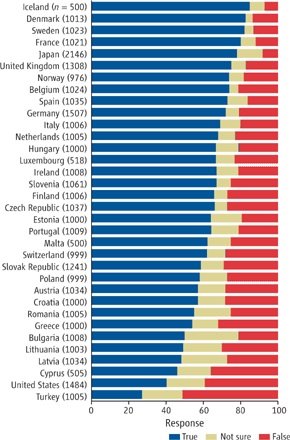
The latest issue of Science has a statistical analysis that gets into some of the whys and hows of the strange relationship the US public has with the science of evolution. The results are really best analyzed in two parts. The first compares the US's acceptance of evolution with that in 32 European countries plus Japan. The results produce the graph at right (it's part of the original article, but has been reproduced in several locations on the web already, so I'll join in). The US places next-to-last both in terms of accepting the accuracy of the theory of evolution, and in terms of considering it absolutely false. The country we're racing to the bottom is Turkey, which news reports suggest has some obvious issues with both the quality of the national education system and religious fundamentalism. Edging us out is Cyprus, which is currently partitioned as the result of a centuries-old conflict.


But within the grim figures generated by the "Yes/No/Unsure" question are some interesting subtleties. When asked whether species adapt and go extinct over millions of years in a question that did not use the term "evolution," nearly 80 percent of US respondents felt it was true; only six percent called the statement false. Which is good, until you consider that this indicates that the majority of the public must have no grasp of the concept underlying all of biology. The lack of scientific literacy also came screaming through in indications that nearly half the respondents had no idea about the degree to which humans share DNA sequences with other mammals, and half were either unsure or wrong about whether early humans shared the planet with dinosaurs. The high degree of uncertainty probably explains why at least two percent of respondents could apparently agree that humans both did and did not evolve from earlier species. The authors also note that the amount of uncertainty over evolution has actually increased in the last 10 years.
It's interesting while at the same time being absolutely awful.