Thursday, March 30, 2006

Second Scramjet Successful

Here's the Link.
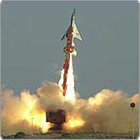
Australian scientists have developed an advanced supersonic jet engine that could profoundly revolutionize warfare and jet travel. The Sydney Morning Herald reported Monday that a University of Queensland team headed by Professor Allan Paull launched their HyShot program -- a two-stage Terrier-Orion rocket carrying their innovative supersonic scramjet -- skyward more than 200 miles to a height of more than 180 miles before it crashed as planned into the desert 250 miles down range.

Scramjets use atmospheric oxygen to burn hydrogen fuel. If such engines were fitted to commercial aircraft they could eventually cut the traveling time between Sydney and London to two hours.
Within a decade. Think of the economic impact of that one!

Tuesday, March 28, 2006

Scramjet Tests At Woomera


I always complain we don't have a proper space programme in Australia, but there's the scramjet research going on, which occasionaly surfaces in the headlines.

A supersonic jet engine known as a scramjet, which could dramatically reduce the time of air travel around the world, has been tested in South Australia's far north.

Seconds after the jet set off, there was a supersonic boom across the Woomera test range.

It travelled more than 300 kilometres into the air before crashing ten minutes later, 400 kilometres down the range.

The University of Queensland is heading an international team testing the scramjet technology, which travels up to 8,000 kilometres an hour - almost eight times the speed of sound.

Team leader Allan Paul says the flight went well but it will take several months to analyse the data they have collected.

He says the team is happy with the result so far.

"I haven't seen them on such a high for a long time," he said.

"It's been a hard couple of weeks, in fact it's been hard since Christmas, and the team has really responded well."

He says the launch went according to plan but there were a few tense moments.

"You're looking at it as it goes up, and you're worried if it's going to make it," he said.

"It's probably a very unnerving feeling actually."

Dr Paul says they should have some preliminary results by tomorrow.
That's kind of cool that the scramjet project is still going on.
What's really interesting is that JAXA have their own scramjet engine ready to be tested in Australia:
The test in Australia was the first of three flights planned for this year by the international Hyshot consortium.

Another Hyshot engine designed by the Japanese Aerospace Exploration Agency (Jaxa) will be next, followed in June by an engine capable of reaching Mach 10 designed by the Australian Defence Science and Technology Organisation (DSTO).

The success of the weekend's test spurred researchers from the University of Queensland to run a second scramjet test in South Australia this week.

Scramjets were first tested in 2001, but the trial failed as the rocket carrying the engine flew off course.
Hmm. That'ss interesting. I did see that Woomera was one of the places where JAXA did their experiments.

Sunday, March 26, 2006

Hard To Do


...Rockets Of Any Size
After having seen the JAXA facilities and spoken to the folks who do rockets, I can appreciate how diffciult it actually can be to launch rockets. So when I noticed this, I thought it was worth posting.
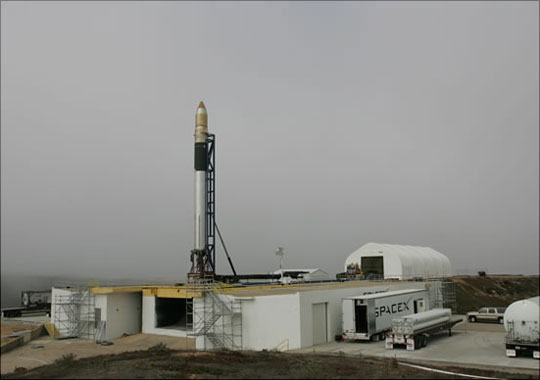
March 25, 2006— The low-cost, built-from-scratch Falcon 1 rocket faltered a minute after liftoff on Friday, dashing the hopes of Internet entrepreneur Elon Musk that after four years and roughly $100 million, his creation would be spared the fate that awaits most debut rocket flights.

"We had a successful liftoff and Falcon made it well clear of the launch pad, but unfortunately the vehicle was lost later in the first-stage burn," Musk, the founder of California-based Space Exploration Technologies, wrote in a blog shortly after the 5:30 p.m. ET liftoff from a remote launch site in the Kwajalein Atoll in the Pacific Ocean's Marshall Islands.

The cause of the failure was not known. Claimed in the accident was a $750,000 science satellite built by U.S. Air Force Academy cadets that was to monitor how space plasma disrupts communications and navigation satellite signals.

Musk, who made his fortune designing and selling the electronic services firms PayPal and Zip2, had said many times prior to the launch that it would take more than one failure to derail his plans to build and fly a family of low-cost, mostly reusable rockets.
At least the man is willing to try.
The Falcon rocket is powered by Liquid Oxygen and Kerosene. It is multi-staged and this version was to have two stages. If you read the article, they discuss a nine stage model.
Looking at the photo above, the control facilities seem awfully close to the blast off area...

Monday, March 13, 2006

Back From JAXA Part 2


Rocket Science Ain't Rocket Science
The old adage "it's not exactly rocket science" implies that Rocket Science is difficult. Well, it's Ballistics so it's not like the science of it is much harder than High School Physics. Even the engineering is something quite comprehensible. So why is rocketry so hard? It turns out that launching rockets is difficult because so many things have to be coordinatedd perfectly; so System Engineering as it is known is the bit in rocketry that is truly difficult.

Here's an example. The main engines of the HII-A rocket consists of Liquid Oxygen and Liquid Hydrogen engines. The explosive power is derived from controlled combustion of the LOX and Liquid H2, and this much is high school chemistry. The actual appartus of making and storing LOX and Liquid Hydrogen are also old chemical engineering problems. The fuels must be refrigerated to -150degrees celsius to keep them liquid.

The thing is, with rockets, the super-cooled liquid fuel has to be delivered to the fuel tank of the rocket on the launch pad without leaks and breakages. Organising it so that the rocket arrives for the launch window in time with the fuel in place to be poured in to the rocket's fuel tank takes a chunk of system enginnering, and in turn this is why you build a space center.

Tanegashima Space Center
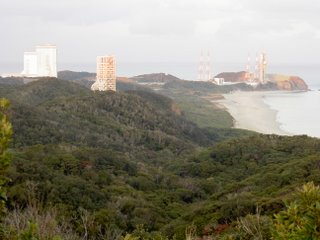
The most remarkable aspect of the Tanegashima Space Center is how far from the centre of civilization it feels. If not for the constant references to the space center and its rockets, the township of Minamitane is one of the furthest outposts from Tokyo. The place is historic in its own way, forever linked ballistics as the place where the Portuguese brought the musket to Japan; and it is here ballistics gets a second breath in the story of Tanegashima.

Tanegashima Space Center houses the facilities where they do the final assembly of the rocket; do the launch; but also test engines and assemble satellites. It's a big sprawling complex built on one of the most beautiful shorelines.

Surprisingly, the staff at Tanegashima are young. If you're used to meeting middle-aged men running institutions in Japan, you will get a rude shock here. There are many young men and women involved in important tasks; they're not window dressing. They have their degrees in rocket engineering and they are filled with hopes and ambition for the space program. One gets a sense of dynamism and activity quite unlike the stodgy bureaucratic feeling one gets from dealing with the main JAXA office. These operatives mean business. At one point I felt I missed my calling - I should've done rocket engineering.

What Is JAXA Like?
This is strictly my experience and therefore my own observation:
JAXA as an organisation is still very young.
You talk to the PR department and mostly they are enthisastic. You talk to the people on the ground actually running the rocket systems and they are incredibly enthusaistic. Even the big boss of JAXA has a long term vision as to where Japan's space program should be going.

Alas the thing that lets JAXA down is the level of management that is still a holdover from NASDA. It's really hard to get them to understand how important Public Relations can be for a space program. So even with the help of the PR department, you end up hitting strange, arbitrary walls that are set up by people who would rather keep things simple in their own minds by saying 'no'. Unfortunately, that's not good enough when Discovery Channel is spending big bucks to give you a 50minute commercial of your wares.

Some departments are very happy to show you what they are worrking on> Others say irrational things like "we can show it to you but you can't shoot it."
Well, what's the good of that? It's that kind of weird response that makes you think, "how seriously do they take the media?"

Indeed , it's symptomatic of large organisations in Japan that they do really bad PR, so JAXA are not an exception when their PR department can't convince their department heads to show off their wares. While I sympathise with the actual PR people I encountered the long term outlook on it is not very encouraging. If anything, it seemed they were drawing the wrong lessons and conclusions.

Other than that, JAXA is a young, dynamic organisation doing amazing things.
Thursday, March 09, 2006

Back From JAXA Part 1

Here's that Photo Again...

33 Days On The Road - What Did I Find?
It was a tough little road trip, hopping from island to island, covering 2 documentaries for a very big documentary company. We went from Sydney to Narita to Okinawa (via Nagoya), then to Tanegashima (via Kagoshima) where they have the Space Center, then to Nagoya (via Kagoshimaa once more) and onto Tsukuba (via Narita), and then back to Sydney from Narita.

So Which bits exactly were JAXA? All of it except for Okinawa and Nagoya - Nagoya is where Mitsubishi Heavy Industries build rockets for JAXA. JAXA scatters itself widely across the Japanese archipelago. They have observations stations in Okinawa, and they have high altitude engine test-firing facilities, north of Sendai.

JAXA is what the old NASDA and a sundry bunch of organisations has been rolled into in ordert o be a more unified organisation. In the wake of the HII Rocket program being shutdown, a total re-organisation took place. Installled at the head of the organisation was Keiichi Tachikawa and theoretically, the whole organisation is meant to have unified into one big space development agency.

The Launch
The HII-A No. 9 launch we saw on the 18th of February represents a milestone accomplishment in many areas for JAXA. The No.9 launch delivered the largest payload into orbit, and it was part of a double launch that happened within a month of the 23rd January launch of the No.8 vehicle. In other words, it was the first time rockets were assembled parallel to one another in the big Vehicle Assembly Building and wheeled out to launch one after the other.

A lot of emphasis was made by the publicity people that what wass significant in this process was how two rockets were launched in quick succession; much more so than the issue of payload. Rocketry, it turns out is not comlex in its concept or in its component parts. If anything theey use tried and tested materials and parts. What is truly cutting edge about any rocket technology lies in the system engineering aspect, managing the diverse technological needs that go into successfully organising and assembling for launch. At the critical stages, at 270 seconds from laucnh the system goes into full automatic. People take shelter in the blockhouse or over 3.2 kilometres away.

The Rocket
The HII-A Rocket is the successor to the HII rocket. The HI Rocket was a rocket made mostly of imported technology. So the HII was developed during the 1990s with fully domestic Japanese technology. The problem was it turned out to be a very complex machine with too many parts, which in turn meant it was a very expensive machine to fire. This meant it was more vulenrable to failure and so when the HII program was cancelled, a concerted effort was made to streamline the cost of the rocket as well as reduce the number of parts. The result is the HII-A rocket.

The HII-A rocket has far fewer parts than its predecessor. The most important 'part reduction 'took place in the black ring you see in the above ph0to. A quick way to tell apart the HII and HII-A is the 'interstage section'. The HII had a yellow metal ring. In the HII-A, it has now been replaced by a composite black material that has 80% fewer parts.

The payload of the HII-A rocket is 10 tons for Low Earth Orbit and 4 tonnes for Geostationary Orbit. In the future, they are hoping to make the HII-B rocket with up to 16.5 tons of payload to Geostationary Orbit.

The HII-A rocket is a 2 stage rocket with a main drive using a Liquid Oxygen and Liquid Hydrogen drive. In addition to the liquid fuel are the Solid Rocket Boosters and the secondary strap on boosters that fire solid rocket at launch. What makes the HII-A interesting is how the second stage engine is turned off and on during its flight. The rocket itself weighs in at 285tons, but the combined thrust of the first stage liquid fuel engine and the boosters is in the vicinity of 500 tons. With the HII-A rocket, Japan's aerospace lift capacity matches that of the ESA's Arianne 5, and the USA's Delta. What's remarkable about it is the cost with which they achieve their lift-offs. However, I'll leave that discussion for tomorrow.