Thursday, September 21, 2006

Back To Earth, Back To Work

Atlantis Lands
No, I'm not talking about the Red Sox. I'm talking about the Space Shuttle Program which is now rebuilding the momentum it lost in the aftermath ofthe Columbia disaster. Next on the agenda are lifting the components of ISS supplied by the Europeans and the Japanese that have been sitting around in storage.

Here's the latest.
"It's obvious to me that we are rebuilding the kind of momentum that we have had in the past and that we need if we are going to finish the space station," said NASA Administrator Michael Griffin during a postlanding briefing. "We have an awesome task ahead of us.... I think we're going to make it."

That's an assessment that undoubtedly brings a smile to the project's international partners.

"International partners, especially the Japanese and Germans, were crossing their fingers, hoping this mission would pan out," says Ray Williamson, with George Washington University's Space Policy Institute. "If NASA is successful at getting the space station completed, you'll see a lot more openness in Europe and Japan to collaborate with the US in new exploration efforts."

For December's mission, spacewalking astronauts are set to perform tasks that initiate the most complicated phase of station construction, mission planners say. In addition to delivering another truss segment, Discovery's crew will overhaul the electrical wiring and cooling-system plumbing to all of the major US components.

"It would be the equivalent to changing who delivers the electricity and water to your house - not just changing the source, but changing the wires and the pipes coming into the house and being routed around and under the house. It's that significant a change," says Paul Hill, a NASA flight director. "And it's all going to be done outside."

Then come the missions of 2007, during which the shuttle will drop off more basic- infrastructure components. To install them in their permanent locations, space-station crew members will use the station's robotic arm and conduct spacewalks to move existing elements in two high-stakes, slow-motion games of musical modules. At one point, they will have to disable and move the only connector, or node, capable of mating with the space shuttle - critical for resupply and crew exchanges, as well as construction.

If astronauts damage that connector, "the contingency scenarios get kind of ugly," Mr. Hill says. Between December's wiring and plumbing job and the station crew's segment shuffles, the next 12 months will see NASA undertake "the three most complicated things we're going to do in the entire construction of the space station."
It's all smooth-sailing for now.

Lucy's Child

...so to speak. They've dug up a very interesting hominid fossil.
In a discovery sure to fuel an old debate about our evolutionary history, scientists have found a remarkably complete skeleton of a 3-year-old female from the ape-man species represented by "Lucy."

The remains found in Africa are 3.3 million years old, making this the oldest known skeleton of such a youthful human ancestor.

"It's a pretty unbelievable discovery... It's sensational," said Will Harcourt-Smith, a researcher at the American Museum of Natural History in New York who wasn't involved in the find. "It provides you with a wealth of information."

For one thing, it gives new evidence for a contentious feud about whether this species, which walked upright, also climbed and moved through trees easily.

The species is Australopithecus afarensis, which lived in Africa between about 4 million and 3 million years ago. The most famous afarensis is Lucy, discovered in Ethiopia in 1974, a creature that lived about 100,000 years after the newfound specimen.

The new find is reported in Thursday's issue of the journal Nature by Zeresenay Alemseged of the Max Planck Institute for Evolutionary Anthropology in Leipzig, Germany; Fred Spoor, professor of evolutionary anatomy at University College London, and others.
Interesting news for those of us interested in early hominids.

Tuesday, September 19, 2006

Atlantis Is Coming Home

The New Routine
The new routine is to check damages to the heat shield. Atlantis has spearated from the ISS and is coming home.
Cape Canaveral, Florida - Atlantis' astronauts gave the ship's wings and nose one last inspection on Monday with a remotely operated TV camera and laser, and Nasa said there appeared to be no damage that would prevent the shuttle from coming home.

Atlantis and its six crew members are set to touch down early on Wednesday at the Kennedy Space Centre after 11 days in space delivering a major addition to the International Space Station and conducting three spacewalks to install it.

The astronauts attached a 15-metre boom to the shuttle's robotic arm to inspect for any damage. The boom has a TV camera and a laser imagery system attached to its end. An identical survey was conducted on Day 2 of the mission.

Monday's inspection was conducted while the shuttle was about 80 kilometres from the space station.

If the astronauts had found the type of damage that could cause a deadly accident, the shuttle would have been able to return to the station. However, the space station had its own problems on Monday.

Space station crew members pulled an alarm and donned protective gear after smelling a foul odour that turned out to be burning rubber and a harmful chemical leaking from an oxygen system.
It all looks well.

Friday, September 15, 2006

Today's Headlines

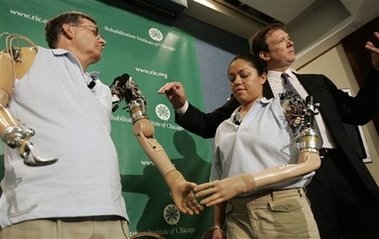
"Bionic Woman"


The world's first bionic woman Claudia Mitchell didn't even know about the 1970s show when she heard the term.
When her doctors first called her "The Bionic Woman," 26-year-old Claudia Mitchell didn't understand the reference to the 1970s TV show about the secret agent who was part woman, part machine.

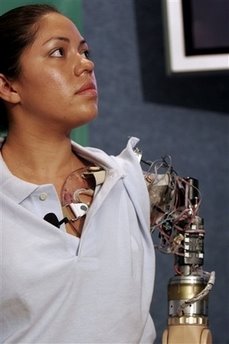
Besides, the first woman to be outfitted with a bionic arm says that when the motors are running in the 10-pound device, it reminds her of another famous cyborg - Arnold Schwarzenegger's The Terminator.

"It's really cool," she says. "This is not just something in the movies. This is really happening." Mitchell, a former U.S. Marine, lost her left arm in 2004 on an Arkansas highway when the friend she was riding with lost control of his motorcycle.

As she struggled to cope with the loss of the limb, she read a Popular Science story about Jesse Sullivan, a Tennessee man who received the first bionic arms at the Rehabilitation Institute of Chicago after losing his in an electrical accident in 2001.

"I said, 'I've got to have one of those,' " Mitchell says.

Last year she had surgery and received an arm that's even more advanced than Sullivan's. Today, in a Washington, D.C., news conference with National Institutes of Health officials, Mitchell will show off her skills with the arm developed in a $4 million project funded largely by the NIH.

Though recent prosthetic research has focused on implanting sensors that link devices to movement commands from the brain, Mitchell was drawn to the less-invasive work in Chicago.

"Most people have been looking at trying to tap into the brain, but that has a number of challenges," says Todd Kuiken, who heads neural engineering at the Chicago institute. Implants are "becoming more doable, but if something breaks you have to have surgery to fix it. The exciting thing about this technique is we are not implanting anything into her body."

Kuiken found a way to use chest muscles to connect the prosthetic to nerves that once sent signals to the hand, wrist, elbow and shoulder. After an amputation, the brain still thinks the arm is there. It feels sensations and sends signals to move. But those signals are too weak for modern mechanics to detect from the surface of the skin, so Kuiken's team amplified them.

First, plastic surgeon Greg Dumanian of Northwestern Memorial Hospital moved the targeted nerves into muscles in Mitchell's chest. Then, the nerves that cause the motion of those muscles were disconnected. Mitchell can no longer send a signal to flex her pectoral muscle, but when she wants to close her hand or bend her elbow, the nerve impulse moves her "pec."

When that muscle moves, it sends a signal strong enough for a sensor on the skin to detect. After some rewiring by Dumanian, six muscles in Mitchell's chest now move six motors in the bionic arm.

And nerve data flow up, too. When Kuiken touches a certain spot on Mitchell's chest, she feels him touch her hand, even though it's no longer there.

There is much still to sort out. Though Mitchell can perform a simple task such as folding a pair of pants without first stretching them out on a flat surface, Kuiken calls the arm clumsy. Both he and Mitchell say they are optimistic about making the prosthetic - hers and future versions - more sensitive and precise.

"We hope to be able to close the loop with Claudia and have the sensation be there so that when she touches something, she feels a touch of her hand," Kuiken says. Mitchell, who hopes to go to college next year to study communications, says she is proud to be part of the team. "I am really excited about the prospects of being able to, hopefully, pave the way to make this something that is more common," says Mitchell, a volunteer at Washington, D.C.-area military hospitals.

Until today, her role in the bionic research project has been shrouded in secrecy. But now, the former Marine who served in Kuwait can tell the amputees she counsels about her arm and the research.
Cyberpunk is just around the corner.

ISS Spreads Its Solar Panels


The crew of Space Shuttle Atlantis are looking to do one more spacewalk.
Joe Tanner and Heidemarie Stefanyshyn-Piper, the pair who did the first spacewalk on Tuesday, are going out for the third and final excursion this morning.
"You just can't imagine a flight going as well as this one has gone," said lead space station flight director John McCullough. The astronauts have been working on installing a new addition to the space station, the first since the 2003 Columbia disaster. "I couldn't ask for a better start - a re-start - to assembly," McCullough added.
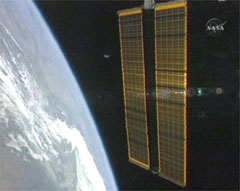
The US$372 million addition consists of two solar panel wings that will eventually provide a quarter of the space station's power when it's completed by 2010. They won't generate any electricity, though, until the next space mission - slated for December - when the power system is rewired.
On Friday's spacewalk, Tanner and Piper will be unpacking a radiator that will later be used to dissipate the heat generated by electronics on the newly installed solar panels.
They'll spend the rest of the roughly 6 1/2 hours with tasks like replacing an antenna and picking up science experiments.
All's well that works well.

Tuesday, September 12, 2006

ISS Build Conitnues

Atlantis Has Docked With The ISS


Here's the article.
Two spacewalking astronauts began installing on Tuesday the first big addition to the international space station in more than 3½ years, and NASA pronounced the outing a success, even though a small bolt floated off and got lost.

“I felt today like this is what NASA is supposed to do,” lead space station flight director John McCullough. “This is what we're here to do.”

Wearing bulky suits and gloves, the two Atlantis astronauts ventured outside to begin attaching a new 17½-ton box-like truss section that the space shuttle delivered earlier this week. The job involved connecting 17 wires or tubes and tightening or loosening 167 bolts.

Astronaut Joe Tanner was working with a 1½-inch bolt with an attached spring, when the washer holding it in fell off. The bolt and spring floated over the head of astronaut Heidemarie Stefanyshyn-Piper and skittered across the truss.

While the washer went out into space harmlessly, Tanner worried the bolt and spring could get into the truss's wiring and tubing and cause problems.

“I just hope that bolt is on its way to Mother Earth right now and not on its way” to a crucial joint, Tanner said.

Even though NASA didn't have any video showing the bolt missing the mechanism, officials said they are certain that the bolt flew off into space harmlessly.
Err, yeah, that last bit's a little scary, but it seems all is progressing well.

Monday, September 11, 2006

H2A Flight 10

JAXA Launch A Success


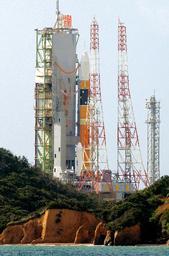
JAXA launched the 10th H2-A Rocket yesterday.
当初は10日午後に打ち上げる予定だったが、悪天候が予想されたため延期していた。全長53メートルのロケットは燃焼済みの部分を切り離しながら高度400〜600キロに達した後、衛星を南北に周回する軌道に乗せる。打ち上げ費用は衛星を除いて96億円。

 情報収集衛星は、98年の北朝鮮によるミサイル「テポドン」発射を機に国が導入を決めた事実上の偵察衛星。計画では、地球上のどの地点でも一日1回は監視できるようにするため、高性能の望遠カメラを備えた光学衛星と、電波で地上の様子を探るレーダー衛星を2基ずつ運用する。

 まず03年3月にH2A5号機で各1基を同時に投入したが、同11月の6号機の打ち上げ失敗で残り2基を失い、機能半減の状態が続いていた。今回打ち上げたのは光学衛星で、地上にある1メートル程度の物体を見分けられるという。衛星の大きさや外観、詳しい軌道などは安全保障上の理由から公表されていない。
The launch, originally scehduled for the tenth, was delayed due to bad weather. The 53m long rocket flew to a hecight of 400-600km while separating stages, launching the satellite into a north-south orbit. Thee launch cost US$ 90million excluding the satellite costs.

The satellite is specifically to carry out surveillance on North Korea who have been a regional threat since the launch of its Tepodong missile in 1998. The satellit uses both opitcal and radar for its surveillance. Orbit details, appearance and size are a secret for security reasons.

Lookng at the photos, it seems Flight 10 was launched from LPT 1, just like Flight 9.

Saturday, September 09, 2006

Atlantis Blasts Off Finally

After Many Weather Delays


Atlantis is off and flying.
After two weeks of postponements caused by bad weather and nagging mechanical problems, the Atlantis lifted off on time at 11:14:55 a.m.

The countdown was unhindered by any major technical issue. After a blazing rise into the sky, the yellow flames of its booster rockets visible through holes in billowing cloud banks, the shuttle slipped into orbit without incident about 10 minutes later.

"Your long wait is over," NASA's launch director, Michael D. Leinbach, told the crew just before liftoff.

The fuel tank sensor that forced postponement of Friday's attempt appeared to work normally during early-morning fueling of the 500,000-gallon tank that held the propellant for the shuttle's three main engines. The engine cutoff sensor that failed and three others that operated properly in the hydrogen section of the shuttle's external tank proved not to be an issue.

The National Aeronautics and Space Administration has been trying to launch the shuttle on its 11-day mission to resume construction of the station since Aug, 27. A lightning bolt hitting the launching pad, a threatening tropical storm and equipment problems with a shuttle power generator and the fuel sensor forced repeated delays.

The shuttle had to get off this weekend to avoid conflict with a Russian launching of a Soyuz spacecraft carrying a new crew to the space station on Sept. 18 . A delay would have forced NASA to wait until at least the end of September.
Back to the construction of the ISS.
Meanwhile in Japan...

JAXA Launch Delayed Due To Weather


JAXA were launching a surveillance satellite, but they have delayed their launch due to inclement weather.
宇宙航空研究開発機構は10日未明、同日午後に予定していた政府の情報収集衛星の打ち上げを11日以降に延期する、と発表した。打ち上げ場所の種子島宇宙センター(鹿児島県)の天候が悪化したため。

 情報収集衛星は3基目で、北朝鮮のミサイル施設などを監視する事実上の偵察衛星。国産主力ロケットH2A・10号機で10日に打ち上げる予定だった。
They'll try again next week. Now that I know what it's like in the PR observation room, I can just imagine the deep sighs amongst the press. I even know that grey-haired guy in that photo handing out the PR stuff. He's a really annoying, unhelpful man.

Sunday, September 03, 2006

This Week In Space

I've been slack lately because I've actually been busy in the real world outside of cyberspace. Anyway, here's this week's space news dumpdown.

SMART-1 Probe Hits Target


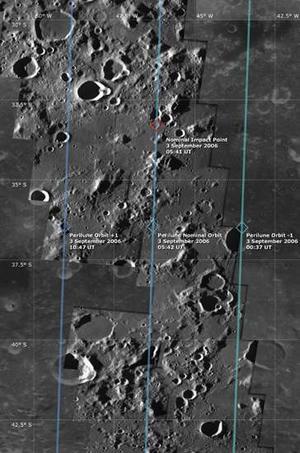
The SMART-1 probe from the ESA crash landed on the moon as scheduled, yielding the nice montage above. Here's the write up in the SMH.
Darmstadt, Germany: Europe's first spacecraft to the moon ended its three-year mission on Sunday by crashing into the lunar surface in a volcanic plane called the Lake of Excellence, to a round of applause in the mission control room.

Hitting at two kilometres per second, or 7200 kmh, the impact of the SMART-1 spacecraft was expected to leave a three- by-10-metre crater and send dust kilometres above the surface.

Observatories watched the event from Earth and scientists hoped the cloud of dust and debris would provide clues to the geologic composition of the site.

"That's it - we are in the Lake of Excellence," said spacecraft operations chief Octavio Camino as applause broke out in mission control in Darmstadt, Germany. "We have landed."

Minutes later, officials showed off a picture captured by an observatory in Hawaii displaying a bright flash from the impact.

"It was a great mission and a great success and now it's over," said mission manager Gerhard Schwehm.

The spacecraft ended a three-year mission that scanned the lunar surface from orbit and tested a new, efficient, ion-propulsion system that officials hope to use on future interplanetary missions.

Launched into Earth's orbit by an Ariane-5 booster rocket from Kourou, French Guiana, in September 2003, SMART-1 used its ion engine to slowly raise its orbit over 14 months until the moon's gravity grabbed it.

The engine, which uses electricity from the craft's solar panels to produce a stream of charged particles called ions, generates only small amounts of thrust but only needed 80 kilograms of xenon fuel.

The craft's X-ray and infrared spectrometres have gathered information about the moon's geology that scientists hope will advance their knowledge about how the moon's surface evolved and test theories about how the moon came into being.

On Saturday, mission controllers had to raise the craft's orbit by 600 metres to avoid hitting a crater rim on final approach. Had the orbit not been raised the craft would have crashed one orbit too soon, making the impact difficult or impossible to observe.

SMART-1, a cube measuring roughly a metre on each side, took the long way to the moon - more than 100 million kilometres instead of the direct route of 350,000 to 400,000 kilometres.

But the European Space Agency did it for a relatively cheap 110 million euros ($185 million).

The spacecraft also been taking high-resolution pictures of the surface with a miniaturised camera, taking its last images just minutes before the impact.
I like the price tag. It's not something Australia couldn't affford to do... if it had the vision. Except it has been underfunding space research for a very long time, there's no invested know-how left. One sort of wonder what Australia is going to do when it has to re-join space exploration.

Shuttle Countdown Recommences


After the delay that was hurricane Ernesto, Space Shuttle Atlantis is back on deck, readying for countdown.
Launch time is set for 12:29 p.m. ET Wednesday. If the shuttle does not lift off then, NASA has launch opportunities on the following two days.

Engineers and technicians at the Kennedy Space Center planned to spend the coming days checking out flight software, testing navigational systems and fueling the cells that will power Atlantis' systems.

This is the second time a countdown was started for this mission of Atlantis, which originally was to blast off Aug. 27. The launch was delayed after lightning struck the launch pad, requiring engineers to check for damage to Atlantis' systems.

---

Atlantis will deliver a 17.5-ton, $372 million addition to the half-built international space station during the 11-day mission. Four astronauts will take three spacewalks to resume construction on the orbiting space lab, which stopped being built almost four years ago after the space shuttle Columbia disintegrated while returning to Earth.
Godspeed and all that to the crew.

Lockheed Martin To Build Next Moon Space Vehicle


Here's the article from the SMH.
WASHINGTON: Lockheed Martin has won a multibillion-dollar contract to build a space vehicle to replace NASA's shuttles, put a human on the moon for the first time since 1972, and be the precursor to a manned ship to Mars.

The award marks NASA's most concrete step to fulfil President George Bush's $US230 billion ($300 billion) promise that the space agency would return astronauts to the moon and restore excitement about space exploration. NASA has planned to replace the shuttles since the mid-1980s, and has spent almost $US5 billion to do so - with little success so far.

"It's just thrilling, for all of us," said Skip Hatfield, NASA's project manager, after the announcement on Thursday. The vehicle, Orion, is the embodiment of the "very future of human space flight".

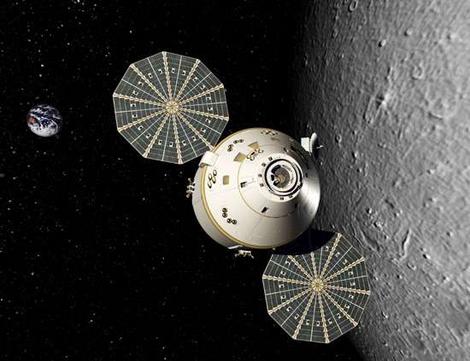
Orion will look somewhat like the three-man Apollo command module but will carry up to six astronauts. Like the shuttle, it will be able to carry cargo to and from the International Space Station.

Orion is expected to make its first manned flight by 2014, four years after NASA's three operating shuttles are retired. NASA hopes for a moon landing by 2020.

Unlike the shuttle, which lands on a runway, Orion will descend with the aid of a parachute to land in the ocean or on land. NASA plans to build two of the vehicles, one for manned flight and the other for unmanned. It will decide how many more to buy after judging how often they can be reused.
The Herald being the Herald, just posted up this story from Reuters.
It sort of tells you why there isn't much interest in Space Exploration in Australia.

Anti-Pluto Revisionism
Last month, in a rigged vote, Pluto lost its status as a planet. Now the backlash is on.
More than 300 scientists have signed a petition protesting against the definition of "planet" decided by the International Astronomical Union last week. That definition demoted Pluto, leaving the solar system with eight planets.

The petition states: "We, as planetary scientists and astronomers, do not agree with the IAU's definition of a planet, nor will we use it. A better definition is needed."

The signers of the petition included NASA scientists, astronomers at major observatories, university professors and graduate students. The astronomical union allowed only scientists attending a conference last week in Prague, Czech Republic, to vote.

The group's definition for a planet specifies three conditions: the object orbits the sun; it is large enough for its gravity to pull it into a round shape; and it "has cleared the neighbourhood around its orbit".

The last condition excludes Pluto, because it is located among many other icy bodies in a ring of debris known as the Kuiper Belt.
It all depends on where you draw the lines. Some people want to draw it where pluto is excluded. Others want to draw it where Pluto plus other bodies become certified planets. You'd think they'd settle in inclusion rather than exculsion, but science probably has its fair share of anal-retentive definitionalist types. It's kind off funny to watch from afar. The funny thing is, in my mind, Pluto will always be a planet to me.