Just a quick note to let you all know I fly out on Sunday 5th Feb and return on 9th Mar. It's the longest roadtrip I've been on. Don't knoww if can post aanything while I'm over there. I will take my laptop with me, so we'll see.
There have been some amazing changes of schedule within that block but as of this minute I think we're on top off it ... right now. Of course it may blow up on us tomorrow morning, but for now, we're on top. Yay.
So if you don't hear from me this month, apologies in advance.
Peace,
Art
Tuesday, January 31, 2006

Monday, January 23, 2006
H2-A Launches Successfully
H2-Away
After an anxious night of waiting, the H2-A rocket made its launch today at 10:33 as re-scheduled.

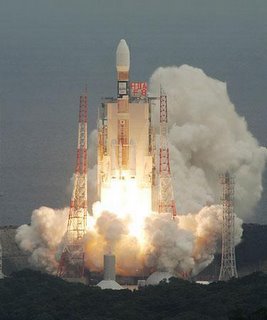
And this is good because it means it won't impact on our shooting schedule. It also means the thing works pretty well so weather permitting, she'll fly according to schedule on the 15th of Feb too.
After an anxious night of waiting, the H2-A rocket made its launch today at 10:33 as re-scheduled.

宇宙航空研究開発機構(JAXA)は24日午前10時33分、H2Aロケット8号機を鹿児島県南種子町の種子島宇宙センターから打ち上げた。約16分後、搭載した陸域観測技術衛星(ALOS)「だいち」を計画通り分離し、打ち上げは成功した。JAXAは2月中旬にも大型ロケット2機の打ち上げを予定している。1カ月間に3機連続の打ち上げは国内初で、衛星打ち上げ市場参入など、日本の宇宙開発の今後を占う試金石として注目を集めている。
◇2月中旬の2機打ち上げに弾み
ロケットは太平洋上を東南に向かって上昇。予定通り高度約700キロで第2段ロケットから衛星を分離、衛星は地球を南北に周回する軌道に乗った。今後、観測機器の動作確認などをして、約3カ月後に運用を始める予定。
8号機は当初、昨年9月に打ち上げ予定だったが、衛星に不具合が相次ぎ、今月19日に延期された。この影響でJAXAは8号機のほか、2月15日に種子島宇宙センターからH2A9号機を、同18日に内之浦宇宙空間観測所(鹿児島県肝付町)からM5ロケット8号機を打ち上げることになった。H2A8号機は今月19日の打ち上げも機器などの不具合や天候不良で延期されていた。
今回の打ち上げ費用は約101億円で、衛星開発費は約547億円。【河津啓介】
【ことば】H2Aロケット 宇宙開発事業団(現JAXA)が開発した2段式ロケット。全長53メートル、重さ321トン(衛星除く)。燃料の液体水素を液体酸素と反応させて推進力を得る。地球を回る高度300キロの軌道に約10トンの大型衛星を打ち上げられる能力がある。固体補助ロケットの種類や数を変えることで、さまざまな重さの衛星に対応できる。第1段ロケットを大型化し、国際宇宙ステーションへ物資を補給する17トン級の輸送機を打ち上げられる「H2B」を開発中。
【ことば】陸域観測技術衛星「だいち」 高度700キロから地表を観測し、2万5000分の1の地図作成のための地形データ収集などを行う。46日ごとに同じ地点を同じ時間帯に観測できる軌道を回る。地表の2・5メートルのものを見分ける光学センサーなど3種類のセンサーを搭載。昼夜、天候に関係なく観測したり、災害時、3日以内に観測したい地点で緊急観測する機能も備えている。重さ約4トンで、国内打ち上げ衛星で最重量。

陸域観測技術衛星「だいち」を搭載したH2Aロケット8号機。打ち上げから約16分半後に、高度約700キロで分離され、地球を南北に約100分で回る軌道に投入された(24日午前、種子島宇宙センター)(時事通信社)12時03分更新
And this is good because it means it won't impact on our shooting schedule. It also means the thing works pretty well so weather permitting, she'll fly according to schedule on the 15th of Feb too.
Sunday, January 22, 2006
Pluto Probe Launch

 Finally, the probe is launched and underway towards Pluto.
According to the NASA press release, the Atlas V rocket carrying the vehicle lifted off at 14:00 EST. It separated from the solid fuel "kick motor" a tad under 45 minutes later. Five minutes after that, radio signals from New Horizons confirmed that all was well.I'm glad that one's underway. The JAXA launch is now sitting on the pad, waiting to go tomorrow morning.
Dr Colleen Hartman, deputy associate administrator for NASA's Science Mission Directorate, enthused: "Today, NASA began an unprecedented journey of exploration to the ninth planet in the solar system. Right now, what we know about Pluto could be written on the back of a postage stamp. After this mission, we'll be able to fill textbooks with new information."
Dr. Alan Stern, New Horizons' principal investigator, indulged in a bit of flag-waving with: "The United States of America has just made history by launching the first spacecraft to explore Pluto and the Kuiper Belt beyond. No other nation has this capability. This is the kind of exploration that forefathers, like Lewis and Clark 200 years ago this year, made a trademark of our nation."
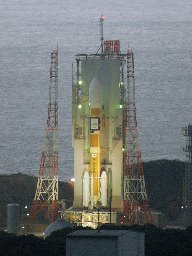
宇宙航空研究開発機構は23日、陸域観測技術衛星「だいち」を搭載したH2Aロケット8号機の打ち上げを、24日午前10時33分に再延期すると発表した。
23日の打ち上げに向けて最終的な準備を進めていた22日深夜に、衛星を保護するカバー内の空調温度を監視する地上のシステムが、温度の上限を上回っているとの警告を発したため。The gist of that one is that there were some ground to tower problems.
同機構が、カバー内に送り込まれる空気の温度を別の複数のセンサーで測定したところ、正常な温度だった。同機構では「監視システムに誤った温度が設定されていることが判明したが、なぜそうなったかは不明」としている。同機構では、温度の監視を目視に切り替え、24日の打ち上げに臨むとしている。
8号機は当初19日に打ち上げる計画だったが、ロケットの送信機に不具合が見つかって延期された。今回で2度目の延期となった。
So we'll see how that one goes.
Tuesday, January 17, 2006
We Are Stardust


Mission personnel remove a canister, bottom section, containing comet dust as they dismantle the Stardust capsule in a clean room Sunday, Jan. 15, 2006, at Dugway Proving Ground, Utah. The seven-year project collected particles from a comet. (AP Photo/Douglas C. Pizac)We Have Fallen
NASA's Stardust Mission has returned to Earth. After a seven year mission to collect comet debris, NASA are describing the return of the stardust probe as a victory.
The Stardust capsule survived a fiery plunge through the atmosphere early Sunday, parachuting to the Utah salt flats. It bounced three times in soft mud before coming to rest on its side.Two years ago the other probe just went bung on the way down and that was that. It's also the first bit of space rock to be brought back to Earth since the last Apollo Mission to my knowledge.
The landing chipped off a piece of the capsule's heat shield, meant to protect it as it re-enters Earth. But the capsule and its canister were in otherwise good shape, said Joe Vellinga of Lockheed Martin, which built the capsule.
"Everything is very clean. It looks very pristine," Vellinga said Monday.
Stardust's homecoming with the first comet particles ever captured in space was a relief for NASA, whose Genesis space probe carrying solar wind particles crashed and split open in 2004 after its parachutes failed to open. Despite the accident, scientists were able to salvage some of the fragile solar samples for analysis.
Getting Back To The Garden
I'm just going to jot down some headline that I've been unable to write about here. Well, it's life, y'know, I got busy. :)
The Propsed probe to Pluto is about to be launched.

It will be the fastest spacecraft ever launched, zooming past the moon in nine hours and reaching Jupiter in just over a year at a speed nearly 100 times that of a jetliner.One of the outcomes of the Space Shuttle scuttlebut and dealys has been that many of the scheduled payloads haave not made their way into orbit. For instance, this European space laboratory here.
Its target is Pluto - the solar system's last unexplored planet, 4.8 billion kilometres from Earth. And the New Horizons spacecraft, set for liftoff on Tuesday, could reach it within nine years.
The US shuttle is the only vehicle that can carry large equipment to the International Space Station and its grounding has left the European Space Agency wondering how else it might send the Columbus research centre into orbit.So that's been drag.
"What we hope is for the Columbus to be launched as quickly as possible," Jean-Jacques Dordain, director general of the European Space Agency, told a news conference on Monday.
US space agency Nasa halted shuttle flights for more than two years after the space shuttle Columbia disintegrated over Texas in February 2003, killing seven astronauts.
It launched the Discovery shuttle last July but the fleet was quickly grounded again because of new problems.
The next shuttle flight is tentatively scheduled for May. But Dordain said there are other countries with scientific projects waiting to catch a ride.
"There are others in the queue, notably the Japanese who want their laboratory launched as quickly as possible," he said.
Here's an interesting story on doing EVA.
The heavy reliance on orbital hardhat crews to build the station has raised the stakes for each journey out of the hatch. Now "assembly" walks, which last 6 to 8 hours, are packed with chores, and an unfinished job could affect construction for years to come.It's tough up there.
During his time in space, the dangers were secondary, says astronaut and four-time spacewalker Michael Foale. "I'm not anxious about my life. I'm anxious about the task."
There is so much work to do that spacewalkers, who always go outside in pairs, no longer tackle all their tasks together. Instead they split up and may not see each other for hours, "a lonely feeling ... especially at night," Tanner admits.
Adding to the crew's burden, the chill of space will ruin some cold-sensitive parts of the station if they are not quickly installed. So spacewalkers race the clock, knowing that a $500-million piece of equipment could be a pile of space junk if they dawdle.
"The mental stress shouldn't be underplayed," says consultant Leroy Chiao, who left the astronaut corps in December. "When you're out there doing the work, you can't help but feel the pressure."
Here's another on EVA, this time with a cosmonautical flavour:
In a country where vodka is consumed in industrial quantities, officials at Russia's medical space research establishment said the consumption of alcohol in space was not only a right but a positive advantage.
"Folks are flying in orbit for half a year or so," a spokesman said. "They do tons of work. Especially exhausting are space walks where they can lose several kilos in several hours. That's why, many of us think that it won't be that bad to have a little drink to replenish one's strength."
Russian cosmonauts and space officials welcomed the idea of lifting the ban, but cautioned that weightlessness multiplies the effect of alcohol.
Yuri Lanchakov, commander of the Cosmonaut Corps at the Gagarin Cosmonaut Training Centre near Moscow, told the Sunday Telegraph: "Twenty grams of a good cognac [about one pub measure] would be good." He intends to issue a tot to anyone returning after a space walk, and to allow astronauts to drink alcohol to toast New Year.
Champagne, however, will remain prohibited because the pressure could turn bottles into small missiles if opened in the gravity-free atmosphere of the space station.
An official at Russia's Federal Space Agency (Roskosmos) said: "Not only could the recoil be unpredictable, but the bottle could explode even before you open it."
He welcomed the idea of allowing alcohol on the space station but said "everything should be in moderation" - perhaps remembering how in 1994 President Boris Yeltsin failed to emerge from his plane at Shannon Airport in Ireland after imbibing too much.
And that about wraps it up.
Thursday, January 12, 2006
My JAXA Trip
I've been rather busy and unable to post too much stuff here, so my deepest apologies.
It's been on the cards for a month now, but it's suddenly looking solid. I'm going to tag along on a shoot covering the 15th of Feb launch of the HII-A Rocket from Tanegashima Space Center (amongst other things). So hopefully, I'll be able to bring back some pictures for your all to see, andd hopefully some interesting insigght into Japan's Space Program which got revamped.
The more I reflect on it, the more I feel Australia let go of something big when they actually had Woomera running sending satellites into space and then stopped following it up. Australia was the fourth nation into space and it has to be said that we're nowhere near clawing back the lost distance. The lack of vision in this country is dissappointing on both sides of the political fence and there doesn't seem to be a single politician even remotely conversant with Space policy beyond satellite bandwidths. It's truly pathetic.
Anyway, that's my rant of the day.
It's been on the cards for a month now, but it's suddenly looking solid. I'm going to tag along on a shoot covering the 15th of Feb launch of the HII-A Rocket from Tanegashima Space Center (amongst other things). So hopefully, I'll be able to bring back some pictures for your all to see, andd hopefully some interesting insigght into Japan's Space Program which got revamped.
The more I reflect on it, the more I feel Australia let go of something big when they actually had Woomera running sending satellites into space and then stopped following it up. Australia was the fourth nation into space and it has to be said that we're nowhere near clawing back the lost distance. The lack of vision in this country is dissappointing on both sides of the political fence and there doesn't seem to be a single politician even remotely conversant with Space policy beyond satellite bandwidths. It's truly pathetic.
Anyway, that's my rant of the day.
Saturday, January 07, 2006
Cat Evolution Unlocked

Hi Gravity Traininng In This Thing? No Way!
That confused look on the kitten in the clothes drier isn't a look of consternation; it's more like the confusion of being annointed most successful lineage of the entire felidae 'cat' family.
Researchers have gained a major insight into the evolution of cats by showing how they migrated to new continents and developed new species as sea levels rose and fell.Right.
About nine million years ago - two million years after the cat family first appeared in Asia - these successful predators invaded North America by crossing the Beringian land bridge connecting Siberia and Alaska, a team of geneticists writes in the journal Science today.
Later, several American cat lineages returned to Asia. With each migration, evolutionary forces morphed the pantherlike patriarch of all cats into a rainbow of species, from ocelots and lynxes to leopards, lions and the lineage that led to the most successful cat of all, even though it has mostly forsaken its predatory heritage: the cat that has induced people to pay for its board and lodging in return for frugal displays of affection.
This new history of the family, known as Felidae, is based on DNA analyses of the 37 living species performed by Warren E. Johnson and Stephen J. O'Brien of the National Cancer Institute and colleagues elsewhere.
Before DNA, taxonomists had considerable difficulty in classifying the cat family. The fossil record was sparse and many of the skulls lacked distinctiveness. One scheme divided the family into Big Cats and Little Cats. Then, in 1997, Dr. Johnson and Dr. O'Brien said they thought most living cats fell into one of eight lineages, based on the genetic element known as mitochondrial DNA.
Having made further DNA analyses, the researchers have drawn a full family tree that assigns every cat species to one of the lineages. They have also integrated their tree, which is based solely on changes in DNA, with the fossil record. The fossils, which are securely dated, allow dates to be assigned to each fork in the genetic family tree.
Knowing when each species came into existence, the Johnson-O'Brien team has been able to reconstruct a series of at least 10 intercontinental migrations by which cats colonized the world. The cheetah, for instance, now found in Africa, belongs to a lineage that originated in North America and some three million years ago migrated back across the Bering land bridge to Asia and then Africa.
Dr. O'Brien said the cats were very successful predators, second only to humans, and quickly explored new territories as opportunity arose. Sea levels were low from 11 million to 6 million years ago, enabling the first modern cats, in paleontologists' perspective (saber-tooth tigers are ancient cats), to spread from Asia west into Africa, creating the caracal lineage, and east into North America, generating the ocelot, lynx and puma lineages.
The leopard lineage appeared around 6.5 million years ago in Asia. The youngest of the eight lineages, which led eventually to the domestic cat, emerged some 6.2 million years ago in Asia and Africa, either from ancestors that had never left Asia or more probably from North American cats that had trekked back across the Bering land bridge.
Sea levels then rose, confining each cat species to its own continent, but sank again some three million years ago, allowing a second round of cat migrations. It was at this time that the ancestors of the cheetah and the Eurasian lynxes colonized the Old World from the New.
Chris Wozencraft, an authority on the classification of carnivorous mammals, said the new cat family tree generally agreed with one that he had just published in Mammal Species of the World, a standard reference. Dr. Wozencraft, a taxonomist at Bethel College in Indiana, based his classification on fossil and zoological information, as well as on DNA data already published by Dr. O'Brien's laboratory.
Cat fossils are very hard to tell apart, because they differ mostly just in size, and the DNA data emerging over the last decade has helped bring the field from confusion to consensus, Dr. Wozencraft said.
Despite their evolutionary success, most of the large cats are in peril because their broad hunting ranges have brought them into collision with people. "With the exception of the house cat and a few other small cat species, nearly every one of the 37 species is considered endangered or threatened," Dr. Johnson and Dr. O'Brien write in the current Annual Review of Genomics and Human Genetics.
Let's face it, the common housecat is more likely to go to space than any of the big cats - but that applies to dogs, pigs, chickens and most anything that is domesticated. Or maybe, put simply there's something in being domesticated that gives unnatural survival advantages to a species called human protection.
Tuesday, January 03, 2006
Second Year For Rovers
Rover Enter Second Year On Mars
Spirit and Opportunity are no longer Rookies.

Spirit and Opportunity are no longer Rookies.

In two years, they have traveled a total of seven miles. Not impressed? Try keeping your car running in a climate where the average temperature is 67 below zero and where dust devils can reach 100 mph.The little machines just keep going like the duracell bunny. Watch out for the 'Sophomore jinx', I guess.
These two golf cart-sized vehicles were only expected to last three months.
The rover Spirit landed on Mars on Jan. 3, 2004, and Opportunity followed on Jan. 24. Since then, they’ve set all sorts of records and succeeded in the mission’s main assignment: finding geologic evidence that water once flowed on Mars.
Part of the reason for their long survival is pure luck. Their lives were extended several times by dust devils that blew away dust that covered their solar panels, restoring their ability to generate electricity.
Like most Earth-bound vehicles, these identical robots have their own personalities.
The overachieving Opportunity dazzled scientists from the start. It eclipsed its twin by making the mission’s first profound discovery — evidence of water at or near the surface eons ago that could have implications for life.
The rock-climbing Spirit went down in the history books by becoming the first robot to scale an extraterrestrial hill. Last summer, it completed a daredevil climb to the summit of Husband Hill — as tall as the Statue of Liberty — despite fears that it might not survive the weather.
Subscribe to:
Posts (Atom)