Friday, September 30, 2005

From The Science Headlines

You Decide If This Could Be Good
Google and NASA are teaming up. Who knows hat this alliance will bring about.


NASA and Google have signed a memorandum of understanding (MOU), that outlines plans for co-operation in a variety of areas, including large-scale data management, massively distributed computing, bio-info-nano convergence and encouragement of the entrepreneurial space industry. The MOU also highlights plans for Google to develop up to one million square feet, within the NASA Research Park at Moffett Field.

G Scott Hubbard, director - NASA Ames center, said, "Our planned partnership presents an enormous range of potential benefits to the space program. Just a few examples are new sensors and materials from collaborations on bio-info-nano convergence, improved analysis of engineering problems as well as Earth, life and space science discoveries from supercomputing and data mining, and bringing entrepreneurs into the space program. "

Eric Schmidt, chief executive officer, Google, said, "Google and NASA share a common desire - to bring a universe of information to people around the world. Imagine having a wide selection of images from the Apollo space mission at your fingertips whenever you want it. That's just one small example of how this collaboration could help broaden technology's role, in making the world a better place."

Located on property at Ames Research Center, the NASA Research Park is being developed into a world-class, shared-use educational and R&D campus. As part of a comprehensive plan for this area, new laboratories, offices, classrooms, housing, auditoriums, museums, a training and conference center, open space, parking and limited retail facilities are envisioned.

The plan calls for NASA to partner with local communities, academia, private industry, non-profit organizations and other government agencies in support of NASA's mission to conduct research and develop new technologies.

And my friend PJ said, "yeah, whatever. It's not like humanity is going to get laid more as a result."

Arctic Meltdown Continues


It needs to be said that if this trend continues, it's not going to bode well for many countries that are island atolls.
Here's another article on where this horror situation is at:


Combined with record or near record declines since 2002, the ice appears to be slipping into a long-term meltdown that may be slowly accelerating as the summer sun pumps more and more heat into the green-dark surface of the sea.
If the sea ice continues to shrink at the same rate, the summertime Arctic could be completely ice-free well before the end of this century, the scientists said.
While many factors contribute to the ice loss -- warm water creeping north from the Bering Sea and Atlantic Ocean, changes in air circulation, thinning floes that don't rebound in winter -- overall warming across the Arctic appears to be a growing influence.
"The sea ice cover seems to be rapidly changing and the best explanation for this is rising temperatures," said climate researcher Mark Serezze, a senior scientist at the snow and ice center. "My view is it's getting increasingly difficult to argue against the notion that what we're seeing is a greenhouse gas effect taking hold."

This is really not the most fun news around. meanwhile the powers that be in 'conservative' (read 'head-in-the-sand') governments keep refusing to acknowledge there is a great problem. Their excuse is that any measures to counter Global Warming might be bad for the economy. Well, there might not be an economy left if this is left to continue.
Argh, I've said my piece.

Gorillas Use Tools


More Monkey Business right here
Gorillas use tools.



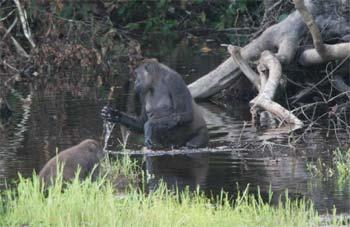
"We've been observing gorillas for 10 years here, and we have two cases of them using detached objects as tools," said Thomas Breuer, from the Wildlife Conservation Society (WCS), who heads the study team in Nouabalé-Ndoki National Park in the Democratic Republic of Congo.

"In the first case, we had a female crossing a pool; and this female has crossed this pool by using a detached stick and testing the water depth, and trying to use it as a walking stick," he told the BBC.
The second case saw another female gorilla pick up the trunk of a dead shrub and use it to lean on while dredging for food in a swamp.

She then placed the trunk down on the swampy ground and used it as a bridge.

"What's fascinating about these observations is the similarity between what these creatures have done, and what we do in the context of crossing a pond," observed Dr Breuer.

"The most astonishing thing is that we have observed them using tools not for obtaining food, but for postural support."
This discovery makes the gorilla the last of the great apes to be documented using tools in the wild.

Chimpanzees use stone tools to process food, and their close relatives bonobos will use the mashed ends of sticks to soak up liquids.

Orangutans - the only Asian great ape - use branches to forage for food, and leaves to modify their calls.

Though some monkeys and birds also use tools, Thomas Breuer believes that the great apes are special.

"We have now seen tool use in all the great apes in the wild," he said.

The issue remains, monkey.

Wednesday, September 28, 2005

More Monkey Trials


It should drive us all bananas that in this day and age of high-tech everything from cars to computers to dildos, that we should be assailed by the reality that some people want to impose thier medieval views on future children.

Here's another monkey trial, this time where parents are having to sue a distrct board for teling Biology teachers they must teach 'Intelligent (LOL) Design" as well as Evolution.


HARRISBURG, PA. — Tammy Kitzmiller testified yesterday that she is a firm believer in the separation of church and state, a stand that has made her a reluctant soldier in the battle raging across the United States over the teaching of evolution in high-school biology classes.

An office manager for a landscaping company and the mother of two teenage daughters, Ms. Kitzmiller is also the lead plaintiff in Kitzmiller et al v. the Dover District Board of Education, a case that opens a new chapter in the century-old struggle over the teaching of evolution that reached an early climax with the Scopes Monkey trial in 1925.

She and 10 other Dover parents have sued their school district, arguing that the board imposed a religious view on public-school students after board directors demanded that biology teachers present a one-minute statement promoting the intelligent-design concept as an alternative to Charles Darwin's theory of evolution, which it describes as flawed.

The U.S. Supreme Court ruled in 1987 that creationism -- the belief that Earth and its beings were created by God and not by natural selection -- could not be taught in public schools since it violated the separation of church and state


And as if that is not enough, there's the rest of it with this:


More than 30 U.S. states are considering measures to teach alternatives to evolution, Reuters reported. The Harrisburg case is the first to challenge such initiatives in court and is widely expected to end up at the Supreme Court of the United States, regardless of the outcome.

The parents and their supporters in the scientific community and at the American Civil Liberties Union argue that the intelligent-design concept is simply a retooled effort to introduce the God of Genesis into biology class.

The board and its supporters among Christian conservatives insist the intelligent-design concept is a valid scientific theory that makes up for fatal flaws in evolutionary theory.

Advocates on both sides of the divide are watching the case closely. President George W. Bush waded into the controversy recently by suggesting that schoolchildren should be taught both views.

The Dover parents are being represented pro bono by the ACLU and backed by the Americans United for Separation of Church and State and the National Center for Science Education.

The school district is being represented, also free of charge, by the Thomas More Law Center, a non-profit legal firm dedicated to the defence and promotion of the religious freedom of Christians; it litigates key church-and-state issues including school prayer, abortion and, now, intelligent design.

In testimony before Federal Court Judge John Jones yesterday, parents said that key school board members had initially wanted creationism introduced into the biology class, despite the fact that U.S. courts have rejected such attempts.

After advice from their lawyers, the directors settled on requiring a statement about intelligent design before the evolution lessons, which suggested students read a book on the concept, Of Pandas and People, which had been purchased and placed in the school library.

Ms. Kitzmiller, whose daughter, Jessica, opted out when the intelligent-design statement was delivered to her Grade 9 biology class last year, said the board's policy has devalued science education in Dover District High School, and subjected her daughter to ridicule for protesting against the move.

"I feel they brought a religious idea into the classroom, and I object to that," she said.

Bryan Rehm taught science at Dover High but transferred last year. He also has a daughter in Grade 9 who will have to decide whether to stay in the classroom or opt out when the intelligent-design statement is presented prior to the class taking up evolution in January.

Mr. Rehm said he attended several board meetings and met with board members who made it clear they considered evolutionary theory to be anti-Christian, even un-American. For several years, he said, teachers resisted pressure to "balance" their teaching of evolution and natural selection with the creationist notion that God created the Earth no earlier than 10,000 years ago with all species as they now exist.

"You're not going to tell me I come from apes," he recalled one angry board member, Jim Buckingham, demanding of him.

In fact, he said, the Grade 9 biology curriculum does not deal with the origin of the human species but focuses on evolutionary changes within organisms, changes that can lead to superbugs in humans and plants that are resistant to antibiotics and pesticides.


Yeah, buddy, you don't come from apes. You come from Harrisburg PA. While we're at it, the Earth is flat too; that's how we fly spaceshuttles in this day and age... not!

The thing is, it's not even that I object to organised religion (which is a different thing altogether); it's the sort of brazeen ignorance parading itsself as akind of pride, when in fact it'ss just a naked ego dance. And there's nothign to distinguish that kind of pride from say, Gay Pride or Feminism or any old crappy chauvinism or reverse-chauvinism. It still doesn't meaan what you believe in is scientific. Sort of like the stupid rantings of the Angry Fat Man, really.

There's also the ugly notion that every kid has to sit there and listen to this crappy piece of fiction when indeed there might be kids from non-Christian backgrounds to start with. Or as Chris once famously encountered while talking about Evolution in class to his students, a Muslim girl piped up and said, "Sir, I don't think you should be pushing your Christian views on to us".

The Blame game
There's not much to make folks laugh in the aftermath of hurricane Katrinaa, but you might like this for a laugh:


A combative Michael Brown blamed the Louisiana governor, the New Orleans mayor and even the Bush White House that appointed him for the dismal response to Hurricane Katrina in a fiery appearance Tuesday before Congress. In response, lawmakers alternately lambasted and mocked the former FEMA director.

House members' scorching treatment of Brown, in a hearing stretching nearly 6 1/2 hours, underscored how he has become an emblem of the deaths, lingering floods and stranded survivors after the Aug. 29 storm. Brown resigned Sept. 12 after being relieved of his FEMA onsite command of the Federal Emergency Management Agency's response effort three days earlier.

"I'm happy you left," said Rep. Christopher Shays (news, bio, voting record), R-Conn. "Because that kind of, you know, look in the lights like a deer tells me that you weren't capable to do the job."

"You get an F-minus in my book," said Rep. Gene Taylor (news, bio, voting record), D-Miss.

At several points, Brown turned red in the face and slapped the table in front of him.

"So I guess you want me to be the superhero, to step in there and take everyone out of New Orleans," Brown said.

"What I wanted you to do is do your job and coordinate," Shays retorted.

Talk about people sinking really low.
This is the government, people. Isn't it clear by now that the inmates definitely run the asylum?

Saturday, September 24, 2005

Gen X In Space

Here We Come, Here We Come
According to this cool article.


It is all very exciting… and long overdue. The Gen X-ers seem especially excited, as well they should be. Not only were they born too late to see the last moon landing, but at last, they may have found the great generational quest they've been longing and training (think computer games, robotic competitions, Star Wars/Trek, extreme sports, etc.) for their entire lives.
Some, like Elon Musk, couldn't wait for NASA. He took the millions he made founding PayPal and started Space Explorations Technology, the celebrated new rocket launch company. As it happens, Elon and I made a small side bet a couple years ago after he predicted to me that he would put a man on Mars within 15 years. It is a bet I sincerely hope to lose.

But the enthusiasm of Gen X-ers for space exploration should also be a warning. The more you ponder NASA's new plan the more you realize that it is fundamentally flawed. While the NASA lunar exploration plan is up-to-date on all of the new technologies invented over the last 50 years, philosophically and organizationally it is still trapped in the big business/big government paradigm of the '50s.

Like many established bureaucracies, NASA has largely failed to account for the generational — and attendant cultural — shift that has taken place outside of its walls. After my father retired from the Air Force, he went to work for NASA, and thus I spent a lot of the '60s hanging out (and eventually interning) at NASA's Ames Research Center. Looking at the old photos and memorabilia from that era, I am reminded that it was another country. NASA was the glorious culmination of an organizational culture that had its birth in the late 1930s at places like General Motors, was literally battle tested in World War II, and perfected in the corporate America of the 1950s.

The space program was the culmination of that culture, manned by the ex-GIs of the so-called "Greatest Generation" and led by the middle-aged men of the previous, arguably even greater, generation — those men and women born in the late 19th century, who came of age in the '20s. This group, the most extraordinary of any in American history, save the founders, included the likes of Eisenhower, Marshall, Dulles, Watson and Sloan.

It experienced more change than any generation that has ever lived. (My grandmother, who spent her infancy in a dugout cave on the Cherokee Strip, lived to see Neil Armstrong walk on the moon). And they knew how to build and manage huge, bureaucratic organizations. They also had millions of WWII vets, with their unique combination of discipline, duty and independent thinking, to fill those organizations. Between them, they created the wealthiest society in history, defeated totalitarianism and reached the moon. It is a legacy that will resound through history.

Damn it, let's go, let's go...

Imbecilic Denial
Also known as 'Intelligent Design' *gag* faces its first court-trial.


A federal judge in Pennsylvania will hear arguments Monday in a lawsuit that both sides say could set the fundamental ground rules for how American students are taught the origins of life for years to come.

At issue is an alternative to the standard theory of evolution called “intelligent design.” Proponents argue that the structure of life on Earth is too complex to have evolved through natural selection, challenging a core principle of the biological theory launched by Charles Darwin’s “The Origin of Species” in 1859. Instead, contend adherents of intelligent design, life is probably the result of intervention by an intelligent agent.

Argh. There is no end to these monkey trials.

Wednesday, September 21, 2005

More On The Space Vision Stuff


This Just In From The NYT
Nobody seems to quite agree on where the space program is going. The NYT has this article going through the various parties' objections to the current plan as it stands.


Advocates of the plan praise the recent choice of Dr. Griffin as head of the National Aeronautics and Space Administration, saying he has the knowledge, drive and experience to make big things happen. A physicist and an engineer with wide experience in academia, industry and the federal government (as well as six advanced college degrees), he joined the agency in April with a mandate to re-energize exploration plans.

"He's outstanding," said Louis D. Friedman, executive director of the Planetary Society, a group in Pasadena, Calif., that advocates space exploration. "He's got a serious intent to do it and do it right."

Backers also say Dr. Griffin is seeking to achieve the exploration goal within a level space agency budget, at least initially. His goal is to squeeze the shuttle to pay for developing new rockets and exploration vehicles. That, the supporters say, helps make the overall aim achievable, at least in theory, despite tightening budgets.

"From my own experience, the administration is very serious," said Douglas O. Stanley, an aerospace expert at the Georgia Institute of Technology who led the NASA exploration study. But Mr. Stanley added a significant caution, noting that the plan still faced votes in Congress.

Skeptics see a huge spending gap. Even if Congress blesses the effort, they say, no real bill will come due until Mr. Bush is long out of office.

"Stick the next administration with an impossibly expensive and pointless program and let them take the blame for ending human space exploration," said Robert L. Park, a physicist at the University of Maryland and an official at the American Physical Society, which has opposed many piloted space programs as scientifically unproductive. "This is a poison pill."

Dr. Park noted that in 1961 Kennedy promised a Moon landing "before this decade is out" and that the nation did so in eight years. By contrast, he said, Mr. Bush's goal is to redo the same accomplishment in 14 years, nearly twice as long.

"We went to Moon because of the cold war and won hands down," he said. "Now there's no political reason to do it."

Dr. Park noted that the first President Bush in 1989 proposed a space program with the same exploratory goals but failed to make any progress. Some political analysts say Mr. Bush consciously or unconsciously seeks to avoid his father's mistakes on Iraq, taxes, conservatism and other issues.

Rightly, the sceptics are looking at the plan as being incrdibly retrograde in its vector. The worst outcome would be if the program produces a destination for the embattled shuttle to go to.
OTOH it seems it's time to seriously think about the Sky Needle.

While we're on the topic, I found this article where the main gist is that any space program is not worth contemplating.


Since the 1980's, the U.S. space program seems to have no real goal or mission (other than to waste taxpayer money). We have spent enormous sums to build a fleet of space shuttles, which do nothing but orbit the earth and launch satellites.

We can launch satellites much quicker and cheaper with the use of rockets. This method also removes the risk of the loss of life. Considering the fact that each shuttle launch costs $600 million, the use of rockets seems an obvious answer. In fact, every scrubbed launch costs over $600,000 in labor and fuel costs.

Of course, the argument over whether or not the space program is a complete waste of money has been raging for decades. Truthfully, the American taxpayer sees very little or no return on their yearly donations to NASA. Private industry however, has reaped the largest rewards.

Here is a short but rather amusing list of some of the discoveries or 'side-benefits' of the taxpayer-funded space program:

-scratch resistant lenses
-golf ball aerodynamics
-athletic shoes
-sports bras
-fogless ski goggles
-cordless power tools

Presidents Clinton and Bush as well as the Republican-led Congress have all supported the expensive Mars Rover Project. Billions of dollars were spent to retrieve a few rocks and photos from the Red Planet. Besides pleasing lots of techno-nerds--the benefits of the project are tough to find.

How much impact does the discovery of an obscure mineral really have on the lives of most Americans?

President Bush has spent more on social programs than any other president (Republican or Democrat). Our supposedly conservative leader has never seen a spending bill he didn't like, or like to increase. Bush has never vetoed one bill. He recently signed a shameful pork-laden $286 billion highway bill. There seems to be no end to his generosity with our money.

It is obvious that we cannot rely on our current president to bring any measure of sanity to Congress' spending habits. We must find a leader who is a true conservative, both socially as well as fiscally. At this point, most of us would settle for one or the other.

There will come a time in the near future when we will be forced to cut back (and not just cuts in the increases!) on federal spending. The current space program is both wasteful and redundant. It must go!


Of course this sort of thing wouldn't get said if the current space program actually looked like it was doing something better than toss shuttles in the air and hope they come back down safely. The thing is, it could be so much better.

Idiot Watch
More on Creationists trying to convince science it ain't true.

Lenore Durkee, a retired biology professor, was volunteering as a docent at the Museum of the Earth here when she was confronted by a group of seven or eight people, creationists eager to challenge the museum exhibitions on evolution.
They peppered Dr. Durkee with questions about everything from techniques for dating fossils to the second law of thermodynamics, their queries coming so thick and fast that she found it hard to reply.

After about 45 minutes, "I told them I needed to take a break," she recalled. "My mouth was dry."

That encounter and others like it provided the impetus for a training session here in August. Dr. Durkee and scores of other volunteers and staff members from the museum and elsewhere crowded into a meeting room to hear advice from the museum director, Warren D. Allmon, on ways to deal with visitors who reject settled precepts of science on religious grounds.

Similar efforts are under way or planned around the country as science museums and other institutions struggle to contend with challenges to the theory of evolution that they say are growing common and sometimes aggressive.

One company, called B.C. Tours "because we are biblically correct," even offers escorted visits to the Denver Museum of Science and Nature. Participants hear creationists' explanations for the exhibitions.

So officials like Judy Diamond, curator of public programs at the University of Nebraska State Museum in Lincoln, are trying to meet such challenges head-on.

Dr. Diamond is working on evolution exhibitions financed by the National Science Foundation that will go on long-term display at six museums of natural history from Minnesota to Texas. The program includes training for docents and staff members.

"The goal is to understand the controversies, so that people are better able to handle them as they come up," she said. "Museums, as a field, have recognized we need to take a more proactive role in evolution education."

Dr. Allmon, who directs the Paleontological Research Institution, an affiliate of Cornell University, began the training session here in September with statistics from Gallup Polls: 54 percent of Americans do not believe that human beings evolved from earlier species, and although almost half believe that Darwin has been proved right, slightly more disagree.

"Just telling them they are wrong is not going to be effective," he said.

It should be enough, though.
There is seemingly no end to religious idiocy. No End.

Tuesday, September 20, 2005

2020 Hindsight


Back To The Future, Here We Come
We're talking the moon here. I saw the news bullwtin in the plane as I was heading back from NZ. NASA is planning to return to the moon with a manned mission by 2020. The pricetag? 135 Billion. Naturally critics are grumbling.


Some pundits took a stance similar to those at The New York Times, who saluted NASA’s “Apollo on steroids” approach in an editorial but also noted: “Unfortunately, the new plan lacks the pizzazz to inspire public support and will be operating under budget constraints that make delays or overruns likely.”

NASA’s roadmap to the moon, Mars and beyond also prompted House Science Committee Chairman Sherwood Boehlert, a Republican from New York, to applaud the exploration architecture while underscoring budgetary concerns.

Boehlert congratulated Griffin and his team on the “very thorough work” they have done. “While we are still reviewing the details, it appears that NASA has come up with an effective way to move forward, making the most of past U.S. investments in human space travel to enable us to enter the next phase of exploration in the safest, least expensive and most efficient way.”

That being said, Boehlert added: “The question Congress and the administration will still have to grapple with most is not the nature or desirability of the exploration architecture, but rather its timing.”

The lawmaker cited funding shortfalls in the space shuttle program, explaining that there is simply “no credible way” to accelerate the development of the shuttle follow-on — the Crew Exploration Vehicle — unless the NASA budget increases more than has been anticipated.

“Whether such an increase is a good idea in the context of overall federal spending at this time is something neither Congress nor the administration has yet determined,” he said in a written statement.


It's unappealing because in people's minds, the moon is a place where we've been and gone. People are looking to Mars. At the same time it should be noted that what NASA is talking about is talking about is developing a heavy lift vehicle that will take on future missions to Mars, let alone the moon. There's alos a Zurbin quote heere that's notable:


Zubrin also said there is negative aspect to the heavy-lift launch vehicle decision.

While preserving the heavy-lifter infrastructure, the plan relegates its development to a subsequent administration. “In consequence, for the next 13 years, NASA will continue to send crew after crew up and down to low Earth orbit, at a cost of some $70 billion, for no justifiable purpose whatsoever.”

In the post-Columbia environment, Griffin and others “have made the point that if we are to accept the costs and risks of human spaceflight, we should be undertaking missions that are worthy of those costs and risks,” Zubrin explained. “But for the next 13 years, we will continue not do so.”

So it might be the case that they get to the moon much later than the scheduled 2018/"by 2020".


Paul Spudis, a lunar and planetary scientist at the Applied Physics Laboratory, a research and development arm of the Johns Hopkins University in Laurel, Maryland, takes issue with those that see the NASA vision as an Apollo replay.

There is significant difference in Apollo of yesteryear judged against the NASA plan of today, Spudis said.

In the first place, the systems making up the vehicles are being designed for maximum leverage: long-life, cryogenic-based propulsion, potential reuse in space, Spudis explained.

Secondly, the mission is different.

“In Apollo, the mission was to prove we could land on the Moon and return safely to Earth. In this case, the mission is to determine the best site to collect and use the resources of the Moon and to emplace the necessary infrastructure to do so,” Spudis said. “Admittedly, the early missions will be very much like a ‘super-Apollo.’ However, they have potential to grow into something very different.”

Exactly what kind of 'different' he didn't say.

Wednesday, September 07, 2005

Tempel 1 Points To Panspermia


That's Right, You Heard The Man
Upon collision with Deep Impact, Tempel-1's contents revealed some very interesting substances. One of them was methyl cyanide, a chemical involed in the formation of DNA.

From the Christian Science Monitor (Perhaps a bit of Oxymoronic Irony there, no?) is this passage:


They have yet to identify all of the chemicals present in the material, which was ejected on July 4, when the comet collided with a projectile the Deep Impact spacecraft released.

But what they've seen so far makes it "more likely" that comets seeded Earth with the chemical precursors for organic life, says Michael A'Hearn, a University of Maryland planetary scientist and the mission's lead researcher.

Past studies from ground-based observatories and comet flybys have identified many of the chemicals in the halo of dust and gas that surrounds the core, as well as in the bright tails of comets.

But these sightings have had little to say directly about the amounts and relative abundance of the compounds comets contain in their cores.

As the team continues to pour through its data, researchers expect to identify all of the chemicals "that comets brought in abundance to the early Earth," Dr. A'Hearn says. "That will be our biggest contribution" to understanding comets' roles in the story of life on Earth.

One surprise: The team has detected an unexpectedly high concentration of methyl cyanide. Biologists say methyl cyanide is a key player in reactions that form DNA.

"If methyl cyanide is a particularly abundant component, it would suggest that comets could have delivered an abundance of these highly reactive compounds to the early Earth," notes Tom McCollom, a researcher at the University of Colorado at Boulder's Laboratory of Atmospheric and Space Physics.

Methyl cyanide's abundance may also confirm that comets like Tempel 1 can open a window on conditions from which the sun and solar system formed some 4.6 billion years ago.

In the dust and gas that inhabits the distances between stars, hydrogen cyanide is more abundant than methyl cyanide, notes Diane Wooden, an astrophysicist at the NASA Ames Research Center at Moffett Field, Calif.

But once frigid clouds of dust and gas begin to condense, methyl cyanide begins to dominate hydrogen cyanide in the center of the cloud where sun-like stars and planets will form.

Thus, Deep Impact may be looking at the heart of the cloud that gave birth to our solar system.

Deep Impact also has given planetary scientists the first direct measurements of a comet's density. The results imply that the nearly four-mile-wide nucleus is a loose ball of rubble. Global pictures of the nucleus suggest that it is built from two smaller sections that merged early in the object's history.

Moreover, when the impact struck, it burrowed into a layer of loosely bound, fine icy dust that is at least 30 feet deep. The surface appears to offer little support to anything that would land on it.


So in a roundabout way, Hoagland's ruminations about panspermia are being reinforced by the data that is coming out.
Oh yes, more notably, there are still no new photos or analyses. How'bout that, nudge-nudge-wink-wink?

Here's the same topic as covered by our fave popular science rag, 'New Scientist':


On 4 July, about 80 telescopes on Earth and in space trained their sights on Comet Tempel 1 when a 370-kilogram copper impactor was sent hurtling into its path. Just after the smash, a bright vapour plume spewed from the surface at about 5 kilometres per second, followed quickly by a stream of particles that spread into a cone.

The cone appeared to remain attached to the comet's surface for about 22 hours before separating into a detached arc. Researchers used this gravitational attraction to estimate the mass and density of the comet's main body, or nucleus. They found that the 72 trillion kilogram-nucleus was extremely porous, with as much as 80% of its volume taken up by empty space.

"That tells me there is no solid layer all the way down to the centre," says Mike A'Hearn, the mission's principal investigator at the University of Maryland in College Park, US. He says he had expected that the ice might become denser towards the core of the nucleus, but that instead "probably all the way in, ice is all in the form of tiny grains".

"It’s like a sponge, with a lot of cavities," agrees Horst Uwe Keller, an astronomer at the Max-Planck Institute for Solar System Research in Germany. He observed the event with Europe's Rosetta spacecraft and says the discovery confirms previous observations suggesting other comets are also porous. "When you touch it, it just crumbles under your hands."

Observers estimate the impact released about 5 million kilograms of water from beneath the comet's surface and between two and five times as much dust. There was so much dust, in fact, that mission members have not been able to see the impact crater with the high-resolution camera on the mission's flyby spacecraft, about 500 km away.

To add to the problem, that camera was malfunctioning but now image-processing techniques may have revealed a glimpse of the crater and team members may release the image later on Wednesday.

So there are images to come...
That ought to make things a lot more interesting.

BY THE WAY...
I'm off to NZ for 10 days. I may not have internet access during that time, in which case I won't be posting.
Just lettin' you all know so that you know why it's going to be quiet here. :)

Tuesday, September 06, 2005

Saturnine Rings Are Weird


It's Official
Here's a link to The Register with the article.


The Cassini imaging team has released a slew of previously unseen pictures from the Saturn ring and moon system, to coincide with the 37th annual meeting of the Division of Planetary Sciences of the American Astronomical Society held in Cambridge.
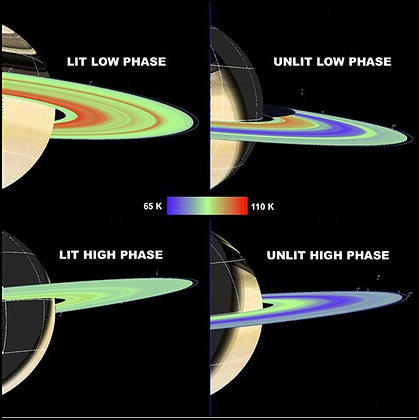
The scientists have identified new features in the rings, including some that are slightly mysterious. For instance, in the image below, you can make out small clumps in the ring structure. But what are they?

Scientists have long speculated that small moons, hidden among the many strands of the F-ring could be responsible for the odd structure of the region. The question is, are these clumps just disturbances in the ring structure caused by interactions with larger moons nearby such as Prometheus, or are they moons in their own right?
The imaging team explains that working out the answer is tricky, precisely because perturbations from nearby moons make the orbits in the region so complicated. This makes it hard to say whether sightings are the same object seen many times, or many, short-lived objects caught on camera during their brief existence.
Other images are less mysterious, but just as interesting. Recent snaps of the D-ring have been compared with older images from the Voyager missions. The results reveal that the structure of the ring has changed over time. In particular, one strand of the ring, known as D72, which was the brightest feature in the D-ring a quarter of a century ago has become much dimmer, and has moved inwards by about 200km.


Sort of puts a dent into the notion these rings of Saturn have been around forever and a day. I don't know about you, but i always thought that they'd been there since Saturn was formed.


Other related news:
BBC News
USA Today
Washington Post


While scientists puzzle over what caused the changes, their observations could reveal something about the age and lifetime of the rings.

Cassini-related discoveries were discussed Monday at a meeting of the American Astronomical Society's division of planetary sciences in Cambridge, England.

"I don't think Saturn's rings will disappear anytime soon, but this tells us how the rings are evolving and how long they might last, " deputy project scientist Linda Spilker said in a telephone interview from England.

Scientists are interested in Saturn's rings because they are a model of the disk of gas and dust that initially surrounded the sun. Studying them could yield important clues about how the planets formed from that disc 4.5 billion years ago.

What if they find out that they're a lot more recent than people thought? That'll cause a stink.


In other news, Cassini makes a flyby of Titan once more today, looking for lakes.

Saturday, September 03, 2005

Mailbag Stuff


Mother Of All Panoramas In Colour And Widescreen
That's the pickie above from when Spirit got up 'Husband Hill' on Mars, but now in colour.

No Blame?
I try to refrain from talking about the Presidency of GW (Global Warming?) Bush because the man inspires nothing but incredulous-ness and an odd sense of inappropriateness for a civilization in a post-modern era. The man is hardly modern, even though he preobably thinks he is because he totes a gun and drives a car and uses a mobile phone.

The War in Iraq is a subject in great contention here as it is everywhere, as some people disagree with it on principle, while others point out that crude oil is the issue and because civilization is running out of the stuff, we're suddenly in a bind. So it is today that I want to put up this link from Pleiades about how GW Bush diverted funds from eco-management and into his war effort, and howw that made an impact on how Hurricane Katrina made her impact on New Orleans.


Our friends at the Center for American Progress note the Office of Technology Assessment used to produce forward-thinking plans such as "Floods: A National Policy Concern" and "A Framework for Flood Hazards Management." Unfortunately, the office was targeted by Newt Gingrich and the Republican right, and gutted years ago.
 
In fact, there is now a governmentwide movement away from basing policy on science, expertise and professionalism, and in favor of choices based on ideology. If you're wondering what the ideological position on flood management might be, look at the pictures of New Orleans - it seems to consist of gutting the programs that do anything.
 
Unfortunately, the war in Iraq is directly related to the devastation left by the hurricane. About 35 percent of Louisiana's National Guard is now serving in Iraq, where four out of every 10 soldiers are guardsmen. Recruiting for the Guard is also down significantly because people are afraid of being sent to Iraq if they join, leaving the Guard even more short-handed.
 
The Louisiana National Guard also notes that dozens of its high-water vehicles, Humvees, refuelers and generators have also been sent abroad. (I hate to be picky, but why do they need high-water vehicles in Iraq?)
 
This, in turn, goes back to the original policy decision to go into Iraq without enough soldiers and the subsequent failure to admit that mistake and to rectify it by instituting a draft.
 
The levees of New Orleans, two of which are now broken and flooding the city, were also victims of Iraq war spending. Walter Maestri, emergency management chief for Jefferson Parish, said on June 8, 2004, "It appears that the money has been moved in the president's budget to handle homeland security and the war in Iraq."
 
This, friends, is why we need to pay attention to government policies, not political personalities, and to know whereon we vote. It is about our lives.

Aye to that.
The major point of why I'm putting it here instead of over at Flaming Horses as I ought with political stuff is because with Global Warming, we're going to be getting more and more severe storms like Hurricane Katrina; not less. Richard Hoagland is offering up a hyperdimensional weapon theory of Hurricane K but he need not look that far for a cuplrit. With all the ice shelves and glaciers melting around the world, there's a lot more water available to be thrown around by storms. This is all part of what's been predicted for years, and unlikely storms in the past are going to increasingly become moe likely in the coming years. Insurance companies are going to lose a lot of money going foorwards because Global Warming is going to throw out all their actuarial calulations.

To have had 5 years of an admnistration in America that chose to ignore this scientific advice, is just literally (as we can see) catastrophic. And ithe Addministration didn't ignore it at its own peril; it did it at the peril of its own citizenry. That's exactly where the outrage lies.

Thursday, September 01, 2005

Chimp DNA Mapped


Here's the big news of the day. they've mapped the chimp genome, and it turns out we don't share 98-98% but only 96% of genetic material. Well, could'a fooled me, given what I've seen in my lifetime.

Here's an interesting tidbit about the Y chromosome that I wanted to share:


But another aspect of the comparison has yielded insights into a different question, the evolution of the human Y chromosome. The new finding implies that humans have led sexually virtuous lives for the last six million years, at least in comparison with the flamboyant promiscuity of chimpanzees.

Some 300 million years ago, the Y chromosome used to carry the same 1,000 or so genes as its partner, the X chromosome. But because the Y cannot exchange DNA with the X and update its genes, in humans it has lost all but 16 of its X-related genes through mutation or failure to stay relevant to their owner's survival. However, the Y has gained some genes from other chromosomes because it is a safe haven for genes that benefit only men, since it never enters a woman's body. These added genes, not surprisingly, all have functions involved in making sperm.

The scientific world's leading student of the Y chromosome, David Page of the Whitehead Institute in Cambridge, Mass., has been seeking to understand whether the Y will lose yet more genes and lapse into terminal decay, taking men with it.

The idea of the Y's extinction "was so delicious from the perspective of gender politics," Dr. Page said. "But many of my colleagues became confused with this blending of gender politics with scientific predictions."

Two years ago, he discovered a surprising mechanism that protects the sperm-making genes. Those genes exist in pairs, arranged so that when the DNA of the chromosome is folded back on itself, the two copies of the gene are aligned. If one copy of the gene has been hit by a mutation, the cell can repair it by correcting the mismatch in DNA units.

The 16 X-related genes are present in only single copies. Dr. Page and his colleagues thought the chimpanzee genome might show how they were protected. To their surprise, they report in Nature, the protection was not there.

The chimp Y chromosome has lost the use of 5 of its 16 X-related genes. The genes are there, but have been inactivated by mutation. The explanation, in his view, lies in the chimpanzee's high-spirited sexual behavior. Female chimps mate with all males around, so as to make each refrain from killing a child that might be his.

The alpha male nonetheless scores most of the paternities, according to DNA tests. This must be because of sperm competition, primatologists believe - the alpha male produces more and better sperm, which outcompete those of rival males.
This mating system puts such intense pressure on the sperm-making genes that any improved version will be favored by natural selection. All the other genes will be dragged along with it, Dr. Page believes, even if an X-related gene has been inactivated.

If chimps have lost five of their X-related genes in the last six million years because of sperm competition, and humans have lost none, humans presumably had a much less promiscuous mating system. But experts who study fossil human remains believe that the human mating system of long-term bonds between a man and woman evolved only some 1.7 million years ago.

Males in the human lineage became much smaller at this time, a sign of reduced competition.

The new result implies that even before that time, during the first four million years after the chimp-human split, the human mating system did not rely on sperm competition.

Dr. Page said his finding did not reach to the nature of the joint chimp-human ancestor, but that "it's a reasonable inference" that the ancestor might have been gorillalike rather than chimplike, as supposed by some primatologists.

The gorilla mating system has no sperm competition because the silverback maintains exclusive access to his harem.


So amongst other interesting observations, it seems alpha-male is deep in our DNA. The socio-biologist inference seems to be that I must go and knock off some boss ape in Hollywood/somewhere for his harem apes and impregnate them all... Or not as the case may be. However, if monogamy is only 1.7million years old for us, no wonder we've still got major problems sticking to that plan. :)

Helix Nebula


"The Eye of God"
This was in from a friend:


This is a real photograph of the Helix Nebula, although it's technically not a single photograph but rather a composite image formed from several photographs taken by NASA's orbiting Hubble Space Telescope and a land-based telescope at the Kitt Peak National Observatory near Tucson, Arizona.
This image was NASA's "Astronomy Picture of the Day" for 10 May 2003. The picture's "Eye of God" appellation appears to have been a title coined by an admirer of the photo due to the nebula's resemblance to a human eye, not something designated by NASA.

There's also a link to a video.
Not bad, huh? Or is it Sauron staring back at us from Deep Space? :)

The Incontinent Continent On Encaledus


Cassini Update
We learn something new almost everyday thanks to the Cassini probe. This report has it that the South Pole of one of Saturn's moons Encaledus seems to be leaking water, venting into space via a hotspot under its South Pole:


Enceladus, a tiny moon orbiting Saturn, appears to be venting water into space from a series of fractures over its south pole.
The water vapour is pouring out of the body through an anomalous hotspot centred over its south pole, in only the second extra-terrestrial observation of thermal activity in the solar system.
According to the latest data from Cassini, the moon might have lost as much as five per cent of its mass since its formation, and figures suggest it is losing enough material to account for Saturn's E-ring.
The difficulty is, scientists can't explain how the south pole region might be getting so hot.
All the instruments on board Cassini point to something very unusual happening at Enceladus' south pole, the area towards the bottom of the moon in the image here, marked by four heavy crevasses, known as the 'tiger stripes'.

Speaking at a press conference in London yesterday, the researchers professed themselves "happy to be baffled" by the tiny moon. "If all you're doing is confirming your colleagues papers, it is no fun," said Torrence V. Johnson of NASA's Jet Propulsion Laboratory.
He explained that the two known sources of heat: radiogenic heating and tidal heating, are not enough, either alone or in combination to account for the behaviour. "Also, you would expect tidal heating to affect the whole body, or at least both poles. Its possible there is something special about Enceladus' structure that is focusing the tidal heating all in one area," he said.
Another possibility is that Enceladus was in a more eccentric orbit some time ago, and that this orbit provided enough tidal heating to kickstart the process we see the results of today. The surface of Enceladus's south pole is very young, so this could have been a relatively recent event.
Johnson says that the researchers have developed several 'cartoon sketches' of what might be causing the heating in the region, but stressed that he would not refer to their ideas as fully-formed hypotheses.
The first sign that something odd was going on was spotted by Professor Michele Dougherty. While reviewing magnetometer data, she noticed that Saturn's magnetic field lines were being deflected by the moon to a greater degree than its size could account for. She suspected the body might have an atmosphere - which would be unusual for a body just 500km in diameter, and would have to have an internal source - and petitioned mission planners for a closer fly by to see what was going on.

So, on 14 July this year, Cassini flew within 176km of the surface of the moon, and returned some spectacular images.
The data it gathered during that fly-by revealed that the moon does indeed have an atmosphere, and a very strange one at that. "It is probably around the entire body, but seems to be concentrated at the south pole," Dougherty explains, comparing the plume of material emanating from the moon to a cometary jet.
Temperature data from the surface revealed that the south pole is conspicuously hot, in contrast to the researchers' expectations.
John Spencer from the Southwest Research Institute in Colorado, analysed the data from the Composite IR Spectrometer said that they had expected the hottest temperatures - no more than 80 Kelvin - to be found near the equator, at noon when the sun was shining directly overhead.
What they actually found was a hotspot of around 85 Kelvin over the south pole. Zooming in for a closer look revealed that the temperature directly over one of the crevasses was 91 Kelvin: "Distinctly warmer than its surroundings," Spencer confirms.
Data from the visual IR mapping spectrometer provided more evidence of some kind of internal heat source.
The ice crystals near the tiger stripes are highly crystalline, as compared to the less ordered ice covering the rest of the moon. Bob Brown from the University of Arizona says that this forces the conclusion that the surface in that area is either very hot, or very young, or both.
The researchers also found simple chains of carbon on the surface near the fractures. "There is something very special about the fractures," Brown said.
Cassini has two more flybys of Enceladus scheduled, and the researchers will be keen to get more data from those to help them unravel the mystery.


Here's another story on the same thing:


Dr Torrence Johnson, from Nasa's Jet Propulsion Laboratory in Pasadena, California, said at a news conference in London yesterday: "We've been here before. These are early days in understanding the data. In a sense, it's nice to be baffled at this point.

"At the moment the maths does not add up. We did not expect what we know to be the available power sources here to be able to produce this kind of heat.

"I think we can expect some of our clever colleagues with models of evolutionary history of orbits and interior structure to come up with ways to explain this." Mission scientists made their first surprising discoveries about the moon after examining data collected by Cassini during two flybys, at 725 miles and 310 miles above the moon, on Feb 17 and March 9.

The spacecraft's magnetometer showed Saturn's magnetic field was being bent around Enceladus, suggesting it had an atmosphere, or layer of gas bound to it.

That an atmosphere is able to persist around a body with such low gravity indicated a level of geological activity sufficient to produce a constant supply of gas and water vapour. On July 14 the spacecraft got down to 108 miles above the moon's surface.

This time magnetometer readings showed the atmosphere was concentrated at the south pole. Cameras captured detailed images, showing the variability of its surface.

While the area to the north of the equator is pockmarked with impact craters, indicating geological inactivity, large areas around the south pole have a smooth surface, suggesting the terrain is much younger.

Of interest was a series of large cracks, dubbed "tiger stripes", centred around the south pole.

Also unexpected was the detection of frozen methane and other simple organic chemicals on the moon and in its atmosphere.

Infrared measurements showed an unexpected temperature distribution with a patch of "warm" temperatures, around -188C (-307F), near the southern fault lines.

Enceladus is believed to be losing material from its interior at the rate of around half a ton a second, probably settling an old debate about whether it is the source of material for Saturn's "E-ring", the outermost of the planet's famous rings.

Now wait for what Richard Hoagland might say. :)