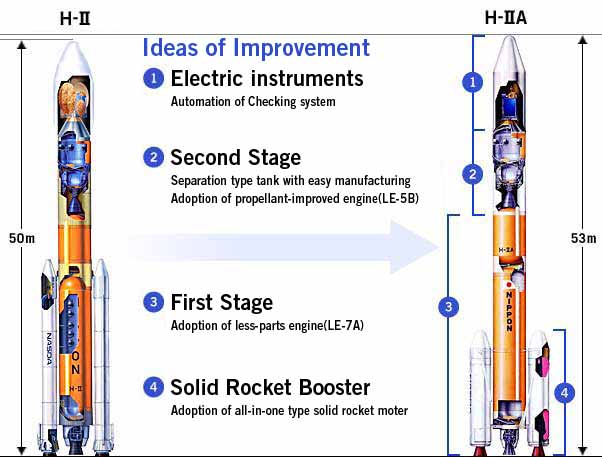
 Just thought I'd post this diagram before I forgot. It illustrates the bits they improved and changed from the all domestic HII rocket to the new and improved HII-A rocket. Apart from a drastic reduction in parts there are some structural changes that are noteworthty. The bit that connects the first and second stage known as the interstage section was one of the places where they vastly reduced parts and mass.
Friday, June 30, 2006
The HII And HII-A Rockets
Just thought I'd post this diagram before I forgot. It illustrates the bits they improved and changed from the all domestic HII rocket to the new and improved HII-A rocket. Apart from a drastic reduction in parts there are some structural changes that are noteworthty. The bit that connects the first and second stage known as the interstage section was one of the places where they vastly reduced parts and mass.

Wednesday, June 28, 2006
Back To The Other Future
No Laughing Matter
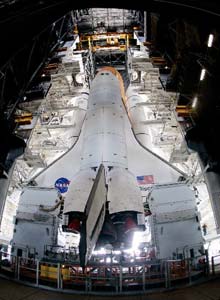
NASA thinks the next generaiton of space craft will be back to the rocket model they so disavowed at the dawn of the Space Shuttle era.
Instead of being carried into orbit piggy-back like the shuttle, its replacement will be sent into space as the payload of a rocket, in similar fashion to the Apollo Moon landers.This amounts to a total write-off of the last 20-30years of NASA since the Apollo missions ended. You really wonder where all that money went. Ugh. Talk about a 'wasted generation'.
Steve McDanels, manager of Nasa’s failure analysis branch at the Kennedy Space Centre in Florida, said that this was the only certain way of protecting crew capsules from the sort of damage that caused the Columbia disaster in February 2003.
“Having a payload-type craft application, where the craft is integral to the structure, is going to be the way forward,” he said. “There is no possibility of a foam strike that way.”
None of the designs currently under consideration for the Crew Exploration Vehicle that will replace the shuttle in 2012 features a winged, reusable craft, and it is highly unlikely that Nasa will return to the model that symbolised manned spaceflight in the 1980s and 1990s. “I think that won’t be at the forefront of the technologies explored,” Dr McDanels said.
They Don't Like Negativity
Engineer Charlie Camarda was displaced from the Shuttle crew in the upcoming launch.
WASHINGTON - New York astronaut Charlie Camarda has been bumped from his top NASA engineering post for backing colleagues who questioned the safety of Saturday's planned space shuttle launch, NASA officials said yesterday.Maybe it's not such a bad thing for his health.
Camarda's removal heightened the turmoil over NASA Administrator Michael Griffin's decision to take the "acceptable risk" of launching the Discovery orbiter despite warnings of potentially fatal blastoff debris.
Camarda, who flew aboard the troubled flight of Discovery last July, told colleagues in an e-mail that he was fired from his post as chief engineer at Houston's Johnson Space Center and given another NASA engineering job.
"I refused to abandon my position and asked that if I would not be allowed to work this mission that I would have to be fired from my position and I was," he wrote.
Camarda, 54, of Ozone Park, Queens, said he supported the dissents on launch safety made by NASA safety chief Bryan O'Connor and engineer Chris Scolese.
The Shuttle is scheduled for lunch this Satutday.
Monday, June 26, 2006
The HTV
JAXA Release Details Of HTV
While the whole International Space Station hangs on the shuttle mission, JAXA have released their idea of supplying the ISS.

This is the HTV 1/20th Model:
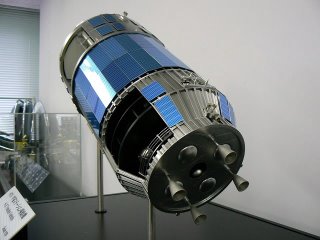 I've seen this object sittng in one of the foyers in Tsukuba. The model has moving sections when you press a switch up front.
This is how the HTV will be launched, on the the H-IIB rocket:

The HTV module is much heavier than any of the other pay-loads JAXA have fired into orbit. It's certainly rated to be beynd the capacity of the current H-IIA rocket system. Hence the development work going into the successor.
Once the HTV is launched and detached, it docks with the ISS:


...at one of the nodes.
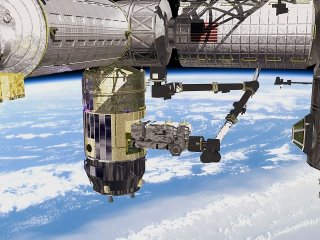
What's really interesting about the HTV is that it has a pressurised section and a non-pressureised section. Once in docking position, people on the ISS can get into the HTV's pressurised section as one of the modules of ISS. Then there is the de-pressurised section which can be exposed to the hard vacuum.
This is a mock up of the actual HTV


When I was there, they were laying in and testing electrical circuitry in this thing.
Now that I see these photos, I'm kind of a little nostalgic about my time there in Tsukuba. I was so exhausted by the end of the trip and it was the last location so I couldn't wait to get out of there; but looking back and seeing these photos, I kind of regret not pestering for more information.
While the whole International Space Station hangs on the shuttle mission, JAXA have released their idea of supplying the ISS.

This is the HTV 1/20th Model:
 I've seen this object sittng in one of the foyers in Tsukuba. The model has moving sections when you press a switch up front.
This is how the HTV will be launched, on the the H-IIB rocket:
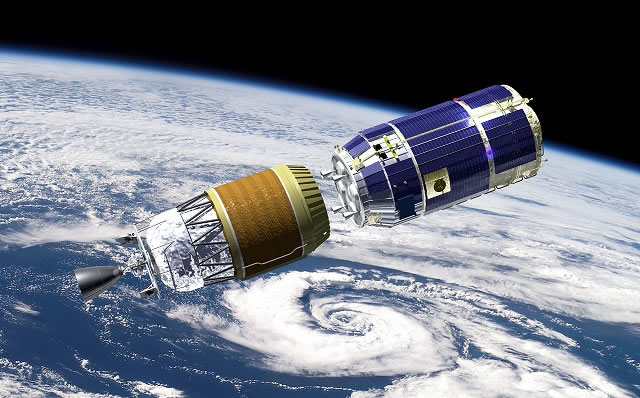
The HTV module is much heavier than any of the other pay-loads JAXA have fired into orbit. It's certainly rated to be beynd the capacity of the current H-IIA rocket system. Hence the development work going into the successor.
Once the HTV is launched and detached, it docks with the ISS:


...at one of the nodes.

What's really interesting about the HTV is that it has a pressurised section and a non-pressureised section. Once in docking position, people on the ISS can get into the HTV's pressurised section as one of the modules of ISS. Then there is the de-pressurised section which can be exposed to the hard vacuum.
This is a mock up of the actual HTV
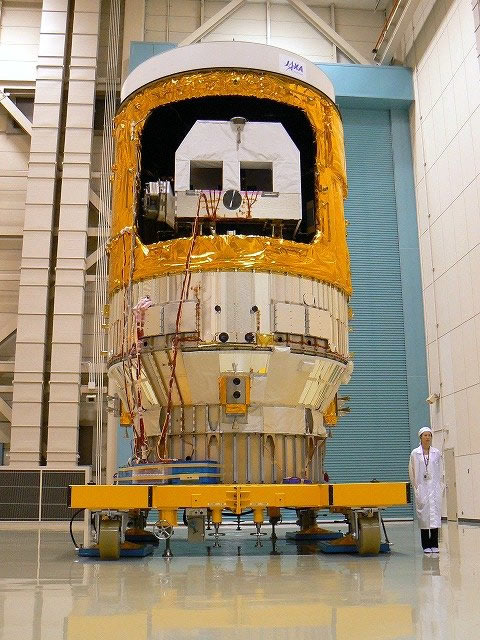

When I was there, they were laying in and testing electrical circuitry in this thing.
Now that I see these photos, I'm kind of a little nostalgic about my time there in Tsukuba. I was so exhausted by the end of the trip and it was the last location so I couldn't wait to get out of there; but looking back and seeing these photos, I kind of regret not pestering for more information.
Sunday, June 25, 2006
This Week's News
Hubble Trouble

The Hubble Telescope's main camera has shut down and this is creating a problem. Here's an entry from WaPo:

Meanwhile...
Everything Riding On This Shuttle Launch
Observers are saying that everything is riding on this coming shuttle launch.
Nix And Hydra
Pluto's been found to have 2 more moons.


The Hubble Telescope's main camera has shut down and this is creating a problem. Here's an entry from WaPo:
The Advanced Camera for Surveys, a third-generation instrument installed by a space shuttle crew in 2002, went off line Monday, and engineers are still trying to figure out what happened and how to repair it.
"It's still off line today," Max Mutchler, an instruments specialist at the Space Telescope Science Institute in Baltimore, said Saturday.
Engineers are hopeful the problem can be fixed, said Ed Campion, a NASA spokesman at Goddard Space Flight Center outside Baltimore, which is responsible for managing the Hubble.
A bad transistor could be causing the trouble, Campion said. If so, a backup could be used. Another suspicion is that some of the camera's memory was disturbed by a cosmic event. That could be fixed by reloading the memory.
"Both possibilities are things that can be resolved here on the ground," Campion said.
The loss of the camera has not shut down the telescope entirely, he said.
"The Advanced Camera for Surveys is regarded as sort of the workhorse for the telescope, but there are other instruments that are still working," Campion said.
Meanwhile...
Everything Riding On This Shuttle Launch
Observers are saying that everything is riding on this coming shuttle launch.
WASHINGTON (Reuters) - Space shuttle Discovery will carry more than crew and cargo for its scheduled July 1 launch from Cape Canaveral in Florida. The whole shuttle program's future is riding on this flight.Ouch. You just pray that this flight doesn't kill another seven astronauts. WaPo article is more matter of fact:
The stakes could scarcely be higher: if the flight proceeds with a clean, safe lift-off and a trouble-free 13 days, NASA officials have planned two more shuttle flights this year, aiming for the eventual completion of the much-delayed International Space Station and a possible fix for the aging but cherished Hubble Space Telescope.
But if Discovery is seriously damaged at launch and the shuttle crew is sent to shelter aboard the space station, NASA chief Michael Griffin has said he would consider ending the quarter-century-old shuttle program.
In that case, Griffin said on June 17, "I would be moving to shut the program down. ... I think, at that point, we're done."
That would make it virtually impossible to finish building the space station as currently designed or repair the Hubble. It would also leave the United States with no homegrown way to get humans to space until the next generation of vehicles is ready, probably around 2011.
Discovery's commander, Steve Lindsey, said he was encouraged by the forthright design debate since NASA was criticized after the Columbia disaster for squelching dissent.This isn't exactly encouraging to read at all.
"Both sides were listened to, very vocally and very publicly," Lindsey said. "You had a group of engineers who said, 'Change it.' Managers decided, 'Don't change it.' I guess time will tell which side was really right."
Armed with data from each new flight, NASA managers and engineers plan to make changes to the foam on the tank before each future flight until the fleet is grounded in 2010. The next-generation vehicle isn't expected to fly until around 2014.
NASA managers have acknowledged that another fatal mistake could ground the three remaining shuttles before the international space station is finished being built. It also could rule out any chances of a repair mission to the Hubble Space Telescope.
"Look, if we go fly and have another accident, that will be the end of the program," Hale said recently. "I'd rather not fly and say we couldn't get our act together ... than rush into some ill-advised launch where we had a catastrophe."
Nix And Hydra
Pluto's been found to have 2 more moons.

Pluto's two new moons formerly known as S/2005 P 1 and S/2005 P 2, have been named Hydra and Nix by the International Astronomical Union (IAU), the recognized authority for assigning names to celestial bodies. The announcement was made 21 June 2006 in IAU Circular 8723. The two moons were discovered with the NASA/ESA Hubble Space Telescope in 2005.There we go.
Oddbjørn Engvold, General Secretary for the International Astronomical Union, says: "I am very pleased with the decision of the IAU Planetary System Nomenclature Working Group".
Wednesday, June 21, 2006
Melroy's Space
 New Female Commander For The Shuttle
Here's the link.
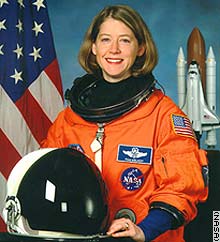
Air Force Col. Pamela Ann Melroy will become the second woman to command a space shuttle mission when her crew heads to the international space station next year, NASA announced.Hopefully this mission is all going to work out fine. We all know what a craptacular concept the shuttle is now, it's scary we're sending anybody up in it, but it does owe a few trips to the ISS.
Melroy, 44, follows in the footsteps of Eileen Collins, who charted a groundbreaking career as the first woman to pilot and command a space shuttle.
Collins retired from NASA in May after serving as commander last year of the first space shuttle since the 2003 Columbia disaster.
Melroy and five crew members will fly to the international space station aboard space shuttle Atlantis to deliver a module that eventually will connect to European and Japanese science laboratories, NASA announced Monday. The mission is tentatively slated for late summer 2007.
Other crew members are pilot George Zamka and mission specialists Scott Parazynski, Doug Wheelock, Mike Foreman and Paolo Nespoli.
It will be the third shuttle mission for Melroy, who served as a pilot on shuttle flights in 2000 and 2002. She is a native of Palo Alto, California, who graduated from Wellesley College and earned a master's degree in Earth and planetary sciences from MIT.
Sunday, June 18, 2006
Mo' Space Shuttlin'
Space Shuttle Luanch Date Set
This is despite the usual current objections.
Here's the article.

If It Talks Like A Duck And Walks Like A Duck...
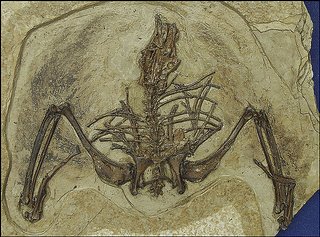
It was most probably a duck.
This is despite the usual current objections.
Here's the article.

NASA Administrator Mike Griffin, overruling objections from the agency's chief engineer and safety office, cleared the shuttle Discovery for launch July 1 on a mission to service and resupply the international space station. The flight also will clear the way for the resumption of station assembly later this fall and deliver a third full-time crew member to the international outpost.Here we go again.
The objections centered on the risk posed by launching Discovery with foam buildups around brackets on the ship's external tank that are now formally classified as "probable/catastrophic" in NASA's integrated risk matrix. That means it is probable that the so-called ice-frost ramps will shed debris with catastrophic results over the life of the program.
Griffin told reporters today he did not agree with the probable/catastrophic classification and added that even in a worst-case scenario, the astronauts would not be in immediate danger. Because of new cameras and other sensors, any damage would be seen and the crew could either attempt repairs or move aboard the space station to await rescue by another shuttle crew.
If It Talks Like A Duck And Walks Like A Duck...

It was most probably a duck.
Paleontologists have unearthed the exquisitely preserved fossils of what is the oldest known ancestor of modern birds, a loonlike swimmer and flier that flourished in lake country 110 million years ago in what is today northwest China.Anybody for calling it Peking Duck?
The fossils included five headless but otherwise nearly complete skeletons that show the outlines of soft tissues, including feathers and ducklike webbing between the toes. Researchers said the find suggested modern birds may have evolved from aquatic ancestors.
An international team led by Hai-lu You, of the Chinese Academy of Geological Sciences, found the fossils, known as Gansus yumenensis , in Gansu province near Changma, a mountain community about 1,200 miles west of Beijing. Results of their research are reported today in the journal Science.
"They were clearly able to fly but were also adaptable for swimming and diving," said team member Matthew C. Lamanna, of the Carnegie Museum of Natural History. "We don't know what they ate because we don't have a skull, but the legs and feet are those of a diver. He had a powerful kick stroke."
Wednesday, June 14, 2006
News To You?

Getting Ready To Leave
Stephen Hawking says we might have to leave Earth to survive as a species.
The survival of the human race depends on its ability to find new homes elsewhere in the universe because there’s an increasing risk that a disaster will destroy the Earth, renowned scientist Stephen Hawking said Tuesday at a news conference in Hong Kong.Need we say more about the cause for space when Stephen Hawking himself pitches in?
The British astrophysicist said that humans could have a permanent base on the moon in 20 years and a colony on Mars in the next 40 years.
“We won’t find anywhere as nice as Earth unless we go to another star system,” said Hawking. He added that if humans can avoid killing themselves in the next 100 years, they should have space settlements that can continue without support from Earth.
“It is important for the human race to spread out into space for the survival of the species,” Hawking said. “Life on Earth is at the ever-increasing risk of being wiped out by a disaster, such as sudden global warming, nuclear war, a genetically engineered virus or other dangers we have not yet thought of.”
STS-121 Update
The crew have arrrived for launch rehearsal.
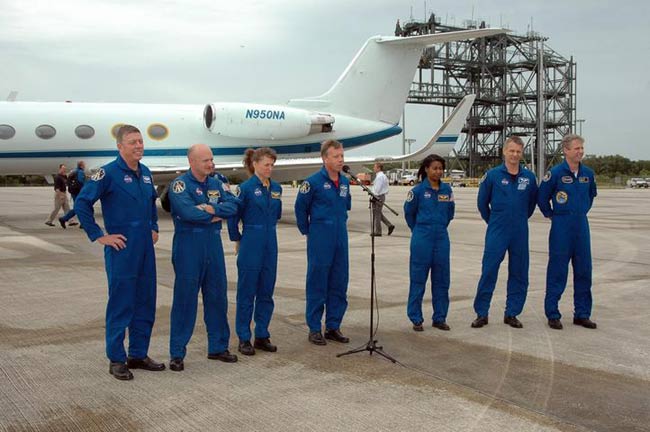
The next seven astronauts to fly the space shuttle Discovery arrived at NASA’s Florida spaceport Tuesday, each confident they will launch early next month and eager for a final dress rehearsal, their commander said.And so it goes again.
Veteran shuttle astronaut Steven Lindsey, commander of NASA’s STS-121 shuttle mission slated to launch July 1, said he believes the mission will lift off early in its 19-day flight window.
“I and my crew are pretty optimistic that early July looks good,” Lindsey said after his crew landed here at Kennedy Space Center (KSC) to practice launch countdown procedures with shuttle ground crews and mission controllers.
NASA managers will meet at KSC this weekend to pick a hard launch date for the STS-121 mission to the International Space Station (ISS), the space agency’s second planned shuttle flight since the 2003 Columbia accident, and hold press conference Saturday afternoon, NASA said in a statement.
Lindsey and his fellow shuttle crewmates walked off their jet transport at about 4:37 p.m. EDT (2037 GMT) after a two-hour flight from Houston, home to NASA’s Johnson Space Center, and one day of delays due to stormy weather spawned by Tropical Storm Alberto.
A veteran of three shuttle flights, Lindsey introduced reporters to his STS-121 crew: Discovery pilot Mark Kelly, mission specialists Michael Fossum, Lisa Nowak, Piers Sellers, Stephanie Wilson, and European Space Agency astronaut Thomas Reiter.
Subscribe to:
Posts (Atom)