Tuesday, April 25, 2006

NASA"s New Bird


It Could Be As Early As 2011...
Michael Griffin, the NASA administrator has been talking to Congress about the next program to replace the aging Shuttle fleet.
Currently, the target date for building a new vehicle is 2014.

With his pitch to Congress, Griffin underscored a point he has made previously about completing the spaceship on a faster time frame.

Pressed by Sen. Bill Nelson (news, bio, voting record), D-Fla., Griffin acknowledged an additional $1 billion could accelerate the program's completion.

The shuttle is to be retired in 2010, and lawmakers are concerned about when a replacement will be ready.

"If money were not an issue — going back to Apollo kinds of days — then I think it would be no technical problem to have an operational system available in five to six years," Griffin said after testifying before a subcommittee that oversees NASA spending.
Which is nice to know.
President Bush's budget calls for a 3.2 percent increase in NASA spending over last year. The House and Senate have authorized an additional $1.1 billion, but that is only a guide. The money must be appropriated by both chambers.

A Senate appropriations subcommittee was to scheduled to meet Wednesday to consider the proposed increase.

NASA will be shelving its three aging space shuttles in four years. The next generation of spaceships is supposed to carry astronauts to the moon by 2018 and eventually to Mars.

The so-called "flight gap" between the shuttles and their replacement could affect research and American space competitiveness, lawmakers said.

"We don't want a hiatus because we think that puts us in a security risk position," said Sen. Kay Bailey Hutchison (R-Texas).
What Hutchison is really saying is he doesn't want a break in the flow of government money into Aerospace industries. Well, we'll see if he has any influence. The old shuttle? That's bad juju.

Thursday, March 30, 2006

Second Scramjet Successful

Here's the Link.
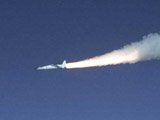
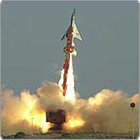
Australian scientists have developed an advanced supersonic jet engine that could profoundly revolutionize warfare and jet travel. The Sydney Morning Herald reported Monday that a University of Queensland team headed by Professor Allan Paull launched their HyShot program -- a two-stage Terrier-Orion rocket carrying their innovative supersonic scramjet -- skyward more than 200 miles to a height of more than 180 miles before it crashed as planned into the desert 250 miles down range.

Scramjets use atmospheric oxygen to burn hydrogen fuel. If such engines were fitted to commercial aircraft they could eventually cut the traveling time between Sydney and London to two hours.
Within a decade. Think of the economic impact of that one!

Tuesday, March 28, 2006

Scramjet Tests At Woomera


I always complain we don't have a proper space programme in Australia, but there's the scramjet research going on, which occasionaly surfaces in the headlines.

A supersonic jet engine known as a scramjet, which could dramatically reduce the time of air travel around the world, has been tested in South Australia's far north.

Seconds after the jet set off, there was a supersonic boom across the Woomera test range.

It travelled more than 300 kilometres into the air before crashing ten minutes later, 400 kilometres down the range.

The University of Queensland is heading an international team testing the scramjet technology, which travels up to 8,000 kilometres an hour - almost eight times the speed of sound.

Team leader Allan Paul says the flight went well but it will take several months to analyse the data they have collected.

He says the team is happy with the result so far.

"I haven't seen them on such a high for a long time," he said.

"It's been a hard couple of weeks, in fact it's been hard since Christmas, and the team has really responded well."

He says the launch went according to plan but there were a few tense moments.

"You're looking at it as it goes up, and you're worried if it's going to make it," he said.

"It's probably a very unnerving feeling actually."

Dr Paul says they should have some preliminary results by tomorrow.
That's kind of cool that the scramjet project is still going on.
What's really interesting is that JAXA have their own scramjet engine ready to be tested in Australia:
The test in Australia was the first of three flights planned for this year by the international Hyshot consortium.

Another Hyshot engine designed by the Japanese Aerospace Exploration Agency (Jaxa) will be next, followed in June by an engine capable of reaching Mach 10 designed by the Australian Defence Science and Technology Organisation (DSTO).

The success of the weekend's test spurred researchers from the University of Queensland to run a second scramjet test in South Australia this week.

Scramjets were first tested in 2001, but the trial failed as the rocket carrying the engine flew off course.
Hmm. That'ss interesting. I did see that Woomera was one of the places where JAXA did their experiments.

Sunday, March 26, 2006

Hard To Do


...Rockets Of Any Size
After having seen the JAXA facilities and spoken to the folks who do rockets, I can appreciate how diffciult it actually can be to launch rockets. So when I noticed this, I thought it was worth posting.
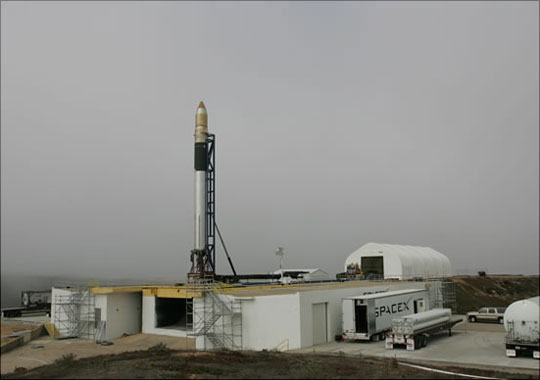
March 25, 2006— The low-cost, built-from-scratch Falcon 1 rocket faltered a minute after liftoff on Friday, dashing the hopes of Internet entrepreneur Elon Musk that after four years and roughly $100 million, his creation would be spared the fate that awaits most debut rocket flights.

"We had a successful liftoff and Falcon made it well clear of the launch pad, but unfortunately the vehicle was lost later in the first-stage burn," Musk, the founder of California-based Space Exploration Technologies, wrote in a blog shortly after the 5:30 p.m. ET liftoff from a remote launch site in the Kwajalein Atoll in the Pacific Ocean's Marshall Islands.

The cause of the failure was not known. Claimed in the accident was a $750,000 science satellite built by U.S. Air Force Academy cadets that was to monitor how space plasma disrupts communications and navigation satellite signals.

Musk, who made his fortune designing and selling the electronic services firms PayPal and Zip2, had said many times prior to the launch that it would take more than one failure to derail his plans to build and fly a family of low-cost, mostly reusable rockets.
At least the man is willing to try.
The Falcon rocket is powered by Liquid Oxygen and Kerosene. It is multi-staged and this version was to have two stages. If you read the article, they discuss a nine stage model.
Looking at the photo above, the control facilities seem awfully close to the blast off area...

Monday, March 13, 2006

Back From JAXA Part 2


Rocket Science Ain't Rocket Science
The old adage "it's not exactly rocket science" implies that Rocket Science is difficult. Well, it's Ballistics so it's not like the science of it is much harder than High School Physics. Even the engineering is something quite comprehensible. So why is rocketry so hard? It turns out that launching rockets is difficult because so many things have to be coordinatedd perfectly; so System Engineering as it is known is the bit in rocketry that is truly difficult.

Here's an example. The main engines of the HII-A rocket consists of Liquid Oxygen and Liquid Hydrogen engines. The explosive power is derived from controlled combustion of the LOX and Liquid H2, and this much is high school chemistry. The actual appartus of making and storing LOX and Liquid Hydrogen are also old chemical engineering problems. The fuels must be refrigerated to -150degrees celsius to keep them liquid.

The thing is, with rockets, the super-cooled liquid fuel has to be delivered to the fuel tank of the rocket on the launch pad without leaks and breakages. Organising it so that the rocket arrives for the launch window in time with the fuel in place to be poured in to the rocket's fuel tank takes a chunk of system enginnering, and in turn this is why you build a space center.

Tanegashima Space Center
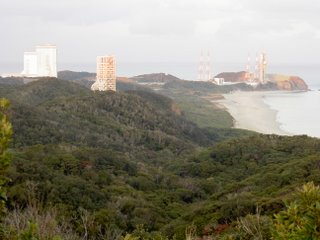
The most remarkable aspect of the Tanegashima Space Center is how far from the centre of civilization it feels. If not for the constant references to the space center and its rockets, the township of Minamitane is one of the furthest outposts from Tokyo. The place is historic in its own way, forever linked ballistics as the place where the Portuguese brought the musket to Japan; and it is here ballistics gets a second breath in the story of Tanegashima.

Tanegashima Space Center houses the facilities where they do the final assembly of the rocket; do the launch; but also test engines and assemble satellites. It's a big sprawling complex built on one of the most beautiful shorelines.

Surprisingly, the staff at Tanegashima are young. If you're used to meeting middle-aged men running institutions in Japan, you will get a rude shock here. There are many young men and women involved in important tasks; they're not window dressing. They have their degrees in rocket engineering and they are filled with hopes and ambition for the space program. One gets a sense of dynamism and activity quite unlike the stodgy bureaucratic feeling one gets from dealing with the main JAXA office. These operatives mean business. At one point I felt I missed my calling - I should've done rocket engineering.

What Is JAXA Like?
This is strictly my experience and therefore my own observation:
JAXA as an organisation is still very young.
You talk to the PR department and mostly they are enthisastic. You talk to the people on the ground actually running the rocket systems and they are incredibly enthusaistic. Even the big boss of JAXA has a long term vision as to where Japan's space program should be going.

Alas the thing that lets JAXA down is the level of management that is still a holdover from NASDA. It's really hard to get them to understand how important Public Relations can be for a space program. So even with the help of the PR department, you end up hitting strange, arbitrary walls that are set up by people who would rather keep things simple in their own minds by saying 'no'. Unfortunately, that's not good enough when Discovery Channel is spending big bucks to give you a 50minute commercial of your wares.

Some departments are very happy to show you what they are worrking on> Others say irrational things like "we can show it to you but you can't shoot it."
Well, what's the good of that? It's that kind of weird response that makes you think, "how seriously do they take the media?"

Indeed , it's symptomatic of large organisations in Japan that they do really bad PR, so JAXA are not an exception when their PR department can't convince their department heads to show off their wares. While I sympathise with the actual PR people I encountered the long term outlook on it is not very encouraging. If anything, it seemed they were drawing the wrong lessons and conclusions.

Other than that, JAXA is a young, dynamic organisation doing amazing things.

Thursday, March 09, 2006

Back From JAXA Part 1

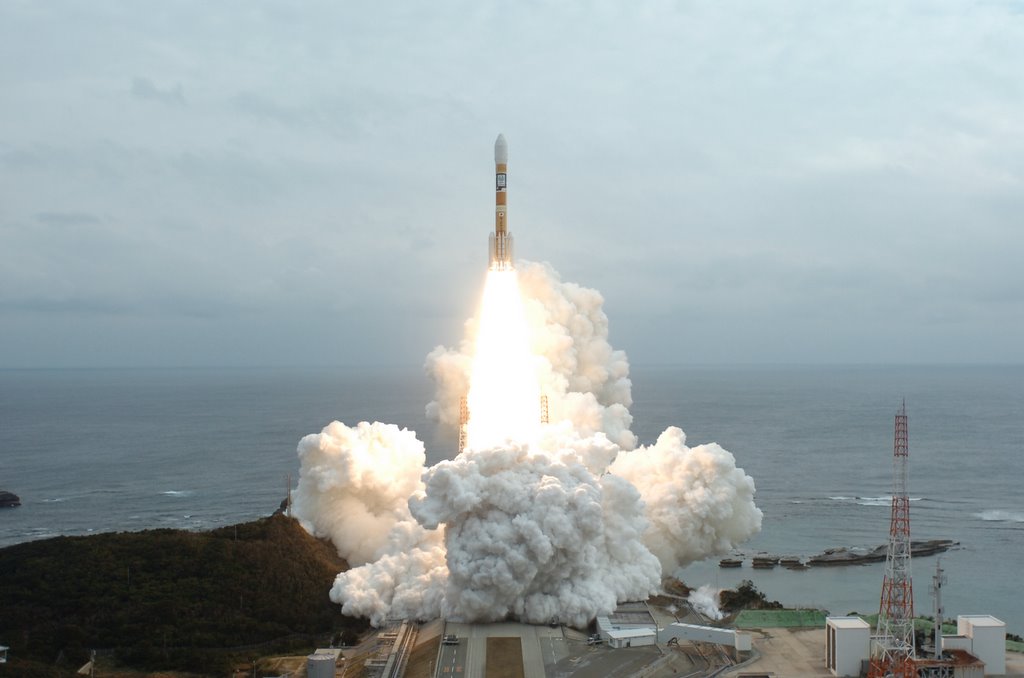
Here's that Photo Again...

33 Days On The Road - What Did I Find?
It was a tough little road trip, hopping from island to island, covering 2 documentaries for a very big documentary company. We went from Sydney to Narita to Okinawa (via Nagoya), then to Tanegashima (via Kagoshima) where they have the Space Center, then to Nagoya (via Kagoshimaa once more) and onto Tsukuba (via Narita), and then back to Sydney from Narita.

So Which bits exactly were JAXA? All of it except for Okinawa and Nagoya - Nagoya is where Mitsubishi Heavy Industries build rockets for JAXA. JAXA scatters itself widely across the Japanese archipelago. They have observations stations in Okinawa, and they have high altitude engine test-firing facilities, north of Sendai.

JAXA is what the old NASDA and a sundry bunch of organisations has been rolled into in ordert o be a more unified organisation. In the wake of the HII Rocket program being shutdown, a total re-organisation took place. Installled at the head of the organisation was Keiichi Tachikawa and theoretically, the whole organisation is meant to have unified into one big space development agency.

The Launch
The HII-A No. 9 launch we saw on the 18th of February represents a milestone accomplishment in many areas for JAXA. The No.9 launch delivered the largest payload into orbit, and it was part of a double launch that happened within a month of the 23rd January launch of the No.8 vehicle. In other words, it was the first time rockets were assembled parallel to one another in the big Vehicle Assembly Building and wheeled out to launch one after the other.

A lot of emphasis was made by the publicity people that what wass significant in this process was how two rockets were launched in quick succession; much more so than the issue of payload. Rocketry, it turns out is not comlex in its concept or in its component parts. If anything theey use tried and tested materials and parts. What is truly cutting edge about any rocket technology lies in the system engineering aspect, managing the diverse technological needs that go into successfully organising and assembling for launch. At the critical stages, at 270 seconds from laucnh the system goes into full automatic. People take shelter in the blockhouse or over 3.2 kilometres away.

The Rocket
The HII-A Rocket is the successor to the HII rocket. The HI Rocket was a rocket made mostly of imported technology. So the HII was developed during the 1990s with fully domestic Japanese technology. The problem was it turned out to be a very complex machine with too many parts, which in turn meant it was a very expensive machine to fire. This meant it was more vulenrable to failure and so when the HII program was cancelled, a concerted effort was made to streamline the cost of the rocket as well as reduce the number of parts. The result is the HII-A rocket.

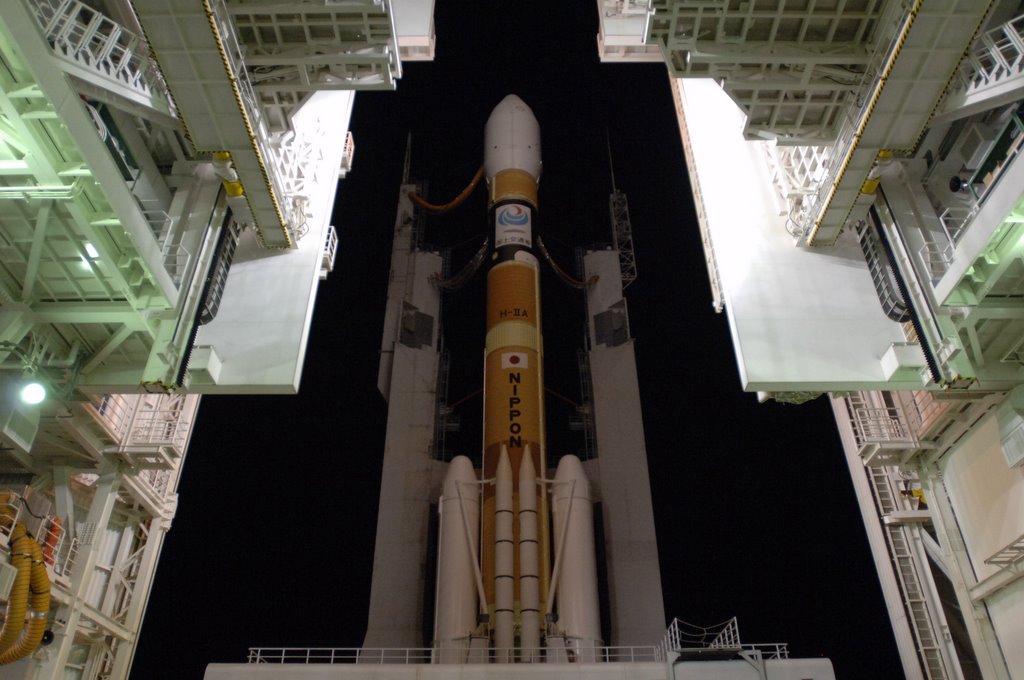
The HII-A rocket has far fewer parts than its predecessor. The most important 'part reduction 'took place in the black ring you see in the above ph0to. A quick way to tell apart the HII and HII-A is the 'interstage section'. The HII had a yellow metal ring. In the HII-A, it has now been replaced by a composite black material that has 80% fewer parts.

The payload of the HII-A rocket is 10 tons for Low Earth Orbit and 4 tonnes for Geostationary Orbit. In the future, they are hoping to make the HII-B rocket with up to 16.5 tons of payload to Geostationary Orbit.

The HII-A rocket is a 2 stage rocket with a main drive using a Liquid Oxygen and Liquid Hydrogen drive. In addition to the liquid fuel are the Solid Rocket Boosters and the secondary strap on boosters that fire solid rocket at launch. What makes the HII-A interesting is how the second stage engine is turned off and on during its flight. The rocket itself weighs in at 285tons, but the combined thrust of the first stage liquid fuel engine and the boosters is in the vicinity of 500 tons. With the HII-A rocket, Japan's aerospace lift capacity matches that of the ESA's Arianne 5, and the USA's Delta. What's remarkable about it is the cost with which they achieve their lift-offs. However, I'll leave that discussion for tomorrow.

Tuesday, February 28, 2006

From The Road


After a 12 day stay on Tanegashima Island, I have emerged from the IT Blackhole that has kept me from posting up these pictures.

I really have to knuckle down and sort through some photos and tell the tale of how I came to see Japan's HII-A Flight 9 launched into space. In the mean time, please enjoy these official pickies from JAXA.

By the way, here's a video clip I took.

Monday, February 06, 2006

REVISIONS IN NEED OF REVISING: WHAT WENT WRONG IN THE IRAQ WAR

This is a report from the Strategic Studies Institute. I've only started reading it and already it has won me over:

...critics also have neglected the larger lesson thatthere are certain limits to
what military power can accomplish. Forcertain purposes, like the creation
of a
liberal democratic societythat will be a model for others, military
power is a
blunt instrument,destined by its very nature to give rise to
unintended and
unwelcomeconsequences. Rather than “do it better next time,”
a better lesson
is“don’t do it at all.”

The full report is here.

Tuesday, January 31, 2006

Off On Sunday

Just a quick note to let you all know I fly out on Sunday 5th Feb and return on 9th Mar. It's the longest roadtrip I've been on. Don't knoww if can post aanything while I'm over there. I will take my laptop with me, so we'll see.

There have been some amazing changes of schedule within that block but as of this minute I think we're on top off it ... right now. Of course it may blow up on us tomorrow morning, but for now, we're on top. Yay.

So if you don't hear from me this month, apologies in advance.
Peace,
Art

Monday, January 23, 2006

H2-A Launches Successfully

H2-Away
After an anxious night of waiting, the H2-A rocket made its launch today at 10:33 as re-scheduled.

宇宙航空研究開発機構(JAXA)は24日午前10時33分、H2Aロケット8号機を鹿児島県南種子町の種子島宇宙センターから打ち上げた。約16分後、搭載した陸域観測技術衛星(ALOS)「だいち」を計画通り分離し、打ち上げは成功した。JAXAは2月中旬にも大型ロケット2機の打ち上げを予定している。1カ月間に3機連続の打ち上げは国内初で、衛星打ち上げ市場参入など、日本の宇宙開発の今後を占う試金石として注目を集めている。
 ◇2月中旬の2機打ち上げに弾み
 ロケットは太平洋上を東南に向かって上昇。予定通り高度約700キロで第2段ロケットから衛星を分離、衛星は地球を南北に周回する軌道に乗った。今後、観測機器の動作確認などをして、約3カ月後に運用を始める予定。
 8号機は当初、昨年9月に打ち上げ予定だったが、衛星に不具合が相次ぎ、今月19日に延期された。この影響でJAXAは8号機のほか、2月15日に種子島宇宙センターからH2A9号機を、同18日に内之浦宇宙空間観測所(鹿児島県肝付町)からM5ロケット8号機を打ち上げることになった。H2A8号機は今月19日の打ち上げも機器などの不具合や天候不良で延期されていた。
 今回の打ち上げ費用は約101億円で、衛星開発費は約547億円。【河津啓介】
 【ことば】H2Aロケット 宇宙開発事業団(現JAXA)が開発した2段式ロケット。全長53メートル、重さ321トン(衛星除く)。燃料の液体水素を液体酸素と反応させて推進力を得る。地球を回る高度300キロの軌道に約10トンの大型衛星を打ち上げられる能力がある。固体補助ロケットの種類や数を変えることで、さまざまな重さの衛星に対応できる。第1段ロケットを大型化し、国際宇宙ステーションへ物資を補給する17トン級の輸送機を打ち上げられる「H2B」を開発中。
 【ことば】陸域観測技術衛星「だいち」 高度700キロから地表を観測し、2万5000分の1の地図作成のための地形データ収集などを行う。46日ごとに同じ地点を同じ時間帯に観測できる軌道を回る。地表の2・5メートルのものを見分ける光学センサーなど3種類のセンサーを搭載。昼夜、天候に関係なく観測したり、災害時、3日以内に観測したい地点で緊急観測する機能も備えている。重さ約4トンで、国内打ち上げ衛星で最重量。


陸域観測技術衛星「だいち」を搭載したH2Aロケット8号機。打ち上げから約16分半後に、高度約700キロで分離され、地球を南北に約100分で回る軌道に投入された(24日午前、種子島宇宙センター)(時事通信社)12時03分更新

And this is good because it means it won't impact on our shooting schedule. It also means the thing works pretty well so weather permitting, she'll fly according to schedule on the 15th of Feb too.

Sunday, January 22, 2006

Pluto Probe Launch


Finally, the probe is launched and underway towards Pluto.
According to the NASA press release, the Atlas V rocket carrying the vehicle lifted off at 14:00 EST. It separated from the solid fuel "kick motor" a tad under 45 minutes later. Five minutes after that, radio signals from New Horizons confirmed that all was well.

Dr Colleen Hartman, deputy associate administrator for NASA's Science Mission Directorate, enthused: "Today, NASA began an unprecedented journey of exploration to the ninth planet in the solar system. Right now, what we know about Pluto could be written on the back of a postage stamp. After this mission, we'll be able to fill textbooks with new information."
Dr. Alan Stern, New Horizons' principal investigator, indulged in a bit of flag-waving with: "The United States of America has just made history by launching the first spacecraft to explore Pluto and the Kuiper Belt beyond. No other nation has this capability. This is the kind of exploration that forefathers, like Lewis and Clark 200 years ago this year, made a trademark of our nation."
I'm glad that one's underway. The JAXA launch is now sitting on the pad, waiting to go tomorrow morning.


宇宙航空研究開発機構は23日、陸域観測技術衛星「だいち」を搭載したH2Aロケット8号機の打ち上げを、24日午前10時33分に再延期すると発表した。
23日の打ち上げに向けて最終的な準備を進めていた22日深夜に、衛星を保護するカバー内の空調温度を監視する地上のシステムが、温度の上限を上回っているとの警告を発したため。

 同機構が、カバー内に送り込まれる空気の温度を別の複数のセンサーで測定したところ、正常な温度だった。同機構では「監視システムに誤った温度が設定されていることが判明したが、なぜそうなったかは不明」としている。同機構では、温度の監視を目視に切り替え、24日の打ち上げに臨むとしている。

 8号機は当初19日に打ち上げる計画だったが、ロケットの送信機に不具合が見つかって延期された。今回で2度目の延期となった。
The gist of that one is that there were some ground to tower problems.
So we'll see how that one goes.

Tuesday, January 17, 2006

We Are Stardust


Mission personnel remove a canister, bottom section, containing comet dust as they dismantle the Stardust capsule in a clean room Sunday, Jan. 15, 2006, at Dugway Proving Ground, Utah. The seven-year project collected particles from a comet. (AP Photo/Douglas C. Pizac)
We Have Fallen
NASA's Stardust Mission has returned to Earth. After a seven year mission to collect comet debris, NASA are describing the return of the stardust probe as a victory.
The Stardust capsule survived a fiery plunge through the atmosphere early Sunday, parachuting to the Utah salt flats. It bounced three times in soft mud before coming to rest on its side.

The landing chipped off a piece of the capsule's heat shield, meant to protect it as it re-enters Earth. But the capsule and its canister were in otherwise good shape, said Joe Vellinga of Lockheed Martin, which built the capsule.

"Everything is very clean. It looks very pristine," Vellinga said Monday.

Stardust's homecoming with the first comet particles ever captured in space was a relief for NASA, whose Genesis space probe carrying solar wind particles crashed and split open in 2004 after its parachutes failed to open. Despite the accident, scientists were able to salvage some of the fragile solar samples for analysis.
Two years ago the other probe just went bung on the way down and that was that. It's also the first bit of space rock to be brought back to Earth since the last Apollo Mission to my knowledge.

Getting Back To The Garden
I'm just going to jot down some headline that I've been unable to write about here. Well, it's life, y'know, I got busy. :)

The Propsed probe to Pluto is about to be launched.


It will be the fastest spacecraft ever launched, zooming past the moon in nine hours and reaching Jupiter in just over a year at a speed nearly 100 times that of a jetliner.

Its target is Pluto - the solar system's last unexplored planet, 4.8 billion kilometres from Earth. And the New Horizons spacecraft, set for liftoff on Tuesday, could reach it within nine years.
One of the outcomes of the Space Shuttle scuttlebut and dealys has been that many of the scheduled payloads haave not made their way into orbit. For instance, this European space laboratory here.

The US shuttle is the only vehicle that can carry large equipment to the International Space Station and its grounding has left the European Space Agency wondering how else it might send the Columbus research centre into orbit.

"What we hope is for the Columbus to be launched as quickly as possible," Jean-Jacques Dordain, director general of the European Space Agency, told a news conference on Monday.

US space agency Nasa halted shuttle flights for more than two years after the space shuttle Columbia disintegrated over Texas in February 2003, killing seven astronauts.

It launched the Discovery shuttle last July but the fleet was quickly grounded again because of new problems.
The next shuttle flight is tentatively scheduled for May. But Dordain said there are other countries with scientific projects waiting to catch a ride.

"There are others in the queue, notably the Japanese who want their laboratory launched as quickly as possible," he said.
So that's been drag.

Here's an interesting story on doing EVA.
The heavy reliance on orbital hardhat crews to build the station has raised the stakes for each journey out of the hatch. Now "assembly" walks, which last 6 to 8 hours, are packed with chores, and an unfinished job could affect construction for years to come.

During his time in space, the dangers were secondary, says astronaut and four-time spacewalker Michael Foale. "I'm not anxious about my life. I'm anxious about the task."

There is so much work to do that spacewalkers, who always go outside in pairs, no longer tackle all their tasks together. Instead they split up and may not see each other for hours, "a lonely feeling ... especially at night," Tanner admits.

Adding to the crew's burden, the chill of space will ruin some cold-sensitive parts of the station if they are not quickly installed. So spacewalkers race the clock, knowing that a $500-million piece of equipment could be a pile of space junk if they dawdle.

"The mental stress shouldn't be underplayed," says consultant Leroy Chiao, who left the astronaut corps in December. "When you're out there doing the work, you can't help but feel the pressure."
It's tough up there.
Here's another on EVA, this time with a cosmonautical flavour:
In a country where vodka is consumed in industrial quantities, officials at Russia's medical space research establishment said the consumption of alcohol in space was not only a right but a positive advantage.

"Folks are flying in orbit for half a year or so," a spokesman said. "They do tons of work. Especially exhausting are space walks where they can lose several kilos in several hours. That's why, many of us think that it won't be that bad to have a little drink to replenish one's strength."

Russian cosmonauts and space officials welcomed the idea of lifting the ban, but cautioned that weightlessness multiplies the effect of alcohol.

Yuri Lanchakov, commander of the Cosmonaut Corps at the Gagarin Cosmonaut Training Centre near Moscow, told the Sunday Telegraph: "Twenty grams of a good cognac [about one pub measure] would be good." He intends to issue a tot to anyone returning after a space walk, and to allow astronauts to drink alcohol to toast New Year.

Champagne, however, will remain prohibited because the pressure could turn bottles into small missiles if opened in the gravity-free atmosphere of the space station.

An official at Russia's Federal Space Agency (Roskosmos) said: "Not only could the recoil be unpredictable, but the bottle could explode even before you open it."

He welcomed the idea of allowing alcohol on the space station but said "everything should be in moderation" - perhaps remembering how in 1994 President Boris Yeltsin failed to emerge from his plane at Shannon Airport in Ireland after imbibing too much.


And that about wraps it up.

Thursday, January 12, 2006

My JAXA Trip

I've been rather busy and unable to post too much stuff here, so my deepest apologies.

It's been on the cards for a month now, but it's suddenly looking solid. I'm going to tag along on a shoot covering the 15th of Feb launch of the HII-A Rocket from Tanegashima Space Center (amongst other things). So hopefully, I'll be able to bring back some pictures for your all to see, andd hopefully some interesting insigght into Japan's Space Program which got revamped.

The more I reflect on it, the more I feel Australia let go of something big when they actually had Woomera running sending satellites into space and then stopped following it up. Australia was the fourth nation into space and it has to be said that we're nowhere near clawing back the lost distance. The lack of vision in this country is dissappointing on both sides of the political fence and there doesn't seem to be a single politician even remotely conversant with Space policy beyond satellite bandwidths. It's truly pathetic.
Anyway, that's my rant of the day.

Saturday, January 07, 2006

Cat Evolution Unlocked


Hi Gravity Traininng In This Thing? No Way!
That confused look on the kitten in the clothes drier isn't a look of consternation; it's more like the confusion of being annointed most successful lineage of the entire felidae 'cat' family.
Researchers have gained a major insight into the evolution of cats by showing how they migrated to new continents and developed new species as sea levels rose and fell.

About nine million years ago - two million years after the cat family first appeared in Asia - these successful predators invaded North America by crossing the Beringian land bridge connecting Siberia and Alaska, a team of geneticists writes in the journal Science today.

Later, several American cat lineages returned to Asia. With each migration, evolutionary forces morphed the pantherlike patriarch of all cats into a rainbow of species, from ocelots and lynxes to leopards, lions and the lineage that led to the most successful cat of all, even though it has mostly forsaken its predatory heritage: the cat that has induced people to pay for its board and lodging in return for frugal displays of affection.

This new history of the family, known as Felidae, is based on DNA analyses of the 37 living species performed by Warren E. Johnson and Stephen J. O'Brien of the National Cancer Institute and colleagues elsewhere.

Before DNA, taxonomists had considerable difficulty in classifying the cat family. The fossil record was sparse and many of the skulls lacked distinctiveness. One scheme divided the family into Big Cats and Little Cats. Then, in 1997, Dr. Johnson and Dr. O'Brien said they thought most living cats fell into one of eight lineages, based on the genetic element known as mitochondrial DNA.

Having made further DNA analyses, the researchers have drawn a full family tree that assigns every cat species to one of the lineages. They have also integrated their tree, which is based solely on changes in DNA, with the fossil record. The fossils, which are securely dated, allow dates to be assigned to each fork in the genetic family tree.

Knowing when each species came into existence, the Johnson-O'Brien team has been able to reconstruct a series of at least 10 intercontinental migrations by which cats colonized the world. The cheetah, for instance, now found in Africa, belongs to a lineage that originated in North America and some three million years ago migrated back across the Bering land bridge to Asia and then Africa.

Dr. O'Brien said the cats were very successful predators, second only to humans, and quickly explored new territories as opportunity arose. Sea levels were low from 11 million to 6 million years ago, enabling the first modern cats, in paleontologists' perspective (saber-tooth tigers are ancient cats), to spread from Asia west into Africa, creating the caracal lineage, and east into North America, generating the ocelot, lynx and puma lineages.

The leopard lineage appeared around 6.5 million years ago in Asia. The youngest of the eight lineages, which led eventually to the domestic cat, emerged some 6.2 million years ago in Asia and Africa, either from ancestors that had never left Asia or more probably from North American cats that had trekked back across the Bering land bridge.

Sea levels then rose, confining each cat species to its own continent, but sank again some three million years ago, allowing a second round of cat migrations. It was at this time that the ancestors of the cheetah and the Eurasian lynxes colonized the Old World from the New.

Chris Wozencraft, an authority on the classification of carnivorous mammals, said the new cat family tree generally agreed with one that he had just published in Mammal Species of the World, a standard reference. Dr. Wozencraft, a taxonomist at Bethel College in Indiana, based his classification on fossil and zoological information, as well as on DNA data already published by Dr. O'Brien's laboratory.

Cat fossils are very hard to tell apart, because they differ mostly just in size, and the DNA data emerging over the last decade has helped bring the field from confusion to consensus, Dr. Wozencraft said.

Despite their evolutionary success, most of the large cats are in peril because their broad hunting ranges have brought them into collision with people. "With the exception of the house cat and a few other small cat species, nearly every one of the 37 species is considered endangered or threatened," Dr. Johnson and Dr. O'Brien write in the current Annual Review of Genomics and Human Genetics.
Right.
Let's face it, the common housecat is more likely to go to space than any of the big cats - but that applies to dogs, pigs, chickens and most anything that is domesticated. Or maybe, put simply there's something in being domesticated that gives unnatural survival advantages to a species called human protection.

Tuesday, January 03, 2006

Second Year For Rovers

Rover Enter Second Year On Mars
Spirit and Opportunity are no longer Rookies
.


In two years, they have traveled a total of seven miles. Not impressed? Try keeping your car running in a climate where the average temperature is 67 below zero and where dust devils can reach 100 mph.

These two golf cart-sized vehicles were only expected to last three months.

The rover Spirit landed on Mars on Jan. 3, 2004, and Opportunity followed on Jan. 24. Since then, they’ve set all sorts of records and succeeded in the mission’s main assignment: finding geologic evidence that water once flowed on Mars.

Part of the reason for their long survival is pure luck. Their lives were extended several times by dust devils that blew away dust that covered their solar panels, restoring their ability to generate electricity.

Like most Earth-bound vehicles, these identical robots have their own personalities.

The overachieving Opportunity dazzled scientists from the start. It eclipsed its twin by making the mission’s first profound discovery — evidence of water at or near the surface eons ago that could have implications for life.

The rock-climbing Spirit went down in the history books by becoming the first robot to scale an extraterrestrial hill. Last summer, it completed a daredevil climb to the summit of Husband Hill — as tall as the Statue of Liberty — despite fears that it might not survive the weather.
The little machines just keep going like the duracell bunny. Watch out for the 'Sophomore jinx', I guess.

Thursday, December 29, 2005

Festive Season Space News

Titan Has A Halo


The thick distended atmosphere gives Titan a halo effect.
Images taken using blue, green and red spectral filters were used to create this enhanced-color view; the color images were combined with an ultraviolet view that makes the high-altitude, detached layer of haze visible. The ultraviolet part of the composite image was given a purplish hue to match the bluish-purple color of the upper atmospheric haze seen in visible light.

Small particles that populate high hazes in Titan's atmosphere scatter short wavelengths more efficiently than longer visible or infrared wavelengths, so the best possible observations of the detached layer are made in ultraviolet light.

The images in this view were taken by the Cassini narrow-angle camera on May 5, 2005, at a distance of approximately 1.4 million kilometers (900,000 miles) from Titan and at a sun-Titan-spacecraft, or phase, angle of 137 degrees. Image scale is 8 kilometers (5 miles) per pixel.
So that's the Cassini update of the month. A picture.

These Are The Rules
The rules for Space Tourism, that is.
More than 120 pages of proposed rules, released by the government Thursday, regulate the future of space tourism. This don't-forget list touches on everything from passenger medical standards to preflight training for the crew.

Before taking a trip that literally is out of this world, companies would be required to inform the "space flight participant" — known in more earthly settings as simply a passenger — of the risks. Passengers also would be required to provide written consent before boarding a vehicle for takeoff.

Legislation signed a year ago by President Bush and designed to help the space industry flourish prohibits the Federal Aviation Administration from issuing safety regulations for passengers and crew for eight years, unless specific design features or operating practices cause a serious or fatal injury.

"This means that the FAA has to wait for harm to occur or almost occur before it can impose restrictions, even against foreseeable harm," the proposal says. "Instead, Congress requires that space flight participants be informed of the risks."

Physical exams for passengers are recommended, but will not be required, "unless a clear public safety need is identified," the FAA says in the proposed regulations.

Passengers also would have to be trained on how to respond during emergencies, including the loss of cabin pressure, fire and smoke, as well as how to get out of the vehicle safely.

Pilots, meanwhile, must have an FAA pilot certificate and be able to show that they know how to operate the vehicle. Student or sport pilot licenses would not qualify.

Each member of the crew must have a medical certificate issued within a year of the flight, and a crew member's physical and mental state must "be sufficient to perform safety-related roles," the rules say.

The FAA also would require each crew member to be trained to ensure that the vehicle will not harm the public, such as if it had to be abandoned during a flight emergency.

The legislation that Bush signed last year tasked the FAA with coming up with rules to regulate the commercial space flight industry, which has been slowly getting off the ground.

Laws governing private sector space endeavors, such as satellite launches, have existed for some time. But there previously has been no legal jurisdiction for regulating commercial human spaceflight.

In 2001, California businessman Dennis Tito became the world's first space tourist when he rode a Russian Soyuz capsule to the international space station. Mark Shuttleworth, a South African Internet magnate, followed a year later on a similar trip, also paying $20 million for the ride.

Last year, in a feat considered a breakthrough for the future of private spaceflight, Burt Rutan won the $10 million Ansari X Prize by rocketing his SpaceShipOne to the edge of space twice in five days.

Two months ago, Greg Olsen, who made millions at a Princeton, N.J., technology company, became the world's third paying space tourist, also on a jaunt to the international space station.

The 123-page proposal was published Thursday in the Federal Register, the government's daily publication of rules and regulations, and will be subject to public comment for 60 days, through Feb. 27.

Final regulations are expected by June 23.

Anyway, you have to be a millinaire at this point to indulge in space tourism.


Galileo Satellite Launched


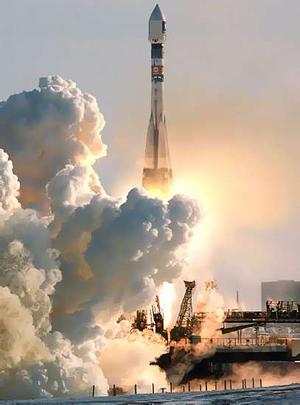
I've been slack with the festive season. The ESA has luacnhed its Galileo GPS satellite using Russia's Soyuz rockets.
The launch marked the start of Galileo, €3.8 billion ($A6 billion) European challenge to the monopoly of the US military-based Global Positioning System.

GPS is the only worldwide system offering services ranging from driver navigation to aid for search-and-rescue missions. But the GPS service offers civilians less precision than for military or intelligence purposes, and it is controlled by the US military, which has the power to degrade or switch off the signal.

Galileo will be a highly accurate civilian system, run by a private consortium. It is expected to go into operation in 2010.

Because it has a more penetrating signal that can work indoors (which GPS rarely does), offers better coverage of northern Europe and assesses its own accuracy, supporters believe it will usher in a new range of safety-critical services, such as aircraft and emergency vehicle guidance systems.

Galileo, which can pinpoint positions to within a metre, is designed for a host of new satnav applications, including ones from mobile phones. With the help of Galileo, it will be possible to find local theatres, shops, restaurants and cash machines on a mobile.

Tourists will be less likely to get lost with multimedia maps and directions delivered to their phones. Other services may locate children separated from their parents.

Galileo will also improve air traffic control and it could pave the way to nationwide road tolls.

Backers say it could create more than 140,000 jobs in Europe by 2013. But there are doubters, with one sceptic famously dubbing Galileo the "common agricultural policy of the sky".

The most important items in the rocket's payload are two rubidium atomic clocks and a navigation signal generator capable of transmitting codes and frequencies to be used by the 30 satellites that will eventually make up the Galileo network.
Great. More ways to extract tolls from moving around.

Wednesday, December 21, 2005

It Mightn't Have Been Water

Volcanoes Or Impacts?

Two scientific teams are claiming it might not have been water that gave rise to the features seen on the surface of Mars. Here's the Link.
Rather than abundant surface water over significant stretches of planet's history, as has been widely reported, Opportunity's observations might represent the results of a meteor impact or volcanic activity on an otherwise very dry world.

The counterarguments, presented in two papers in Thursday's issue of the journal Nature, go to the very heart of the ultimate question about Mars: Was it ever warm and wet enough to support life?

The new reports, however, are based on the initial data from the Opportunity rover during its first 45 days on Mars.

The Mars rover mission’s principal investigator, Steven Squyres of Cornell University, said both of the new studies could not take into account more recent data from Opportunity that were not available to the researchers.
So the stage is set for more arguments.

Cargoship Sent To ISS

In all the shuffle we tend to forget there's an International Space Station up there which is still under construction. Well, here's the update.
Russian engineers want to use the additional time to stow additional garbage and unused equipment on the unpiloted cargo carrier. That Progress and its contents will be destroyed as it re-enters the Earth's atmosphere in early March.
The Progress 20 cargo craft is scheduled to launch from the Baikonur Cosmodrome in Kazakhstan Dec. 21 and dock with the station on Dec. 23. The new Progress will bring supplies of food, water, fuel and air to the station as well as holiday gifts for the crew.

Expedition 12 Commander Bill McArthur and Flight Engineer Valery Tokarev wrapped up last week with more stowage of items in the Progress 19 cargo ship. McArthur also assisted Tokarev as he began Lower Body Negative Pressure testing, using special garments to draw blood down to his lower extremities to counteract the effects of weightlessness.
Life in space goes on. It's amazing how mundane this seems.

Tuesday, December 20, 2005

Operation Restore Sanity

Judge Throws Out The IDiots


Here's what is hopefully the final instalment on the Dover PA Monkey trial saga. Predictably where sanity prevails, the US District court judge John Jones found in favour of science and sanity.
During the trial, the board argued that it was trying improve science education by exposing students to alternatives to Charles Darwin's theory of evolution and natural selection.

The policy required students to hear a statement about intelligent design before ninth-grade lessons on evolution. The statement said Darwin's theory is "not a fact" and has inexplicable "gaps." It referred students to an intelligent-design textbook, "Of Pandas and People."

But the judge said: "We find that the secular purposes claimed by the board amount to a pretext for the board's real purpose, which was to promote religion in the public school classroom."

In 1987, the U.S. Supreme Court ruled that states cannot require public schools to balance evolution lessons by teaching creationism.

Eric Rothschild, an attorney for the families who challenged the policy, called the ruling "a real vindication for the parents who had the courage to stand up and say there was something wrong in their school district."
Judge Jones, I do not know you from a bar of soap, but I know one thing. You are a fine upstanding member of the civilised world! And to the parents who did contest the case against the crazy board, well done. It really is the case that evil happens when good people do nothing.

This bit in the article is both good, but also scary...
In his ruling, Jones said that while intelligent design, or ID, arguments "may be true, a proposition on which the court takes no position, ID is not science." Among other things, he said intelligent design "violates the centuries-old ground rules of science by invoking and permitting supernatural causation"; it relies on "flawed and illogical" arguments; and its attacks on evolution "have been refuted by the scientific community."

"The students, parents, and teachers of the Dover Area School District deserved better than to be dragged into this legal maelstrom, with its resulting utter waste of monetary and personal resources," he wrote.

The judge also said: "It is ironic that several of these individuals, who so staunchly and proudly touted their religious convictions in public, would time and again lie to cover their tracks and disguise the real purpose behind the ID Policy."

Former school board member William Buckingham, who advanced the policy, said from his new home in Mt. Airy, N.C., that he still feels the board did the right thing.

"I'm still waiting for a judge or anyone to show me anywhere in the Constitution where there's a separation of church and state," he said. "We didn't lose; we were robbed."
Hooray Judge Jones.
As for this William Buckingham moron? What a floating turd on the sea of humanity. Goodness. You'd think these crazies would pull their heasds out of their asses and take a look at the world. This business of trying to obfuscate the line between Church annd State that is taking place in the US and Australia is just retrogressive and disgusting.
This is from the doyen of WASP sensibility, TIME:
"Breathtaking inanity" is how U.S. District Judge John Jones characterized the Dover, PA school board's attempt to cast doubt on the theory of evolution—but in fairness, the recently ousted members of that board were relative unsophisticates, snookered by the intellectual scam that calls itself "intelligent design," or ID.

Where to begin? Well, first of all, proponents of ID point to what they insist are serious flaws in Darwin's theory of evolution by natural selection. The truth is that the theory is not only an overwhelmingly powerful explanation for how life on Earth manages to come in such a bewildering array of different types, but the only such theory in science. Like any scientific theory, it can't explain how every aspect of every organism came to be, but each time scientists find new evidence—fossils of dinosaurs bearing feathers; fossils of the mammals whose descendants are whales; the molecular structure DNA that carries traits from one generation to the next; the mutations that can alter DNA to introduce new traits—the case for Darwin's theory has gotten stronger.

Do any gaps remain? Sure. Shall we throw up our hands and say "Since we don't know all the details at this moment, God"—oops, I mean, "an Intelligent Designer must be invoked?" The Discovery Institute, a pro-ID think tank favors teaching the controversy over evolution, but that's the scam. There is no controversy, or at least, not the scientific controversy Discovery says there is..

That's not to say there isn't a tiny handful of actual scientists who back ID. Yes, evolution explains a lot, they say, but some things—the eye, for example, or the whiplike tails on some bacteria—are just too complex to have evolved. To which the vast majority of biologists say nonsense. We don't have remotely enough information to make such a statement. Moreover, if ID is a valid theory on its own, it has to make testable predictions. "It's too complex to explain" is not a prediction.

So ID isn't science, and by that measure alone the Dover school board's attempts to make it so were indeed inane. But beyond that the board insisted that by leaving out the G-word you remove the religious connotation from ID, thus evading a 1987 Supreme Court ban on religion in science classrooms. Again, the board bought the story of people like Lehigh University biologist Michael Behe, an ID proponent, who says that ID doesn't assume the existence of God (although Behe admitted he thinks the Intelligent Designer is God). Judge Jones didn't buy that loophole (and for that matter the Discovery Institute stayed out of this case entirely, evidently realizing that it was a legal stinker).

Alas, ID isn't going away. The Kansas school board recently endorsed new educational standards that downplay evolution, and new assaults on Darwin's brilliant and unsettling idea are sure to continue. Meanwhile, there are still gaps in Einstein's theory of relativity and the germ theory of disease and the theory of plate tectonics. However, none of these contradict the sacred text of any religion—and so no school board is likely to be looking for some way to counter them.
Oh yes. Next we'll be trying to disprove the world is round. More Monkey-Trial Business to come in Kanasa and Georgia.

Monday, December 19, 2005

The Beagle Has Crash Landed

The Beagle 2 Probe, That Is...


Here's the link.
A sophisticated analysis of grainy images from a Nasa spacecraft has convinced the Beagle 2 team that the lander met its end in a small crater, into which it touched down in the early hours of Christmas Day 2003 with little chance of survival.

The pictures from Mars Global Surveyor, which have been pored over by an expert who once interpreted spy satellite images for the RAF, show an impact point in the crater and several objects that appear to be Beagle 2’s protective gas bags and, perhaps, the lander itself.

They suggest that the probe was lost because of cruel luck as it touched down in one of the worst possible places for a soft and successful landing. Rather than dropping to the surface on a flat plain, it appears to have first struck the downslope of a small crater about 18.5m (60ft) in diameter, before crashing into its opposite wall, bouncing several times around the rim and eventually coming to rest at the bottom. Even if the gas bags that were meant to cushion its impact were fully inflated, and there is some evidence that they were not, their design would not have allowed them to protect the probe properly under these unlikely circumstances.

“It’s a bit like hitting the side of the pocket in snooker,” said Professor Colin Pillinger, of the Open University, who led the mission. “The plan was for it to bounce along a flat surface, but instead it seems to have hit the wall of the crater and that messed up the bounce sequence, damaging the lander. If this is all true we were very unlucky. A sideswipe like this was just what we didn’t want.”

The fate of Beagle 2 has been pieced together from two images taken in February and April last year, each of which showed anomalous dark patches inside a small crater inside the ellipse where the probe is known to have landed. Guy Rennie, of Virtual Analytics, has analysed the pictures to make sense of the grainy blotches. One dark patch stands out exceptionally clearly, and almost certainly shows the disturbance of Beagle 2 ’s first bounce to the ground.

Mr Rennie said that the evidence points firmly towards the crater as Beagle 2’s final resting place. “There are objects in the crater, and there are not numerous craters all with objects inside them,” he said.

“These are features that are very, very unusual and are not seen anywhere else. When you add to that the features that look like bags and a lander, then it’s very, very compelling evidence. If we’re right, this was terrible luck.”
So bad luck sunk the Beagle 2 probe. Where were the redundancies in the planning for this?
Beagle 2 was of course supposed to search for signs of life on Mars. What a drag, but at least we know what happened to it.

The Woolly Mammoth On Comeback Trail


About a year before 'Jurasic Park' came out, I wrote about this possibility, so I'm happy to spot this article.
A portion of the genetic code of the mammoth has been reconstructed and, to the surprise of scientists, the team that carried out the feat believes that it will be possible to decode the entire genetic make-up.

The tusked beast stood 12-feet tall, weighed up to seven tons and had a shaggy dark brown coat that hung from its belly.

DNA was extracted from a well-preserved 27,000-year-old specimen found in the Siberian permafrost. So far, about 30 million "letters" of the genetic code have been read, albeit in small pieces, representing around one percent of the entire code.

The team says it could take as little as a year to finish the estimated 2.8 billion-letter code that provides the genetic wherewithal to create the animal.

Scientists in Japan and Russia have announced plans to attempt to clone woolly mammoths with the help of living relatives and, despite scepticism that they will be successful, today's work will renew interest in the idea.

Dr Stephan Schuster of Pennsylvania State University, one of the team that announced the new work in the journal Science, said last night that it may also be possible to genetically alter an elephant to turn it into a mammoth.

The work is described by an international team of researchers, including one from Oxford University, who sequenced a chunk of ancient DNA belonging to the mammoth and "fellow travellers" from its remains, including bacteria, fungi, viruses and plants that lived at the same time as the mammoth.

The team extracted nuclear DNA from the mammoth's jawbone, concentrating it before it was amplified and sequenced by a relatively new technique called pyrosequencing.
It's very close to the Asian Elephant so it's feasible, they say.
So, one of these days we'll probably see a mammoth after all.

Meanwhile Another Species Heads For Trouble
You gotta like this - not.
As if criticism over its stance on the Kyoto Protocol wasn't enough, the United States' government is now facing a lawsuit by three environmental groups over the possibility of extinction of polar bears due to global warming. The suit was filed in the US District Court in San Francisco on Thursday.

The three groups, Center for Biological Diversity, the Natural Resources Defense Council (NRDC) and Greenpeace, have sought protection for the bears under the Endangered Species Act and have demanded that the species be designated as 'threatened'.

“As global warming continues, more bears are going to die. This is very predictable, it's common sense. Their habitat is sea ice. They don't hunt from land, they don't hunt from water. They can't survive if their habitat disappears,” said Kassie Siegel of the Center for Biological Diversity. “To ensure these bears survive, we need to reduce the pollution that is melting their habitat. The Endangered Species Act is a safety net for plants and animals facing extinction. Listing will provide important protections for this majestic animal,” she added.
These are the bear facts: they're not waving, they're drowning.
Preparing To Send Cargo To Pluto


The fastest space vessel yet is set to go on a 10 year trip to Pluto.
Pluto is the only planet that has never yet had a human-engineered visitor, but if all goes well, New Horizons, a piano-size spacecraft wrapped in thermal blankets, will spend five months in close flyby, taking pictures and gathering data on features such as the planet's atmosphere, its surface geology and its temperature.

"We really expect the mission to be transformational," said New Horizons lead scientist Alan Stern of the Southwest Research Institute in Colorado. "This is the capstone of the original visits to the planets. It takes us 4 billion miles away and 4 billion years back in time."

The $700 million mission is the first space expedition aimed specifically at a celestial body beyond Neptune in the Kuiper Belt, a remote region filled with debris from the creation of the solar system. Pluto is also the solar system's only known "binary planet," orbiting the sun in tandem with a moon, Charon, that is more than half as big as Pluto itself. Two other tiny moons were discovered earlier this year.
So what's Goofy?

Thursday, December 15, 2005

Space Spiders And New Mexico Space Base

Robot Assembly In Orbit


Spider shaped robots could be used to build satellites in orbit. well, so goes the headline.

A mission to determine whether spider-like robots could construct complex structures in space is set to launch in January 2006. The spider bots could build large structures by crawling over a "web" released from a larger spacecraft.

The engineers behind the project hope the robots will eventually be used to construct colossal solar panels for satellites that will transmit solar energy back to Earth. The satellites could reflect and concentrate the Sun's rays to a receiving station on Earth or perhaps beam energy down in the form of microwaves.

The Japanese Aerospace Exploration Agency will launch a satellite called Furoshiki on 18 January 2006, which will conduct three experiments to test the idea. The satellite will be deployed from a rocket on a sub-orbital trajectory. This means scientists will have only 10 minutes of microgravity in which to perform their tests before the craft starts its descent back to Earth and eventually burns up in the atmosphere.

The first experiment will see three small satellites detach from the mother ship and stretch out to form two corners of a triangular net with their mother craft forming the other. Onboard cameras will be used to verify that the net, which measures 40 metres on each side, remains as steady as possible and that the daughter satellites do not get tangled in the web.

Well, I guess the Japanese really love their robots. :)
If indeed I get to see the JAXA launch as paart of this doco crew, it won't be the 19 January launch but the 15 February launch.

$250million? (That's A-Rod Money)
It's the cost of Richard Branson's proposed spaceport. It's about the quarter of the cost of a brand new modern MLB stadium.
Branson said that nearly 100 people have paid the $200,000 price to reserve a seat on his planned SpaceShipTwo flights, and thousands more have sent deposits. He said Virgin expects to be launching three seven-passenger flights per day over New Mexico by 2010. The planes are to be equipped with extended seat belts to allow passengers to float in zero gravity.

But Richardson expressed hopes for the spaceport -- to be constructed on the high desert near the White Sands Missile Range -- that soar far beyond Branson's sightseeing trips.

The state's preliminary plans include three intersecting runways and two towers for rocket launches. The terminal will be underground. The governor predicted cargo service from New Mexico to Paris in "a couple of hours" and "orbital hotels" where space fliers could take a vacation of cosmic dimensions.

Richardson said the state government will pay about half the construction cost, in the range of $130 million, with the remainder to come from local and federal governments. Legislative leaders said the funding will almost surely be approved. With record tax revenue from a booming energy industry, New Mexico is predicting a budget surplus of about $1 billion this fiscal year.

"This commitment demonstrates that New Mexico is a state that embraces entrepreneurs, adventurers, pioneers and risk takers," Richardson said.

Who said space programmes had to be expensive?
I think I mentioned this before, but the 1950 Robert Heinlein vision of space travel was strictly funded by brave private financiers and entrepreneurs. I see echoes of that thinking in Branson.

Wednesday, December 14, 2005

Hayabusa Update

It Might Be Long
Before it gets back to us.
The trouble-plagued Hayabusa space probe has developed engine problems that will delay its return to Earth by about three years to June 2010, the Japan Aerospace Exploration Agency (JAXA) said Wednesday.

"We are disappointed about the postponement of the departure, but we will work hard to have the probe back to Earth as long as there is a possibility," professor Junichiro Kawaguchi, a project manager, said.

A glitch occurred in the Hayabusa's engine on Nov. 26, when it landed on and took off from the asteroid Itokawa for the second time.

The probe was supposed to have fired a metal ball into the surface of the asteroid, located about 290 million kilometers from Earth, and collect samples. But the probe apparently failed to fire the ball.

Fuel started leaking from the craft's chemical engine used for positioning immediately after it took off froLinkm the asteroid.

The leak stopped, but the fuel has collected in other parts of the probe and is spurting out sporadically. This has made the craft's position unstable and has almost completely cut off JAXA's communication with the probe since Dec. 9.

Work to determine the cause of the trouble cannot be carried out under such conditions.
So much for that one.

Branson Plans For Space Tourist Customers
Here's the link.

Virgin Galactic, the British company created by entrepreneur Richard Branson to send tourists into space, announced yesterday it will build a $225 million spaceport in New Mexico.
The company said up to 38,000 people from 126 countries have paid a deposit for a seat on one of its manned commercial flights, including a core group of 100 "founders" who have paid the initial $200,000 cost of a flight upfront. Virgin Galactic is planning to begin flights in late 2008 or early 2009.

New Mexico Economic Development Secretary Rick Homans said construction of the spaceport, to be built largely underground near the White Sands Missile Range, could begin in early 2007.

Virgin will have a 20-year lease on the facility, with annual payments of $1 million for the first five years and rising to cover the cost of the project by the end of the lease.

"Virgin is the beginning and many other space companies will follow," Homans said.

Virgin Galactic said it had chosen New Mexico as the site for its headquarters because of its steady climate, free airspace, low population density and high altitude.
So the space tourism era is nigh upon us.

Monday, December 12, 2005

Today's Grab Bag Of Headlines

Making The Same Mistakes?


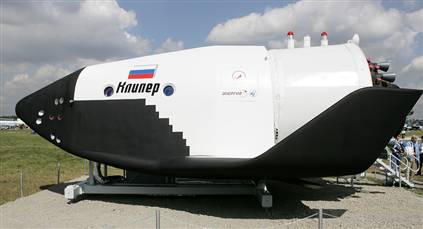
It's odd-looking, I know. This is a mock-up of the proposed Russian Space mini-shuttle 'Klipper'. It's more modern and filled with the experience of Soyuz capsule returns. The European Space Agency has agreed to support this project, but it being a shuttle and all, you sort of wonder if this is a wise investment.
Russia hopes its reusable Clipper shuttle will be ready for test flights early next decade and would then gradually take over from the veteran Soyuz spaceship, which has been putting cosmonauts in orbit since the 1960s.

Earlier this week, ministers from European Space Agency (ESA) countries failed to pledge money to the Clipper program, despite agreeing to spend more on other space research. But ESA Director General Jean-Jacques Dordain remains optimistic.

"I am convinced we can get wide support," he told reporters in Moscow after talks with Russia's Roskosmos space agency.

Officials have said Russia can theoretically fund the Clipper -- or Kliper -- program by itself but would welcome international involvement to speed up the work.

"It is not a question of member states for and member states against. I think the decision could not be taken for reasons that are not linked to Clipper itself. The decision could not be taken because of budgetary restraints," Dordain added.

Then again, you'd think that somebody somewhere might have a better way of building any kind of ERV.

Hayabusa Misses Catch


It turns out that Hayabusa didn't manage to get a sample from the asteroid.
After that, we found that there was a high possibility that the projectile (bullet) for sampling had not been discharged on Nov. 26, as we finally acquired a record of the pyrotechnics control device for projectile discharging from which we were not able to confirm data showing a successful discharge. However, it may be because of the impact of the system power reset; therefore, we are now analyzing the details including the confirmation of the sequence before and after the landing on Nov. 26.

As of Dec. 6, the distance between the Hayabusa and the Itokawa is about 550 kilometers, and that from the earth is about 290 million kilometers. The explorer is relatively moving from the Itokawa toward the earth at about 5 kilometers per hour.

We are now engaging in turning on, testing, and verifying onboard equipment of the Hayabusa one by one to start the ion engine. We currently plan to shift the attitude control to one using the Z-axis reaction wheel, and restart the ion engine. The restart is expected to happen no earlier than the 14th. We are currently rescheduling the plan for the return trip to earth. We need to study how to relax the engine operation efficiency. We will do our utmost to solve the problem with the attitude control (such as the restoration of the chemical engine), then find a solution for the return trip.
Kind of a bummer really, as that's the reasson why it was sent in the first place.

Magnetic Pole Instability


The North Pole is moving South.
After some 400 years of relative stability, Earth's North Magnetic Pole has moved nearly 1,100 kilometers out into the Arctic Ocean during the last century and at its present rate could move from northern Canada to Siberia within the next half-century.

But the surprisingly rapid movement of the magnetic pole doesn't necessarily mean that our planet is going through a large-scale change that would result in the reversal of the Earth's magnetic field, Oregon State University paleomagnetist Joseph Stoner reported today at the annual meeting of the American Geophysical Union in San Francisco, Calif.

Stoner and his colleagues have examined the sediment record from several Arctic lakes. These sediments - magnetic particles called magnetite - record the Earth's magnetic field at the time they were deposited. Using carbon dating and other technologies - including layer counting - the scientists can determine approximately when the sediments were deposited and track changes in the magnetic field.

The Earth last went through a magnetic reversal some 780,000 years ago. These episodic reversals, in which south becomes north and vice versa, take thousands of years and are the result of complex changes in the Earth's outer core. Liquid iron within the core generates the magnetic field that blankets the planet.
This is kind of scary as it means the Van Alllen Belt will be affected.
Shifts in the North Magnetic Pole are of interest beyond the scientific community. Radiation influx is associated with the magnetic field, and charged particles streaming down through the atmosphere can affect airplane flights and telecommunications.
Nice to know, huh?

Killer Whales Are Poisonous


Being a Top Predator in the ocean means you get to absorb all sorts of toxins from your prey.
Previous research awarded this dubious honour to the polar bear, but a new study shows that killer whales have even higher levels of PCBs, pesticides and a brominated flame retardant.

The results are based on blubber samples taken from killer whales in Tysfjord, a fjord in arctic Norway. This is the first time the findings of the research, carried out by the Norwegian Polar Institute (NPI), and partly funded by the Norwegian Research Council, have been revealed.

“Killer whales can be regarded as indicators of the health of our marine environment," said Dr Hans Wolkers, a researcher with NPI.
That's not good news either.

Monday, December 05, 2005

Going To JAXA?

I Might Be There
Yes, I might be there for the 19th January launch at Tanegashima Space Centre. How? It goes like this: I got a call to research some Japanese civil engineering marvels and somewhere along the way, people got excited about Japan's space program.
So I may actually tag along to the crew who will cover Tanegashima Space Station and be there for the scheduled 19th Jan launch... with any luck. :)
Needless to say, I'm excited I might finally get to see a real live launch.

Cassini-Huygens Update


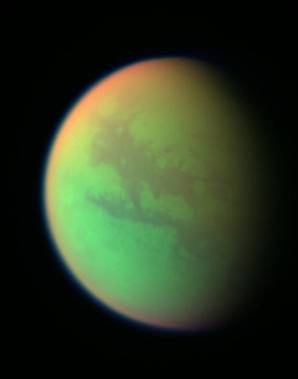
Up close and Personal with Titan. This is a false colour picture. They are reconsidering the possibility of life on Titan again.

Recent findings from NASA's Cassini spacecraft and new discoveries about organisms here on Earth that thrive in extreme conditions are causing scientists to rethink the possibility that there may be life on Saturn's cloudy moon Titan.

Analyzing data from Cassini's recent Titan flybys, scientists at the Southwestern Research Institute (SwRI) in Texas and Washington State University announced last week that several of the key elements crucial for life on Earth are also present on Titan, including liquid reservoirs, organic molecules and ample energy sources.
Do tell, y'know?

Hey, It's A Brave New World


I've been busy lately as the low rate of posting indicates. It never rains, it pours. So too with work, which is good for a change. The fuzzy pic you see is the landscape of Titan.
When the Huygens space probe landed on Titan, the area around the lander is a soft patch of material similar to lightly packed snow. But to get to that soft patch, Huygens had to descend through a treacherous atmosphere with winds ranging up to 270 mph. Temperatures also dropped as low as -333 degrees Fahrenheit, and lightning was about.

Nearly a year after the probe landed on Saturn's largest moon, scientists are still poring over loads of data. Today, researchers released their newest findings in a series of seven reports. The findings provide a better picture of some of the most basic characteristics of Titan, a smog-shrouded world that had eluded close scrutiny until Huygens and the Cassini mothership teamed up for a series of observations.

Scientists had long suspected that Titan's atmosphere was moving around the moon faster than the moon was rotating – a physical characteristic known as superrotation and previously observed on Venus. Now, data from the probe's DISR instrument and the Doppler Wind Experiment have confirmed that Titan's methane filled clouds do indeed superrotate.

While the uppermost clouds – about 75 miles above the surface – spin around the moon at about 270 miles per hour, wind speeds gradually decline as the near the surface. Here generally weak winds, gusting no more than a few feet per second, were observed in the lowest 3 miles of the probe's descent.

The probe passed through one other region of near zero wind speeds, from altitudes 62 to 37 miles. Scientists cannot explain this yet.

During its descent, Huygens provided the first in situ look at what chemicals exist in Titan's atmosphere. The atmosphere is mainly nitrogen and methane, but scientists didn't know how these chemicals originated – did they arrive in their present form or were they originally part of other molecules and were chemically altered to the states seen today.

The gas argon 36 was detected by the Gas Chromatograph Mass Spectrometer in very low abundance, and scientists say this indicates that nitrogen was originally present as part of ammonia. Also, the early atmosphere of the moon was at least five times denser with nitrogen than it is now, suggesting that some of the gas has been lost into space.

Ratios of carbon isotopes also indicate that the atmosphere is also leaking methane, and that there must be some period method for replenishment, although none was observed. Some researchers predicted there would be a large methane surface or subsurface reservoir that replenished the atmosphere, although that too was not seen. Also missing from the observations was the signs of methane rain, which scientists believed showered the moon's surface.


Which is all very nice. The next pic is from this article.


This perspective view shows dark plains on the surface of Saturn's moon Titan about 3 miles (5 kilometers) from the Huygens probe landing site. In this area many discrete bright feature are scattered across the dark plains.

This provides stereo coverage with a resolution of about 45 feet per pixel (about 14 meters) and a convergence angle of about 6 degrees. The perspective image is color-coded in altitude with blue lowest and red highest. The ridges in the center of the view are about 150 feet-high (roughly 50 meters); the area covered is about 1.6 miles by 1.6 miles (2.5 by 2.5 kilometers). The topographic features toward the bottom right part of the view are suggestive of flow and erosion by fluids on the surface.
There's a full resolution version here.
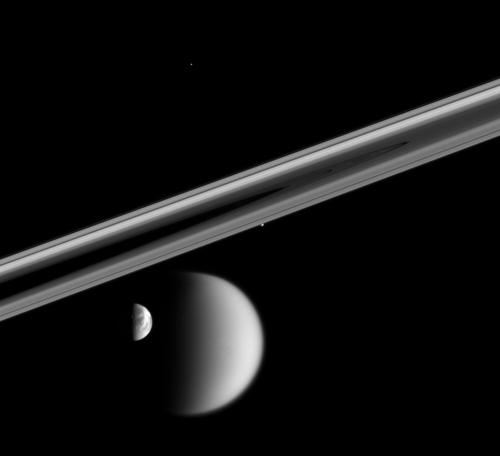
The next picture is a portrait of a near full alignment of Saturn's moons. Of course as we know Iapetus is waywardly off the plane. The article is here.


Seen here are Titan (5,150 kilometers, or 3,200 miles across) and Dione (1,126 kilometers, or 700 miles across) at bottom; Prometheus (102 kilometers, or 63 miles across) hugs the rings at center; Telesto (24 kilometers, or 15 miles across) is a mere speck in the darkness above center.

The image was taken in visible light with the Cassini narrow-angle camera on Oct. 17, 2005 at a distance of approximately 3.4 million kilometers (2.1 million miles) from Dione and 2.5 million kilometers (1.6 miles) from Titan. The image scale is 16 kilometers (10 miles) per pixel on Dione and 21 kilometers (13 miles) per pixel on Titan.
Yeah.

Shuttle Might Go Ramp-less In Next Flight


I don't know how this would work, mostly because I'm no expert, but this article suggests the next shuttle flight might fly without the foam ramp in its next trip.
The picture above is an image taken after separation with the shuttle and shows where the foam fell off.

Into A Bright Sun


This article covers the SOHO project, which brought us images like the one above.
This brings us to SOHO, also a joint American-European project, and another epic solar voyage still underway. Launched Dec 2, 1995, its array of instruments were designed to study the solar wind, as well as the Sun's outer layers and interior structure.

In order to do this, it was placed in an orbit 1.5 million kilometers from Earth, at a point known as the L1 Lagrangian point, where the combined gravity of Earth and Sun keep it in an orbit locked to the Earth-Sun line. Though still far from the Sun, this location, about four times the distance of the Moon in the direction of the Sun, is ideal for long-term uninterrupted observations with the Earth out of the way.

SOHO's scientific findings have been phenomenal. It has imaged the structure of sunspots below the surface, measured the acceleration of the wind from the Sun (streams of protons and electrons traveling at a million miles per hour!), discovered coronal waves and solar tornadoes, and found more than 1000 comets.

Moreover, it has revolutionized our ability to forecast space weather, and provided data on the variability of the Sun's energy, both of which affect us directly on Earth. Some 140 Ph.D. theses have been written using SOHO data, and almost 300 meetings held to discuss its findings.

And what images SOHO has returned during its ten years! Both still images and movies showing the dynamic Sun's prominences, flares, spots, coronal mass ejections, and otherwise lively gyrations fill the SOHO website at http://sohowww.nascom.nasa.gov

As with most voyages, SOHO has remarkable stories to tell, mostly of what it has seen. But there are other stories: for example, of the day on June 24, 1998 when a ground controller accidentally turned the satellite to face away from Earth. The satellite was feared lost, but a month later the enormous 305-meter radio telescope at Arecibo, Puerto Rico found SOHO.
And I never knew about it.

Sunday, December 04, 2005

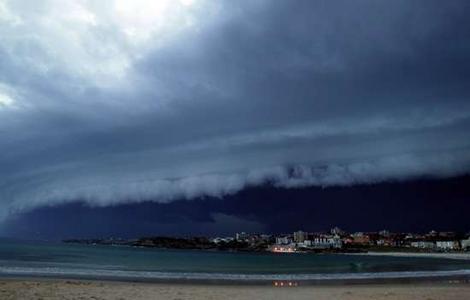
Storm Pics


I saw some amazing, roiling, angry clouds last week just as I sstepped into the Superdome to hear the Foo Fighters play. The above are pics from the newswire. These whacked out violent storms are getting more frequent in Sydney.